As the opening crawl of each film reminds us, the spacefaring Star Wars tales we know and love don't occur in the far-flung future but, rather, in the distant past. It's appropriate, then, that Star Wars: The Old Republic does not represent the future of online role-playing games but a refinement of what has preceded it. Instead of opening a wormhole into an unknown dimension, BioWare has remained in the local galaxy, taking proven game mechanics and heightening them with the branching narrative and overall structure that have characterized the developer's output for many a year now. The result is an enjoyable massively multiplayer online game with knockout production values. The Old Republic's foundation is somewhat ordinary; what makes it great are the fine details that gild its edges.
Many of those details should be familiar to anyone that's played a BioWare game in recent years, such as Mass Effect or Dragon Age II. However, The Old Republic owes less to past BioWare successes (including the related single-player role-playing game, Star Wars: Knights of the Old Republic) than it does to the MMOGs that have come before. In fact, the license and a few other elements aside, the first hours of the game might have you thinking: "I've already played this game." You select from a number of humanoid races, none of which seems particularly unusual, given the breadth of unusual creatures to be found in Star Wars lore. You then choose a faction (Sith Empire or Galactic Republic) and one of eight classes (and after the starting area, an advanced class).
The familiarity continues as you make your way through your class's opening area. You take some missions and kill some creatures using the game's straightforward hotkey combat system, all while a bunch of other people do the same thing. Where Star Wars: The Old Republic tries to stand out in this early stage is with its fully voiced character interactions. Other MMOGs have featured plenty of voice acting (EverQuest II, for example), but not to this extent. In The Old Republic, your interactions play out much as they do in BioWare's single-player games: in oft-lengthy cutscenes in which you respond to others using a dialogue wheel. The three options for even the most minor of conversations are of the usual "kind," "neutral," and "mean" classifications.
Of course, such a description isn't exact, but it's the general gist--at least, as far as standard interactions are concerned. In many cases, these decisions are all smoke and mirrors: a way of playing your chosen moral role but ultimately leading to the same conclusion. Other times (far fewer times), you face decisions that have impact, and the "good" decision might bring you closer to the light side of the Force, while the "mean" might align you with the dark side. A previous ally has been exposed as a traitor; do you kill her or allow her to live? If you show mercy, you earn light side points, which affects your moral alignment. But if you sink your lightsaber into her flesh, you earn dark side points. Your light side/dark side level determines access to certain gear. When you reach a certain tier, you might then use a weapon previously unavailable to you.
The downside to this morality system is that there's little mechanical benefit to staying neutral. If you stay morally ambiguous, your rewards are fewer and less diverse. You may find yourself choosing the light or dark option for the sake of that blaster you want, rather than following the code of your convictions. Yet, your choices don't just have practical implications; there are narrative ones as well. Some are relatively minor. That traitorous ally? If you kill her, your vengeance will be noted in conversation at a later date. If you overlook her transgressions, she might send you gifts to show her gratitude. Some have more dramatic repercussions. A Sith lord gone rogue needs to be put in line. You might send him a warning by killing his son or spare the offspring and kill his duplicitous dad. The implications aren't always major in the broad scheme of things. Even so, they make you feel as if you have power over your own adventure, though not over the world you inhabit.
How involved you feel with the plot depends in part on what class you choose. The Jedi knight tale is plain enough that some long conversations feel more like filler than necessary plot or character development. The terrorist conspiracy driving the Imperial agent story, on the other hand, is far more complex and compelling. Even then, some of the writing falls flat, with much of it coming across as what an author might write on a page, but not what a living being would say. But all of that voice acting goes a long way toward making the characters come alive onscreen. Almost all of it is high quality, with the actors making even the most stilted dialogue brim with character. Even the shortest line readings, such as your companions' battlefield quips, are loaded with personality.
Ah, yes--companions. You've seen this structure in BioWare games already: You amass a crew on your spaceship, which functions as a central hub, and then take one into the fray when you reach planetside. But companions are more than combat pets, though they are certainly effective in that role. They also figure into the story, which makes you far more invested in whomever you summon to your side than you would expect. In fact, your teammates enrich almost every aspect of your virtual life in one manner or another. Equipping new gear is a treat in any RPG; maintaining your crew's equipment, as well as your own, enhances the joys of progression. Combat is better, too. Because you get to know your companions outside of battle, it's like having a real individual at your side rather than a disposable henchman. You can even send your crew members off on gathering missions, have them craft equipment for you, and sell your vendor trash. These conveniences keep the pace moving. BioWare clearly thinks your time is better spent swinging sabers and firing blasters--not mining crystals and scavenging for droid parts. You can still do these things, but they aren't likely to occupy much of your time.
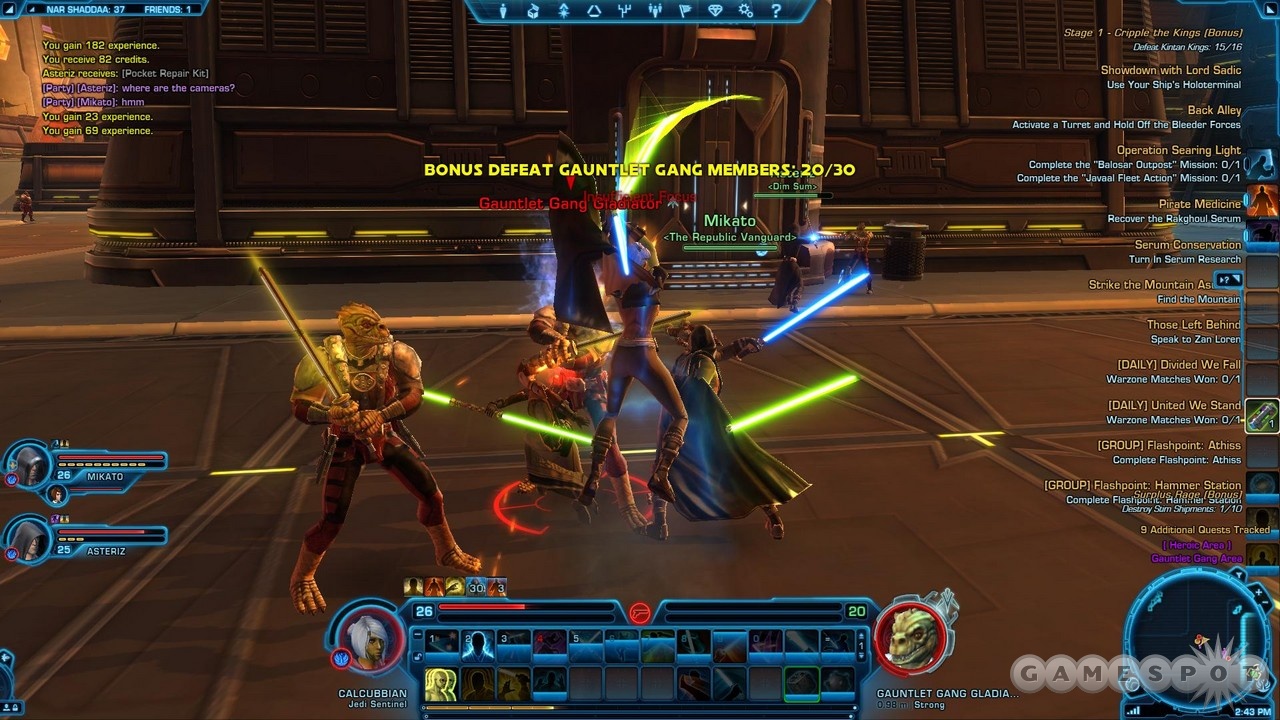
Of course, this is an online game, so AI companions aren't the only individuals you have at your side. When playing with others, you participate in conversations as a group, earning a currency called social points as a reward for consistent responses. You need to be with guildmates or other players to conquer heroic quests, which might require a full party of four. Heroic areas offer a nice difficulty curve. You could steamroll through earlier ones, only to find your party must make good use of crowd-control skills and heals later on. You can also join others for four-person dungeons called flashpoints, which give you a chance to exercise the power of choice as a group. Do you overload power conduits, distracting enemy forces but risking innocent lives? Or do you disable them and keep losses to a minimum? Either way, flashpoints are a lot of fun, and they too offer a wonderful difficulty curve. Early skirmishes might be easy enough to handle. Facing a boss that leaps about the room while turrets pelt you with lasers is a greater challenge. It's also an enjoyable one, particularly if you've got a good tank to absorb all of that turret fire. Prefer something a little more epic? Then you should enjoy the eight-man and 16-man dungeons called Operations.
Of course, you might be seeking conflict with other players, though The Old Republic is not the richest online game in this regard. Consensual player-versus-player conflicts come down to the usual one-on-one duels and the three PVP maps currently in rotation. The most unusual of these is Huttball, in which each team attempts to score by passing the ball from player to player until someone runs it across the opposing team's goal. All this time, you run about, bashing and shooting each other in an effort to maim and kill, which can get pleasantly hectic. All three maps require teamwork, but if you prefer one map to another, that's too bad because you can't queue up for the match type you prefer. There's no matchmaking either: Player levels are all evened out, so you face high-level players long before you reach their skill levels. But don't let this dissuade you from playing these maps; it's all beautiful madness, characterized by the flashes of lightsabers and frantic key tapping.
MMOG veterans should note that Star Wars: The Old Republic isn't a sandbox in the way of Star Wars Galaxies; it's a more guided experience, featuring planets that feel more like large levels than vast continents waiting to be explored. The sense of linearity is most notable on planets like Coruscant and Nar Shaddaa, where you trot down corridor after corridor. To be fair, the sights of shiny towering structures in the distance and skyways busy with rushing vehicles convey the sense of a grand world beyond your understanding. Even planets that offer more breathing room, like Balmorra, funnel you down valleys and force you to kill time waiting for elevators. (And waiting for elevators is something you do far too often in The Old Republic.)
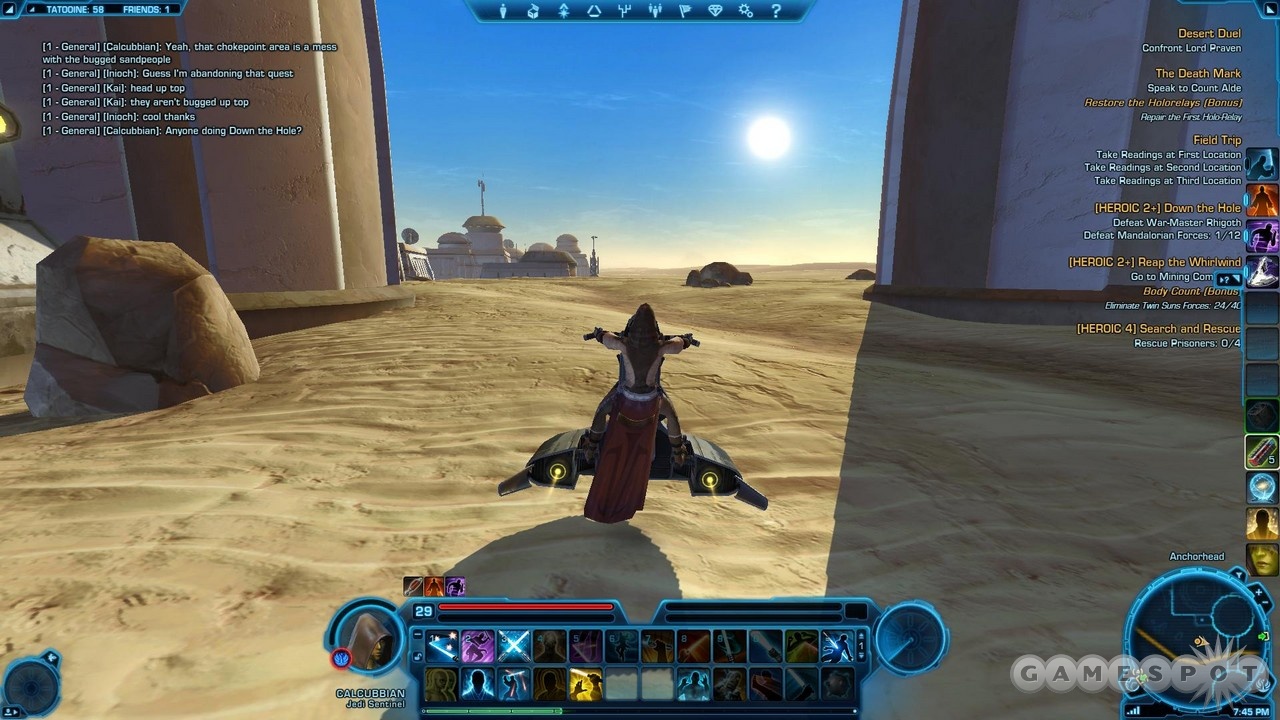
Open planets like Alderaan and Tatooine are refreshing treats because they feel more like lands of untold mysteries than big collections of hallways. The downside to the vaster areas is that they can feel remarkably empty. Even on the most heavily populated servers, it's possible to go for extended periods without seeing another player. Each planet might also be split into multiple instances, which thins out the population and exacerbates the loneliness. Fortunately, if you aren't with friends and want to jump into a heroic area, a call out for help in the general chat is all it takes to have a comrade at your side.
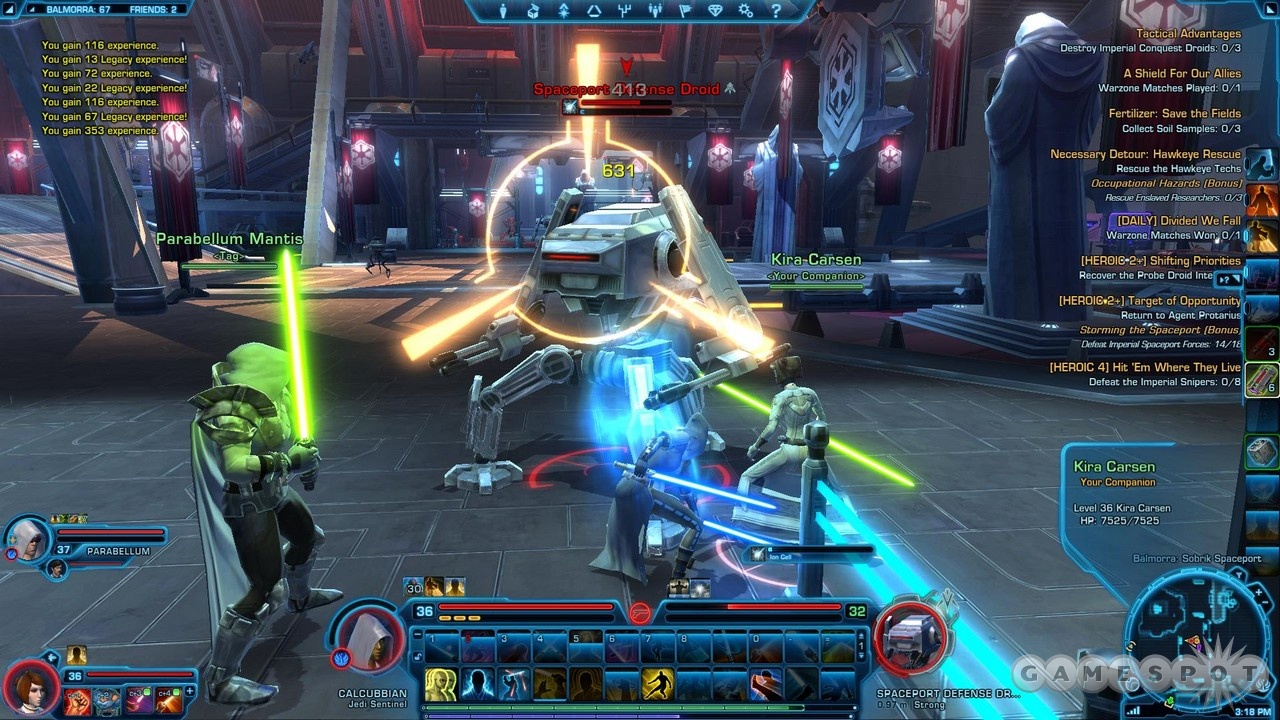
Alone or with others, combat is snazzy enough for you to remain entertained. Short ability cooldowns and the absence of an auto-attack get your fingers busy, while spirited animations and stirring sound effects make combat a pleasure. Not that the action is mechanically unusual: it boils down to the traditional hotkey presses/hotbar clicks that have long characterized the genre. But it remains consistently exciting once your hotbars fill up with a variety of skills. The vivid glow of lightsabers flashes across the screen, Jedi knights leap about like robed acrobats, and combat droids fire bright lasers as they swoop and whir around you.
In fact, Star Wars: The Old Republic deserves kudos for its excellent sound design. That is due in part to the evocative audio associated with the franchise; after all, the drone of a lightsaber is immediately recognizable. There are other iconic audio cues, too, such as the exhausted whine of a forcefield as it powers down. But The Old Republic does more than rely on the old standbys: it elevates them. The thwap of a bounty hunter firing his pistol and the electric buzz of lightning flowing from a sorcerer's fingertips are but a few of the many superb examples of effects that heighten the action. Even the hums of lightsabers retain their edge. The various attacks vary in musical pitch, and they are broken up by other sounds, like the violent crunch of the sentinel's pommel strike. The soundtrack follows suit, mixing new tracks with old and reimagined music from various Star Wars films and games. Tatooine's ambient soundtrack will have you recalling Luke's wistful gaze toward the twin suns. The tranquil tones that purr throughout Alderaan's grasslands aren't so familiar, but they are no less impressive for it.
The visuals join the audio to make for a striking presentation that captures the Star Wars universe. That doesn't mean that The Old Republic sets new standards for graphics engines. Facial features are flat, hair looks more like glued-on plastic than actual hair, and textures are plain. So don't come to the game looking to show off the capabilities of your fancy new video card. But The Old Republic was built to look good on as many computers as possible--even those that aren't state of the art.
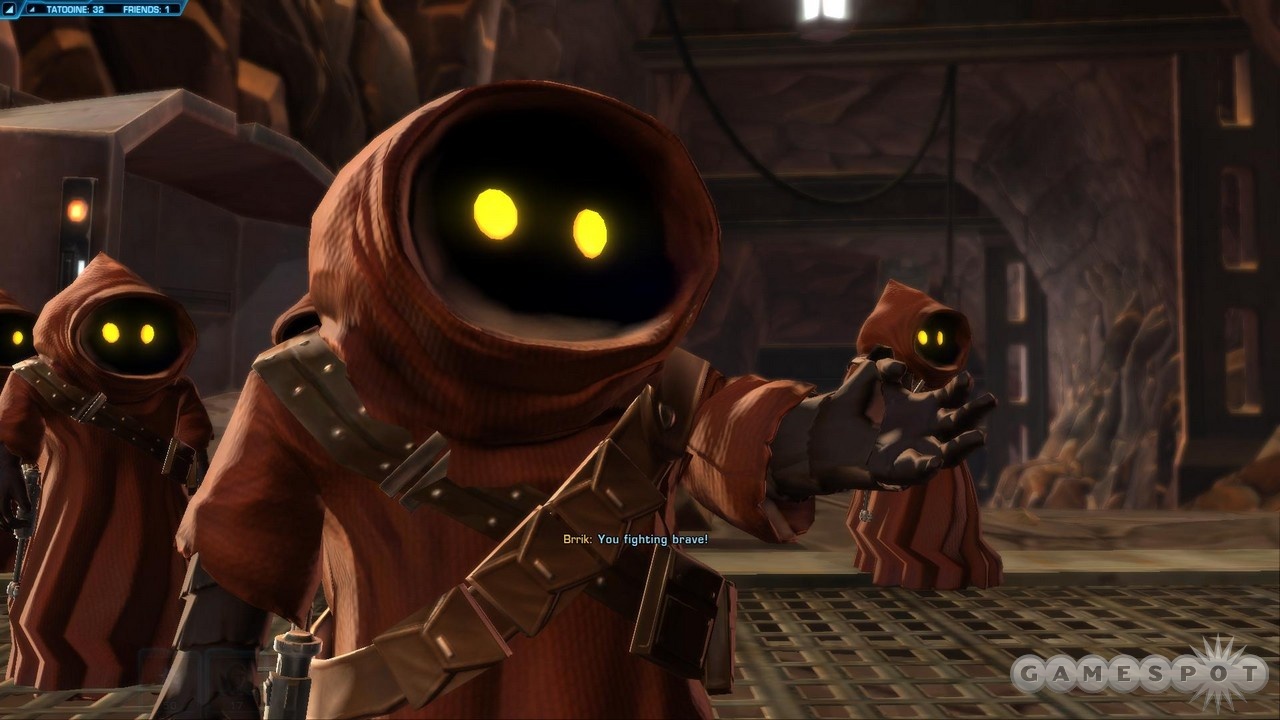
And it does look good. The Galactic Senate on Coruscant looks stolid and imposing behind the soft blue lights that rise into the nearby sky. On Nar Shaddaa, you glimpse neon silhouettes of exotic dancers on the taxi ride to the red light sector, which is a great visual element that betrays the seediness of the neighborhood. The diverse locations look uniformly attractive, from the rolling sands of Tatooine to the craggy mountains of Balmorra. Attention to visual details goes a long way toward making these feel like lived-in places. Quest givers don't just stand around: they crouch behind boulders, bandage an injured soldier's arm, and bend over computer terminals. Enemies tinker with speeders and lean against walls as if relaxing for a spell. How disappointing that other details common to online RPGs, such as weather effects and a day/night cycle, didn't make the cut.

The Star Wars-iness of the production carries over into The Old Republic's space battles. You access space missions from your ship's console, though these aren't massive PVP space battles or even cooperative missions for a small party. Instead, they are solo minigames: shallow affairs in which you don't get full control of your ship. Like in the Star Fox series, such battles are on rails; the game guides your ship through the levels, and you shoot lasers and missiles at fighters and turrets. Space missions are a good way to earn extra experience and credits, and the bright explosions and enthusiastic voice-overs make for some simple fun--at first. But the battles are so easy--and there are so few of them--that they lose their appeal. Considering what the previous Star Wars MMOG accomplished in regards to space combat (albeit, not at launch), this element is a missed opportunity.
The disappointment of space combat, like most of Star Wars: The Old Republic's minor disappointments, is one of scope and originality, as opposed to its level of refinement. 2011's Rift proved once and for all that there is no reason a modern MMOG shouldn't be able to launch in a stable, feature-complete state. The Old Republic follows Rift's lead: It's lag free and delivers a smooth playing experience. It isn't free of the occasional bug or annoyance, however. Galactic market (read: auction house) sort options don't work as they should. A group of sand people may not behave properly or a quest may not complete as intended. You also can't customize the interface: Hotbars can't be moved around and macros aren't yet supported. But rarely does a technological or mechanical failure interfere with progress. There's always something to do, and it almost always works as intended. And most importantly, it's usually fun.
And ultimately, that's what Star Wars: The Old Republic delivers to make it so compelling: a lot of fun. Don't come to it seeking the next online revolution. In fact, when you heard that the developers of Mass Effect were making an MMOG, this is the one you probably predicted: a prototypical online game with the standard BioWare trappings layered on top of them. The surprises are few, but The Old Republic is nonetheless an online RPG of uncommon quality. And with a broad, overarching story to guide you through, you might even reach maximum level with a smile on your face, even if you are one to abandon an MMOG before that point. Such is the power of a beloved universe with so many tales still left to tell.
