War Games: A Word From Our Soldiers
In this feature, we hand over the soapbox to members of the armed forces, who share their thoughts on the exploration of war in video games.
War is a controversial topic. Following the community's response to two GameSpot articles discussing the portrayal of war in video games--regenerating health in Medal of Honor: Warfighter and EA's decision to link to real-life weapons manufacturers--GameSpot asked five United States armed forces servicemen to share their perspective on the topic of war in video games.
This is what they had to say.
Nathaniel Dietrick // Combat Medic // US Army
I joined the army right out of high school in 2006. I enlisted as a combat medic and went to the army's licensed vocational nurse school. As a nurse, I have spent some time at major medical installations in San Antonio, Washington DC, and Hawaii. I witnessed the burn units, orthopedic wards (which provided care to the amputees), and ICUs. I was deployed to Iraq from 2009-10, with a Combat Support Hospital (CHS) during my last year in service. I had, by most standards, a pretty tame deployment--a few mortar strikes here and there but nothing terrible. One of the hardest parts for me was witnessing the loss that everyone experiences at some point. Whether it is a close friend, a son, or husband/wife, war eventually impacts everyone who serves.
We played plenty of video games while deployed. It was always too hot in the afternoon to do anything, so a few of us would always crowd around a PS3. God of War and BioShock 2 were definitely our fan favorites while we were there. Military games and first-person shooters, along with sports titles, are very popular for a lot of people I have known within the army. Games like Battlefield and Call of Duty can be heard blaring in any barracks across the US. I think these games are usually far enough from reality that it doesn't bother most soldiers, although I can easily see how it could affect some.
I don't think soldiers play military games for different reasons compared to most people. They are fun and entertaining, and provide engaging competitive opportunities. Some soldiers may have difficulty if they witness something in-game that resembles a real-life event too closely. However, I feel like most soldiers are able to separate themselves from the game and realize there is nothing threatening about the experience. I also think most soldiers are tough to offend. Soldiers tend to be pretty proud of their service and the job they have done, so games that do not truly portray warfare tend to be overlooked by service members.
"Most soldiers can tell you that [military shooters] are nothing like the war that they have experienced. Military life is full of tedium and drudgery that is unfit for an action-packed game. The hard work, the pounding heat…"
I think most developers miss the authenticity mark when it comes to the emotional content of the game. Sure, the guns look real and the vehicles match the real thing, but most games are flashy set pieces that lead players from one explosion to the next. Most soldiers can tell you that this is nothing like the war that they have experienced. Military life is full of tedium and drudgery that is unfit for an action-packed game. The hard work, the pounding heat, the sweat and fatigue is something that games have difficulty conveying. Often the bonds between soldiers and the pain that is felt if they die are overlooked. Many games have even featured allies that will spawn infinitely with randomized names until an objective is taken. One game I thought really nailed the price of war was the Mass Effect series. Many of the choices and events you are presented with really drive home the unavoidable cost that everyone must face. When a character dies you understand the seriousness of the event, and this is something many games fail to portray.
It seems that there is a structural component to first-person shooter games that leads to the trivialization of war. The single-player campaigns and fast-paced action tend to lead to players seeing war as something that can be undertaken casually. I would like to see many of the major installments like Battlefield or Call of Duty take their time and release a game with a serious and thoughtful look at what being a soldier is really about, rather than continue to release the same adrenaline rush rehash. Military games will always be popular, and I hope that the developers making them will continually try to hold themselves to higher standards.
James Marr* // Submariner // US Navy
I've been active duty for two years now, and actually am still in training. In the military we are taught from day one that it doesn't matter whether you're an officer or enlisted man/woman, that attention to detail will save your life or your buddy's life. The inspections we go through in our initial training are ridiculous, but they serve that purpose. For example, we have what is referred to as the "Room, Locker, and Personnel" inspection in the fourth week of training. To prepare for this, the trainees literally spend dozens of hours folding, refolding, ironing, and removing loose strands from every required item to be inspected. It is a two-person job to fold socks the correct way to pass the inspection, as they must be done a certain way and meet a measurement exactly. If you are off by 1/16th of an inch, you're wrong and get no credit for your effort. And this is just a pair of socks, mind you.
What does this have to do with games? When the television show Last Resort first came on, I immediately started using that attention to detail to pick apart things like uniforms not being properly worn, the size of the captain's stateroom, and so on. If the writers of the show had just asked a former submariner, these things could have been easily addressed. But all this being said, I can remove my Navy cap and enjoy the show for what it is: entertainment. I would argue that my feelings about this show are similar enough to how soldiers feel about military shooters. They'll pick apart how wrong certain things are, but at the end of the day, they know it's just a game and can enjoy it as such.
For example, the team at Danger Close must have spent a lot of time trying to get those little details right in Medal of Honor: Warfighter. Your character wears Mechanix brand gloves. The guns feature brand-name manufacturers with little details like canted iron sights in addition to higher-power scopes. All these little things that we in the military instinctively notice from our training are what to me add up to make Medal of Honor the most "authentic" experience out there. The other thing that the game seems to do is tell the human side of service. No other game that I've ever seen goes into how service impacts the home life at all. Warfighter shows the awkward phone calls with the wife because you've drifted apart.
What is the point of a game? Ultimately it is to entertain, and maybe enlighten. But you're certainly not giving people the full experience. It's not possible. You can't convey or accurately make a player feel the intense pride we feel when the flag gets raised up the pole every morning at 0800. You can't really give a player an appreciation for all of the specialized training every person in service gets, no matter what their job is, so that they can excel at that job. You can't really tell a player what it means to us to serve, or make them understand why we do it. This is what most people will probably never get. Our job, ostensibly, is war. We protect our country, no matter the cost. We don't wish for war. We don't want war. But if there is a war, we want to be the ones in it. It's our job.
I don't think military shooters trivialize war. War is really a bunch of people doing what they can to help out the guy next to them. Games like Brothers in Arms and Medal of Honor do great justice to that camaraderie. I think the game would have to denigrate the soldier himself or his sacrifice to trivialize war, and I've never seen a game do that. Even Call of Duty doesn't, and you can play most of those games without knowing your character's name by the time you're done with it. Your character is really a nobody, just a gun on a screen.
*Name has been changed to protect individual's identity.
Jef Palframan // Lieutenant, Canadian Army // Sergeant, US Army
I was deployed to Afghanistan in 2008-9. I participated in some engagements and experienced rocket attacks. I have seen the costs of war and our current conflicts. I have had two friends killed in combat and have had the privilege of serving with heroes who have done much more than I. Upon returning to school after the military, I founded a veteran support group at my university that seeks to raise awareness about veterans' issues. I am discovering that there are many challenges (mostly unknown) that soldiers face when returning to civilian life.
I think a lot of military games depict soldiers as mindless killing machines who possess some magical power to regenerate their health and kill hundreds of people. We have enough problems with getting soldiers to recognize the symptoms of posttraumatic stress disorder that we don’t need some unrealistic expectation of what a soldier can and cannot endure. Also, the last time I checked, my veteran friends and I were not homicidal killers bent on racking up the biggest body count. Most soldiers avoid speaking about engagements where they were forced to take a life. This is not something that needs to be celebrated. War is a disgusting human behavior, if not the most disgusting. As a soldier I accept that it is part of the sacrifice I am willing to make in losing my innocence by taking another human's life. We are willing to do this on our nation's behalf. Anyone who wants to join the military so that they can kill other human beings has no business in uniform.
My main problem with military shooters is that they seem to be less about celebrating the soldier and more about celebrating killing. I have to admit that I used to play these games as well, but I have seen enough to know that they are fantasy. I don't think that the average gamer realizes what they are seeing. They are given an augmented reality that rewards them for killing, not for serving, and they think that that is reality. Being in the infantry is 99 percent boredom and sacrifice and 1 percent what you see in games. And even then what you see in the game is not what it is like at all. I do believe these games trivialize war: they make it something fun and adventurous.
I think the fact that a soldier can use these games as an escape is telling. A soldier can recognize that they are not real, but the gaming public, the industry's target audience, does not. On more than one occasion I have had civilians ask me if war is really like it is in Call of Duty. My typical answer is to tell them that these guns look real, and that place looks like Afghanistan, but that is not what happens in real life. Then there is an awkward moment where I realize that they are not hearing what they want to hear. They want some kind of affirmation about the $65 they just spent.
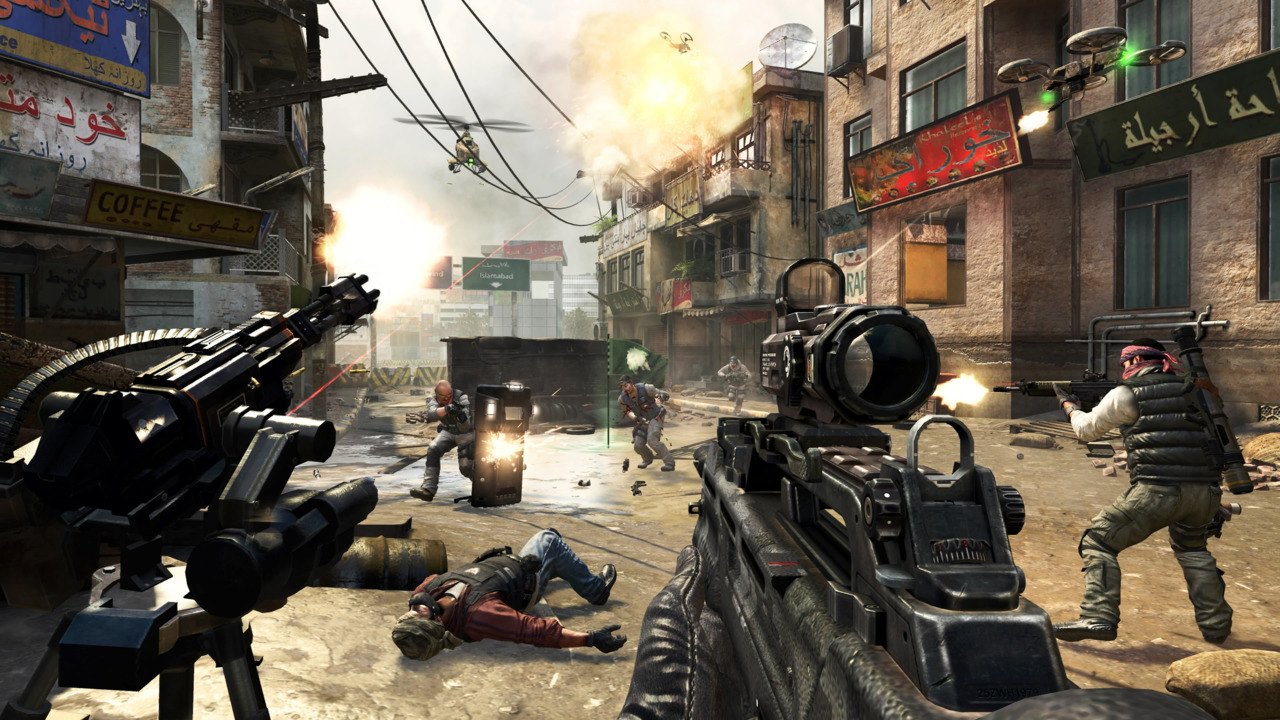
I have since stopped playing these games. Military service has given me some of the best years of my life, and I would not trade them for anything, but there were some really horrible memories that I would not wish on anyone. It kind of makes me sick when I see promos like the most recent one for Call of Duty: Black Ops II where the promotion line was something like "There is a soldier in all of us," and the last scene in one of the trailers is some dude casually dropping a nuke on a city. If games are going to be culturally relevant, then they will need to start feeding something other than a base inhuman urge to kill.
Steven Beynon // Specialist, Cavalry Scout // National Guard
I have been serving in Afghanistan as a rifleman since November 2011. I've been in several dozen firefights and have seen both my comrades and enemy die. I feel as if I see a reoccurring theme among journalists (both in gaming and mainstream) assuming people will be offended by certain content. But soldiers are probably the hardest group to offend. Every combat veteran I know plays Call of Duty and loves the movie Black Hawk Down.
Yes, war is a big deal. I had some truly traumatic moments during my tour. But in combat, we crack jokes and trivialize the situation. You can't be super serious all the time. You'd have a heart attack. It's how we cope. If I ever really analyzed what I was doing, I would stop moving and probably die.
Let me tell you a story to illustrate.
It was my second day in Afghanistan. My platoon was conducting a dismounted patrol down a known Taliban supply route. Suddenly, I heard the snap of a traveling bullet and saw one of our Afghan Army allies go down. It quickly turned into the loudest firing range I've ever been on. I immediately jumped into a ditch.
"Happy Halloween and welcome to Afghanistan!" said the soldier next to me. While our medic was working on the fallen Afghan soldier, I returned fire with my SAW (machine gun) to allow the safe evacuation of the wounded. It was then that I had the realization that I'm living a cliche. I've spent my whole life watching war movies, playing guns as a kid, and enjoying shooters. That evening, some of us gathered around the television set to play a few rounds of Call of Duty. I thought to myself that this should be f***ing weird. I mean, I just fired real weapons at real people in a real war. But it wasn't. Playing Call of Duty that evening felt as natural as any other play session. Why? Because no game about war can possibly come even close to what it's really like.
"Most blockbuster shooters are so cartoonish it's impossible to take them seriously."
The bulk of shooters are so disconnected from reality. I get really put off anytime someone claims these titles are glorifying war or that they're disrespectful to the troops. I can't speak for the entire armed forces community, but every soldier I know plays these games or respects them from a distance. Most blockbuster shooters are so cartoonish it's impossible to take them seriously, and those that claim to be "military simulators" don't go far enough. We live in a world in which one to three American soldiers are shipped home in boxes every day.
EA bowing to pressure to take the Taliban out of Medal of Honor's multiplayer and Konami walking away from Six Days in Fallujah are examples of publishers cowering from a vocal minority. If a developer wants to make a Call of Duty-style video game based on my experiences, I would be flattered. And while it would be inaccurate, games are supposed to be fun.
'Got a news tip or want to contact us directly? Email news@gamespot.com
Join the conversation