Sci-fi action and intrigue are deeply intertwined in Deus Ex: Invisible War, the sequel to 2000's Deus Ex, a first-person cyberpunk thriller in which your decisions--as a cybernetically enhanced secret agent--ultimately decided the fate of the world. The original Deus Ex earned considerable acclaim for its cerebral storyline and its seamless integration of role-playing elements, which collectively added up to a memorable and surprisingly open-ended experience. Invisible War shares many great qualities with its predecessor, though it inherits most of the same shortcomings. It's also one of the first games to make extensive use of dynamic lighting and (relatively) realistic physics, though these rather impressive technical features also have certain drawbacks. The sum total of these factors can be highly rewarding, as long as you're willing to look past some problems along the way.
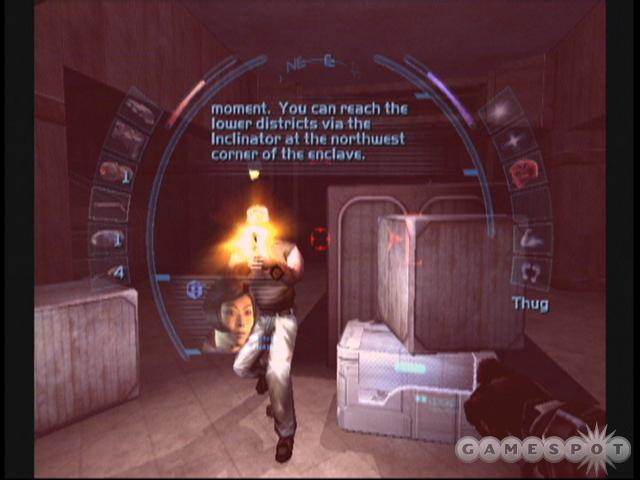
At first glance, Deus Ex: Invisible War appears to be a science-fiction themed first-person shooter, but, like its predecessor, it's really more of a role-playing game that's played from a first-person perspective. You play as Alex D. (whose gender may be chosen at the outset of the game), a trainee at Tarsus Academy, which is a school for gifted youths who graduate to become covert operatives. In the introductory sequence to Invisible War, the city of Chicago is wiped out by a terrorist attack that was seemingly targeted at Tarsus. You and some of the others from Tarsus manage to escape and are transplanted to another Tarsus campus in Seattle. The game itself begins when you awaken in your new apartment. You're asked to report in with the other Tarsus trainees, but now something else is amiss. You soon find that there seem to be at least a couple of different factions interested in either the destruction of or the acquisition of Tarsus' student body--your "student body" included. The storyline of Invisible War is comparable to that of the original game in that the premise is, by all means, intriguing and original. Additionally, there are a number of surprises waiting to be discovered. However, this isn't really a character-driven storyline. Right from the start, you'll be very mistrustful of virtually everyone you meet. The world of the game is every bit as cold as it appears to be.
Of further note, Invisible War's story becomes much more interesting later on as it starts to tie in with that of the original Deus Ex. Yet this is also the point at which those who are unfamiliar with the particulars of the first game's plot will probably start to feel bewildered. Invisible War includes a little bit of background material for those who haven't finished the original game, but, as with most any direct sequel, you'll have trouble getting as involved in the story unless you have the experience of the original to draw upon.
Anyway, you'll quickly learn that there's much more to Tarsus than meets the eye. Once you leave the facility (or, once you manage to escape from the facility, depending on how you look at it), you'll then get to wander around Seattle looking for some answers. Your journey will eventually take you to other parts of the world, including Egypt and Germany, and soon things will start to become clear. Invisible War isn't entirely open-ended, but within each main segment of the game, you'll be able to travel in and around a central hub area of some sort. From here you'll be able to subsequently take on assignments from various characters--at your discretion and at your leisure.
You'll frequently be asked to accomplish mutually exclusive objectives for competing factions. For example, one side will ask you to acquire the plans for a powerful experimental weapons program, while the other side will ask you to assassinate the scientist in charge of the project to slow the program's development. You can be consistent in your decision-making and single-mindedly follow your gut instincts, or you can attempt to play the sides against each other. Or you can just follow your whim, thus reserving the right to double-cross those who would probably just as soon do the same to you. In addition to the main objectives, numerous less important side quests tend to be available, such as a number of missions that let you arbitrarily pick sides in an apparent corporate struggle between two monopolistic coffee corporations, each reminiscent of a certain real-world coffee corporation. These and all your missions are clearly and concisely tracked in a logbook, and an onscreen compass and lots of signage throughout the game's environments should collectively keep you from getting lost or stuck.

There really is no clear sense of right or wrong in this game, which is interesting--though odd--and not always conducive to a satisfying experience. It's great that you're free to choose whether to side with one creepy organization or another and that you can be just about as fickle as you want with every step of the way. Everyone wants your help, so they're willing to keep giving you second chances if you stab them in the back. Since you'll probably be hard-pressed to actually appreciate the motivations of any of the characters who ask you to do things in this game, you won't usually care exactly what happens, or to whom, as a result of your actions. The characters themselves aren't well developed, and the game's artificial intelligence is terrible--if not missing. For instance, you can usually blatantly steal things from off of characters' desks, right in front of them, without any consequence, and you can brandish your submachine guns and sniper rifles in public without anyone batting an eyelash. These types of things conspire to make the characters in the game seem lifeless and unconvincing, thus undermining any dramatic impact.
Just as you'll constantly have a choice about whom to side with, so will you have different options available as you attempt to go about specific objectives. The main options involve force and stealth. In practice, you'll probably rely on a combination of these two elements. The game's manual asserts that "deadly force is always a choice, not a requirement" in the game, which means that it's theoretically possible to go through Invisible War without killing anybody. But that's like saying it's theoretically possible to finish the game in one sitting without ever saving your progress. Yes, you could do it if you really tried, but there's no reward for all that hardship, save for whatever personal satisfaction you'd gain from the accomplishment. In practice, you'll probably find yourself following a fairly obvious path of least resistance through Deus Ex: Invisible War.
The fact is, much like in the original Deus Ex, the stealth elements aren't well implemented in Invisible War. There's no onscreen indicator that lets you know whether or not you're hidden from your enemies' sight, so attempting to sneak past a bunch of guards can become a slow and tedious process--especially since the obvious, easier alternative is to simply take them out. You'll pretty much always be working alone in Invisible War, but the enemy odds are never stacked too high against you, and the enemies themselves simply aren't very dangerous, due mostly to the poor AI.
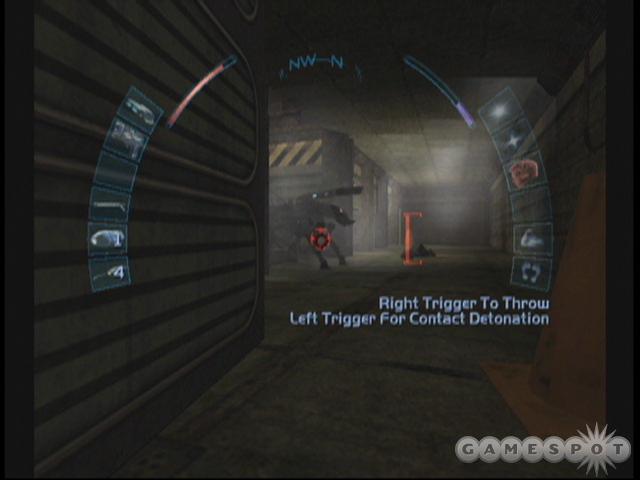
At the default difficulty, most of the combat in Invisible War is a breeze--assuming that you have some prior experience playing first-person action games--as your enemies will all merely rush right at you like fools, or will hover over the dead bodies of their comrades. It's not long before you can get your hands on a sniper rifle in the game, and you can then upgrade it with a silencer. From then on, you can safely shoot most of your enemies in the head before they can do anything about it. Again, there are some nonlethal combat options, but there's no obvious in-game difference between knocking an enemy out and killing him, and the game doesn't rate you on your performance or anything like that, so there's really no mechanism in place to encourage you to do things the hard way (or to reward you for doing so).
For what it's worth, most all of these criticisms applied to the original game as well. Also, as in the first Deus Ex, Invisible War gives you some options for getting through those aspects of the game in which you aren't interacting with other characters. When faced with a locked door, for example, you'll usually have several different ways to proceed. You may blow it apart with explosives; you may find a keycode in some datapad that's been strewn about somewhere nearby; you may unlock the door by using a "multitool" (essentially a disposable key that can also be used to disable surveillance cameras and defensive turrets); or you may look for a way around the door, by typically discovering some nearby ventilation shaft. Actually, much of the game consists of bypassing locked doors or other barriers using these specific methods.
That's a good amount of variety, though these are actually the very same options from the original Deus Ex. Invisible War wears the formula a bit thin by the time you finish the game--which should take just 10 to 15 hours. You might catch yourself feeling a little silly as you bypass one supposedly high-tech, heavily defended compound after another by just crawling through all the conveniently placed, human-sized vent shafts. Optionally, you'll be able to hack into some security terminals to gain access to certain areas so you can disable certain hazards, and more, but the hacking in Invisible War is a bland, skill-free affair that simply involves staring at a terminal for a few moments while a "hack" meter fills up. You'll also learn to observe your environment fairly carefully, as spare multitools, health kits, and other useful items can frequently be found in corners, under things--in "inconspicuous" locations like trash bins--and so on.
The world of the game ultimately comes off as richly detailed but also rather contrived. You'll constantly be reminded that this is, after all, a game world you're playing around in. It doesn't help that the individual "levels" are all quite small and separated by noticeably long loading times. Additionally, the transitions between different cities and countries are completely nonexistent, apart from these loading times--there isn't so much as a cutscene that shows you flying to your new destination. All this is actually a shame, since, clearly, there's been enough thought put into the unique science fiction world of Deus Ex, and, clearly, there's enough detail in the scenery to where this could have been a much more immersive gaming experience overall.

The superficial characters and the inconsistency of the game's presentation also diminish some of the game's appeal. On the one hand, the characters of Invisible War realistically move their lips in tune with their speech and deliver their lines of dialogue naturally enough. It's great, too, that all of Alex's dialogue is recorded differently (and delivered equally as well) for the male and female versions of the character, and some of the interactions will even differ slightly depending on Alex's gender. Also, Invisible War features some highly atmospheric, dynamic lighting and shadow effects and some pretty remarkable physics. These technical features are practically flaunted, as you'll often run across fire pits or dangling lights that are casting shadows throughout the nearby scenery, or you'll encounter stacks of crates and such, which can be knocked around, thrown around, and more. The rule of thumb is that you can pick up and throw just about anything that isn't bolted down in Invisible War, and, for a while, you'll have fun doing it.
Problem is, the physics are goofier than they are believable, as most of the moveable objects in the game seem to lack any real mass--as though everything in this grim future was inflatable or made of Styrofoam. Contributing to the thoroughly unconvincing character behavior, characters in Invisible War don't act right even when they're dead. They fall to the ground in lifeless, contorted heaps, which can then be picked up and flung around effortlessly. Other games involving stealth and the ability to pick and move bodies out of sight at least attempt to give the impression that bodies are heavy and unwieldy. Not so in Invisible War, where human bodies can be carried around or flung about as easily as coffee cups and basketballs. Physics are cool and everything, but some actual death animations and more plausible interactions with heavy, unwieldy objects really could have helped here. Also, the realistic lighting and physics take what seems to be a serious toll on the game's frame rate. Don't expect Invisible War to run nearly as smoothly as most other first-person perspective games you've seen lately. Overall, you'll have to work fairly hard to suspend your disbelief while playing this game. For just about every little detail it successfully and impressively pulls off, there's some noticeable blemish that you'll need to try to ignore.
Invisible War isn't a true role-playing game, if a true role-playing game is defined by the presence of an experience point system and having to kill stuff or solve quests in order to level up. The skill-building system of the original game, which gave you real incentive for solving quests, is completely gone, and this is somewhat disappointing. Alex does grow more powerful during the course of the game, but that's mostly through the acquisition of "biomod" canisters and better weapons and weapon upgrades. The biomod system in Invisible War is similar to that of the first game, only here you get several biomods to play with, almost from the get-go. Basically, you can use biomods to augment abilities that correspond to one of five aspects of your body, including arm, cranial, eye, leg, and skeletal. Each region has three different, mutually exclusive options--one of which is a "black market" upgrade for which you'll need special black market biomod canisters. For example, the available eye upgrades are vision enhancement, regeneration, and spy drone (the latter is the black market upgrade). If you have a biomod canister and choose to use it for the regeneration ability, then you won't have access to the other eye abilities.

This is an open-ended-sounding system, but, in practice, the decisions about which upgrades to get will probably seem pretty obvious to you. Regeneration is an excellent all-around ability, which lets you easily recover after (or in the middle of) any skirmish. "Neural interface," the one really useful black market upgrade, lets you hack into security grids. It also lets you hack into ATMs for free credits, which are credits that you'll need in order to buy access to certain areas or to purchase new weapons or upgrades since they aren't easy to come by without this more or less essential skill. "Strength enhancement" may also seem like an obvious biomod choice since it increases your carrying capacity, which is normally very limited. Like some other aspects of Invisible War, the biomod system theoretically gives you a lot of options, but many of the options are clearly less viable than others.
Apart from customizing your character with biomods, you can augment your weapons with certain enhancements, which include the silencer, the "glass destabilizer" (which lets you silently shoot out panes of glass), and the EMP converter (which causes extra damage to robotic targets). Additionally, there are other upgrades that can increase maximum damage and can decrease ammo consumption. For some reason, there's only one ammo type in Invisible War, so your rocket launcher and your pistol both draw from the same reserve. Also, for some reason, weapons never need to be reloaded, so you either have ammo for another shot or you don't. Bigger weapons simply use more ammo, but since there are only a few weapons in the game, it wouldn't have been hard to keep track of individual ammo types. As in the first Deus Ex, ammo is surprisingly difficult to come by in Invisible War, but if you make all your shots count, you'll generally have enough to get by. The weapons themselves at least have a solid feel to them, though in practice, most all of them seem completely underpowered, save for that sniper rifle.
As previously suggested, Invisible War is a great-looking game, for the most part. The characters look quite good, apart from their blank expressions and stiff animations, and the game's tendency to recycle the same specific character models in many locations. And the environments, though they tend to be densely packed, never give the sense that you're in a sprawling urban environment. Fortunately, though, they are rather moody and atmospheric. Again, don't expect a silky smooth frame rate from either the PC or the Xbox versions of the game. The PC version is technically capable of looking better than the Xbox version by presenting richer colors, sharper textures, and higher resolutions. However, you'd need a high-end PC to get all of that to run reasonably well, whereas you're guaranteed an acceptable performance on the Xbox.
Invisible War mostly sounds great, as well. The game's musical score is the best aspect of its audio and consists of the sorts of low-registering, bass-heavy numbers you'd expect from a cyberpunk-themed game. You'll even hear a couple of catchy songs in the game's bars. It's actually all very good stuff that quietly helps set the mood. Some hard-hitting sound effects and relatively good voice acting go hand in hand with the fitting music.

Like its predecessor, Invisible War obviously has some replay value, especially since you're guaranteed not to see all the various mission outcomes on your first time through. On the other hand, much like the original game, the key decisions to be made in Invisible War will be made toward the end of the adventure, which can culminate in one of several different endings. Seeing as you won't actually need to backtrack very far at all to experience these various outcomes, you won't necessarily feel inclined to start all the way over from the beginning just to see how some of the less important missions might have played out differently. Still, the game's ability to fluidly adapt to your decisions is certainly one of its greatest strengths, so it can be fun to try to "break" Invisible War by acting as irrationally as possible and seeing how all your actions still end up tying together in a relatively coherent manner. However, this is still a single-player-only adventure that can be finished without much trouble in a weekend. It's markedly shorter than the first game, though in Invisible War's defense, it's also not as burdened with as many tedious shooter sequences as the first game was, and it maintains a relatively brisk pace.
Ambitious games like Deus Ex: Invisible War inherently open themselves up to more criticism than most games do. Their attempts to present serious storylines, to portray realistic characters, and to present convincing settings and situations are the equivalent of high-wire acts, which are impressive so long as no missteps are made. Unfortunately, Invisible War does make a few missteps, and though some of these are largely the very same problems that affected its three-year-old predecessor, they might not be as acceptable today as they were back then. None of this should ultimately deter you from checking out Invisible War, if you're otherwise inclined. It's certainly a bold undertaking that delves into some philosophical and science-fiction territory that most games wouldn't dare touch, and though it may not be a superior game to its predecessor, on its own merits it's a great and original experience that's well worthwhile.
