Civilization IV Hands-On - The Middle and Late Eras of the Game
We play around with the middle to late parts of a Civ IV game to get a feel for what to expect.
While there have been many previews of Civilization IV, there's hardly been any coverage of the game's middle to late stages. That's due to the fact that while we've been able to play with the early eras of the game, when you're busy clawing your way out of the Stone Age and researching such groundbreaking technologies as the wheel, Firaxis limited our time with Civ IV to basically everything before 1AD, leaving out the 2,000 years that follow. That changed recently, when we got our hands on the first playable version of Civ IV ahead of everyone else on the planet. So in this preview we'll give you an idea of what the later part of Civ is like.
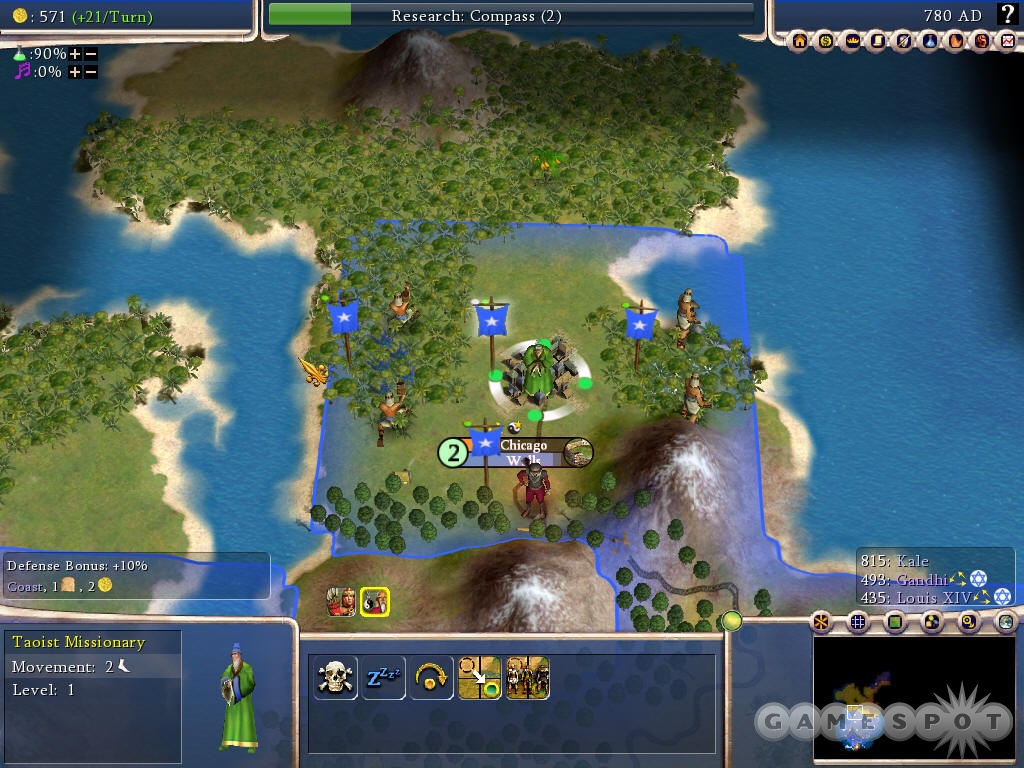
Assuming you're not crushed by rivals or by barbarians during the early part of the game, sooner or later, your primitive civilization will advance its way out of the Stone and Bronze Ages, but then what? Well, if you play on the standard-sized map using the default "continents" world setting, odds are you'll find yourself with a decent-sized civilization with approximately five to 10 cities. At this point, you'll have pretty much established the borders with your neighbors, and all available land on the continent will have been settled. You'll have to switch gears from exploration and expansion to focusing on improving your economy, because now it's a race to see which civilization can advance the fastest up the tech tree.
Several of your cities, mainly your oldest ones, will be your "core" cities. They've simply had more time to build up than the others and are best dedicated toward building key improvements, such as national wonders and great wonders. National wonders are the old "small wonders" from Civilization III and are basically smaller wonders that each civilization can build once. These include the familiar Wall Street wonder, which boosts the economy, but there are also new national wonders, such as Oxford University, which lets every civilization build its own super-university, and Scotland Yard, which lets every civilization that builds it recruit spies. That's right, the old spy unit that was last seen in Civ II makes a return in Civ IV, and she's once again capable of spying on enemy civilizations as well as detecting enemy spies.
You'll also want to get going on constructing more of those great wonders, those one-of-a-kind monumental wonders that can grant the civilization that constructs them a significant boost. While many of the great wonders will be familiar to Civ veterans, keep in mind that a lot of them have been tweaked. Some of the changes are mostly cosmetic (Hoover Dam is now Three Gorges Dam), while others are more significant (Great Library now only gives you free scientists instead of free technology). There are also new great wonders to be aware of, such as Notre Dame Cathedral, Hollywood, Broadway, and rock and roll. Those last three great wonders are particularly interesting, because they highlight the role of culture in the game, and they also produce valuable trade goods in the form of films and musicals that you can export to other countries.
One of the biggest changes in Civ IV, and one that has been discussed in great detail already, is that you can no longer transfer production from one project to another. This is an age-old exploit that has finally been addressed, and we found that it certainly ups the risks involved in undertaking a huge project like a great wonder. In the past, if someone beat you in a race to finish a great wonder, you could simply take the existing production and instantly transfer it to another project, preferably another great wonder. Now, if someone beats you to a great wonder, you receive a refund that's determined by how much work you've already invested in it, which can translate into hundreds of gold. Still, that's little consolation to losing a race to a great wonder. One thing's for sure, though. It will be much more difficult for you to "monopolize" the great wonders, particularly at harder difficulty levels.
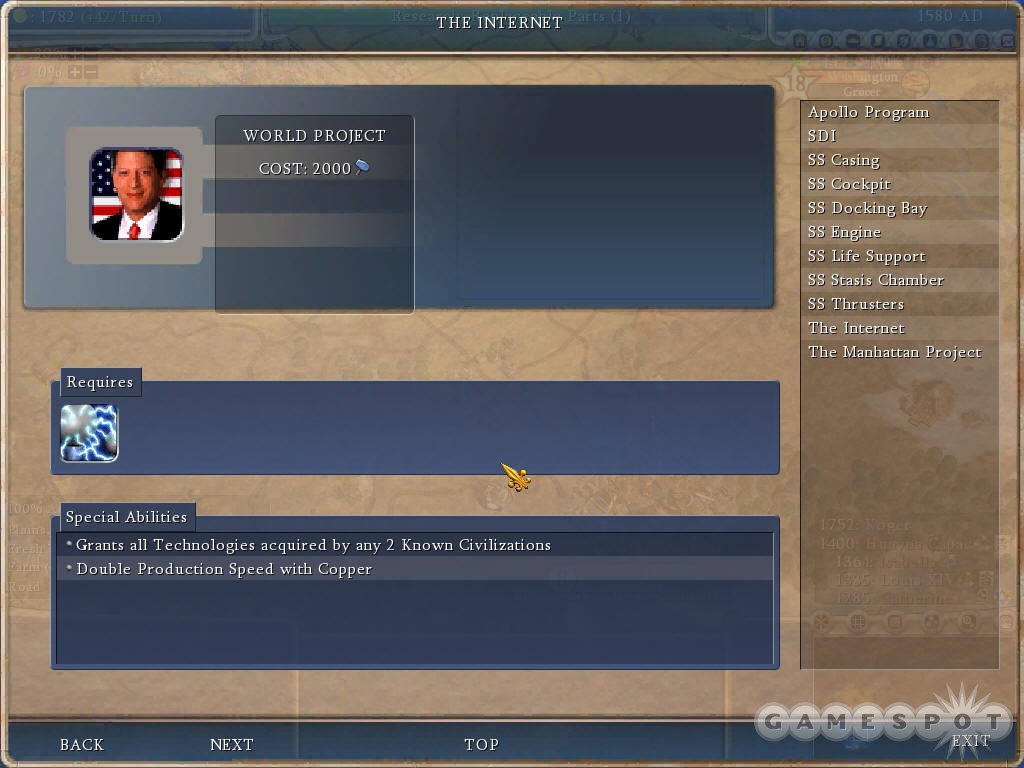
We also found that the "no transfer of production" rule had an effect on our building of regular city improvements. You can no longer switch to another project at the last second like you may have in earlier Civ games. For example, you may be 12 turns into constructing a university when a rival declares war on you. In earlier Civ games, you could simply dump all that production into a military unit, letting you "instantly" recruit it. In Civ IV, the game will "save" the production that's already been done on the university, and you must start any other new project from scratch. This means that you can't afford to procrastinate on important upgrades, such as defenses and military units. Meanwhile, you also can't use this to "store" production for a later date efficiently, because "saved" production will slowly decay over time.
Space, the Final Frontier
While we can't be absolutely certain of this yet, it does feel like the pace of Civ IV is quite different from the pace of its predecessors. There's much more of an emphasis on the "early" part of the game. In previous Civ games, you went from 4,000 BC to 1 AD in a heartbeat, but now it feels like it takes a bit longer. Meanwhile, the later stages of the game feel a bit more compressed. This is seen in the tech tree, where there don't seem to be as many late-era techs as before. If this is true, then the developers at Firaxis have accomplished one of their goals, which was to rework the pace of the game. 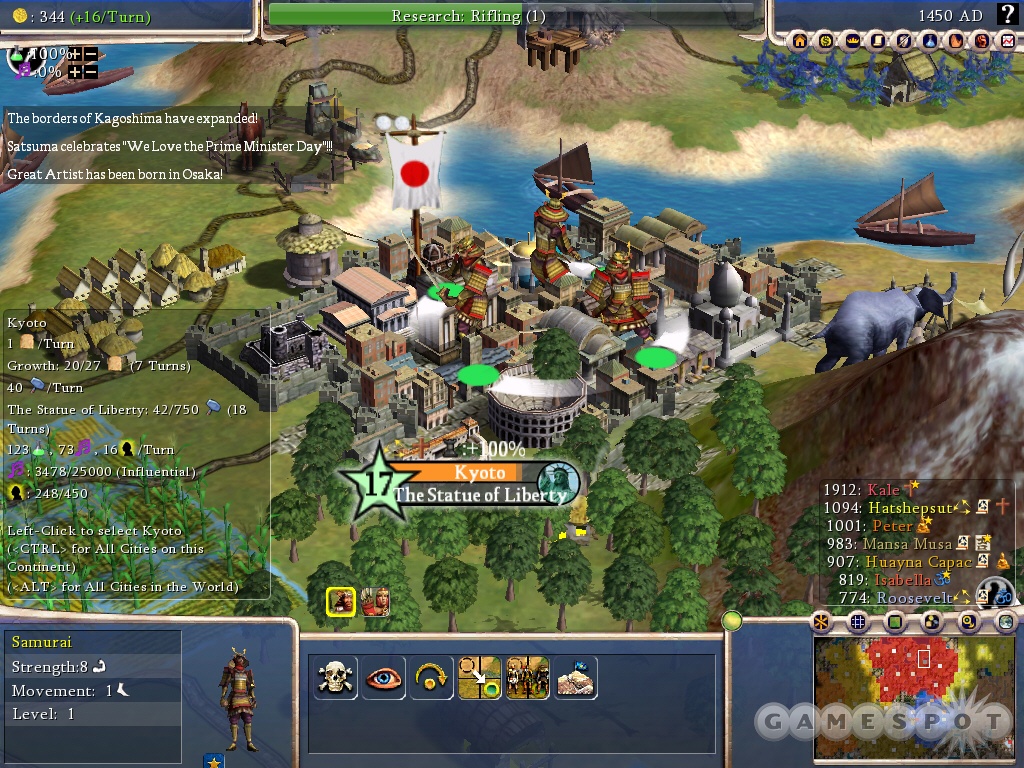
It also feels like the Middle Ages can blow right by, as you can go from the Bronze Age to the Industrial Age fairly quickly. To give an example, for much of the early part of the game, archers are your best city defense unit. When feudalism is researched, this unlocks longbows, which replace the archers. But it isn't long after feudalism before gunpowder is reached, and all of a sudden, muskets replace longbows. By now, you're on the verge of the Industrial Revolution, and technologies such as rifling will unlock infantry, and suddenly you're dealing with relatively modern military units.
As the military units get more powerful, it's more critical than ever that you keep your defenses up to par. Thanks to the new strength system, old units can become obsolete quickly, as they're less likely to defeat a technologically advanced foe than they were in previous Civ games. To help you defend, there are a number of city upgrades that you can construct. City walls seem to stick around for a long time now and don't disappear like they did in previous games, but you can also fortify your cities with castles and bunkers (for air attacks). The most important upgrade, though, is your units. They simply need to keep pace with the enemy, or else. This means constructing pikemen, longbows, and knights in the Middle Ages, but then quickly transitioning to gunpowder units when gunpowder is researched. Siege weapons such as artillery are also key, as they can have an attrition effect on invading armies, and they can also pound the defenses of a fortified city. Thankfully, siege weapons aren't completely defenseless like they were in Civ III. In that game, you could capture an unescorted siege unit simply by moving a military unit over it. Now, siege units will put up a fight.
The winning conditions in Civ IV remain relatively the same, though there have been obvious changes. First, there's plain old conquest, where you eliminate your rivals from the face of the planet. This is arguably the hardest and longest method, because war has a way of grinding down the pace of a game. You'll need to get your economy on war footing to constantly create new units, while you may find yourself fighting a war on multiple fronts. As such, while military conquest is certainly an option, it's certainly understandable if you gravitate toward the other two victory conditions.
Second is the diplomatic victory, where you get enough votes from other civilizations to win the game. The diplomatic victory condition is triggered by construction of the United Nations great wonder, but it's no longer the case that the nation that builds the UN gets to dictate its agenda. One of the first orders of business for the UN is to elect a Secretary General, and every civilization gets a vote in that process. If you manage to get elected, you can then try to get various resolutions passed. (If you fail to get elected, you'll have to wait for the next election.) The resolutions that you can propose include diplomatic victory, but you can also propose a nuclear nonproliferation treaty, which bans nuclear weapons; global civics such as free speech, emancipation, and environmentalism; and open markets.
The third victory condition is to be the first civilization to construct a spaceship to colonize Alpha Centauri, the nearest star system to Earth. The spaceship has been scaled down quite a bit, and we count about a dozen component pieces in total, so you will no longer need to dedicate dozens of cities to building spaceship parts for a long time, like you did in the earlier Civs. You can also boost spaceship production by building laboratories in your cities or by constructing the space elevator great wonder, which boosts spaceship production in all of your cities.
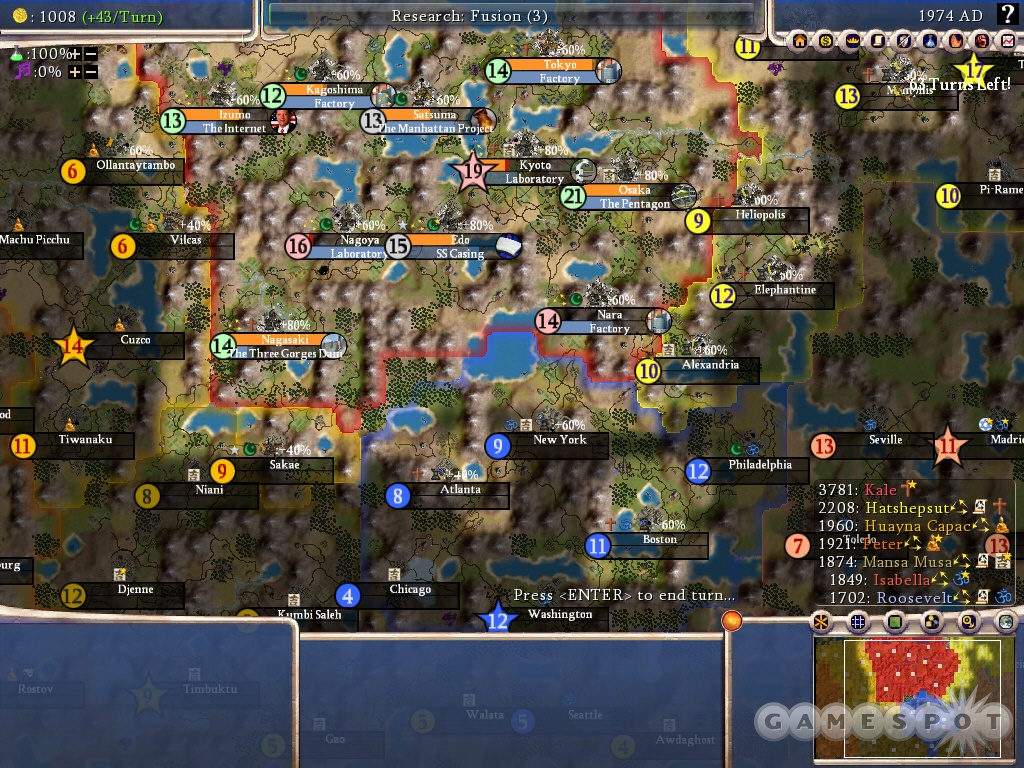
Since we've been playing with an in-production version of the game, details are subject to change. Unfortunately, much of the later portions of the game are still in a working state, and missing textures and graphical glitches are much more numerous than in the early part of the game, so we're limited on the number of screenshots that we can show you. Considering the fact that the game is scheduled to ship late next month, Firaxis certainly has a lot of work to do between now and then. However, we remain excited by what we've seen and played of Civ IV so far, as we can certainly attest that the addictive gameplay of the Civilization series is as sharp as ever. Keep an eye on GameSpot for more updates and lots more video updates every day on into next week.
Got a news tip or want to contact us directly? Email news@gamespot.com
Join the conversation