ARMA III: The Alpha and the Omega
The ARMA III alpha test gives a tantalizing glimpse of what the upcoming war simulator has in store.
As any series enthusiast will tell you that ARMA is not a shooter or an action game: it's a war simulator. A grueling, unforgiving war simulator that requires you to be cautious with every step you take, every bullet you fire, and every leaf you rustle. Developer Bohemia Interactive's dedication to authenticity and open-world structure has made the ARMA franchise deeply respected among PC gamers who crave challenge and realism. ARMA delivers its unique joys only in proportion to how much patience and loyalty you are willing to give back.
15 MORE Things You STILL Didn't Know In Zelda Tears Of The Kingdom Firearms Expert Reacts to Ghost Recon Breakpoint's Guns Xbox Studio Closures Are Confusing | Spot On Gray Zone Warfare | Community Briefing Trailer #1 Senua's Saga: Hellblade II - Senua's Psychosis Feature Trailer Squirrel With A Gun - Official Announcement Gameplay Trailer Night Slashers: Remake || Official Christopher Smith Character Gameplay Trailer Street Fighter 6 - 8 Minutes of Akuma Gameplay (High-Level CPU) Animal Well GameSpot Review Roblox - Netflix Nextworld Official Trailer Crow Country | Official Launch Trailer Master Detective Archives: RAIN CODE Plus - Official Announcement Trailer
Please enter your date of birth to view this video
By clicking 'enter', you agree to GameSpot's
Terms of Use and Privacy Policy
ARMA's next iteration is almost upon us: in Q3 of 2013, ARMA III will be released and hopefully bring with it the same demanding gameplay we've come to expect. If you're anxious for a taste, however, Bohemia is offering a tantalizing glimpse of ARMA III via its alpha test, which is available today, March 5, for anyone who preordered the game. Last week, I was able to play the ARMA III alpha myself, as well as catch up with co-creative director Jay Crowe, who shed light on the differences between ARMA III and ARMA II, the expectations of series veterans, and the technology that could make ARMA III one of the most photo-realistic games to date.
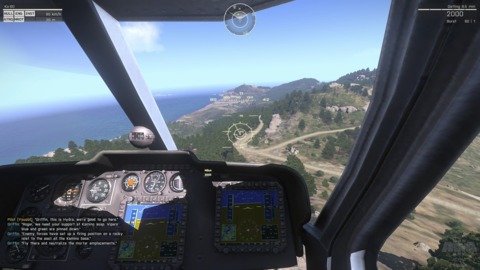
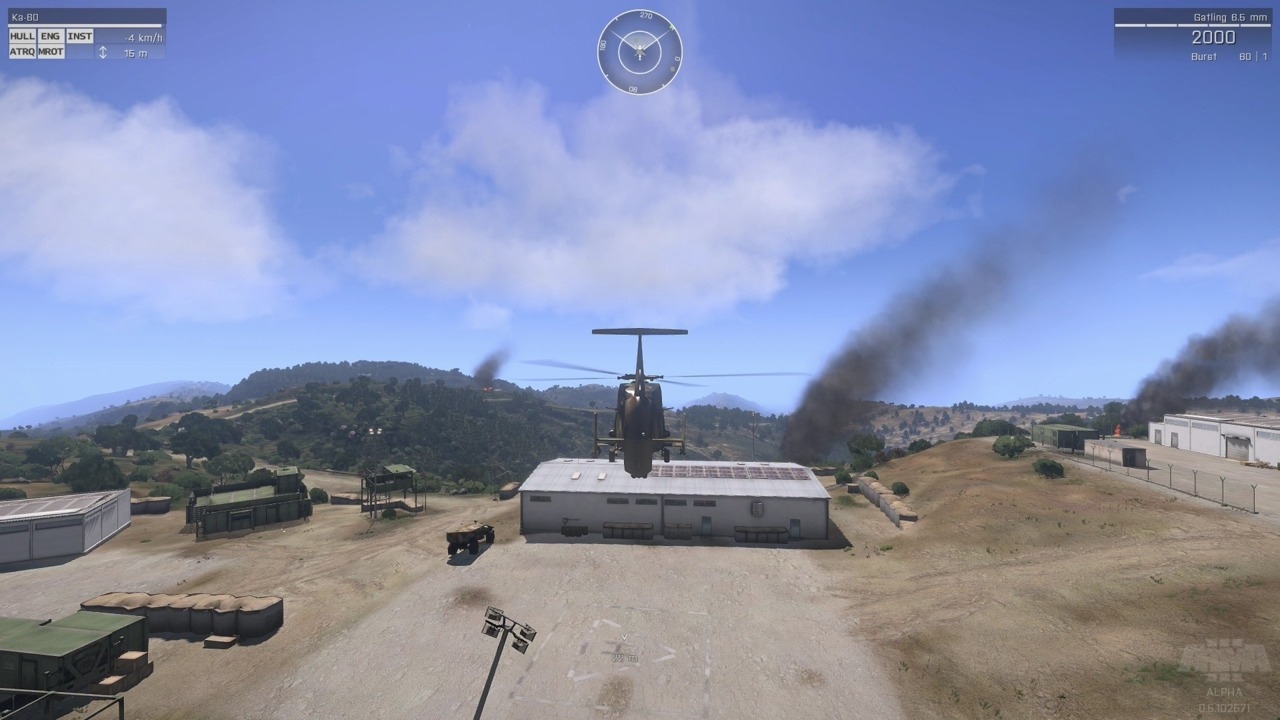
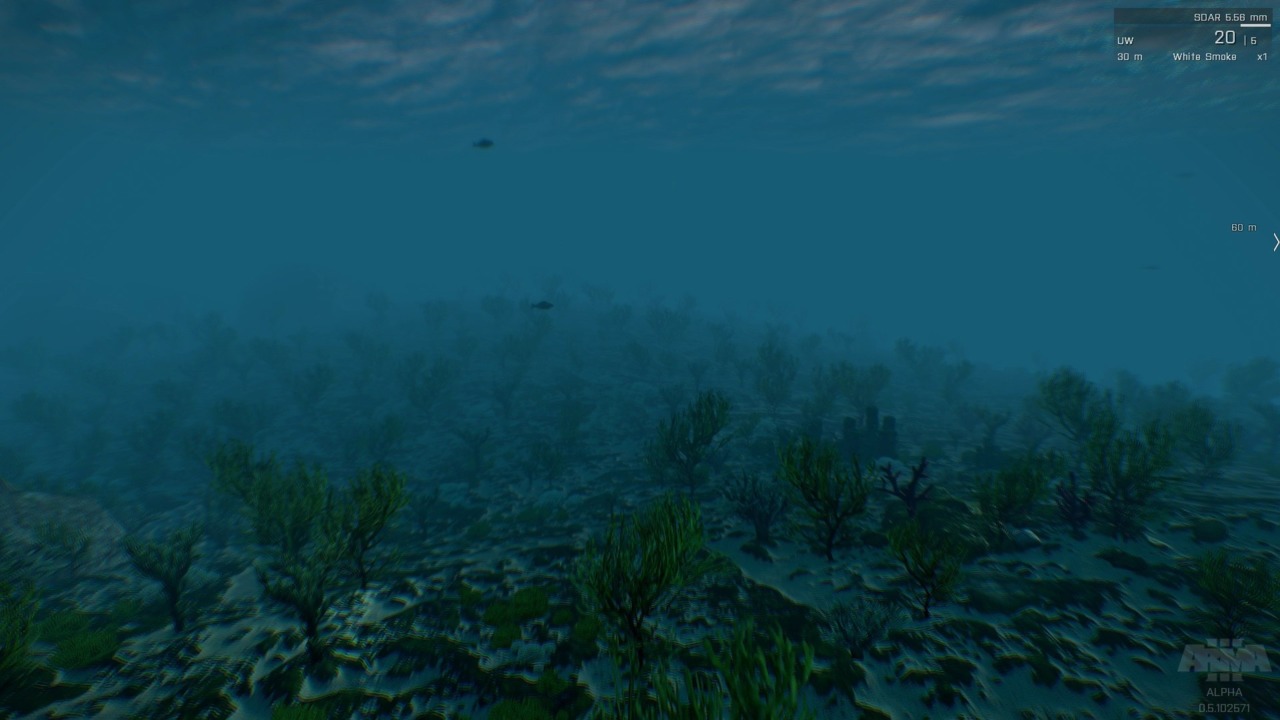
The high quality of the game's graphics engine is clear from the moment you enter a scenario. There are four scenarios to explore in the alpha, each of which focuses on a different aspect of ARMA III: infantry, vehicles, scuba, and helicopter flight. Each mission shows off ARMA III's lifelike vistas. In the scuba mission, you dive underneath the waves and admire the way the light refracts off the water surface above you. Fish swim by and undersea topography guides you through natural trenches. From the vantage point of the helicopter, you can gaze remarkably far into the distance and allow plumes of realistically billowing smoke to guide you toward areas besieged by artillery strikes.
Crowe is understandably proud of the work the team has done on the visuals. "Our terrains play a huge part in how you first experience the game, and the Mediterranean setting in ARMA III feels unique and distinct--you ain't in Chernarus anymore! So, from the way it feels and looks to the way it sounds or is presented, there's a bunch of stuff at work that will mean different things to different players."
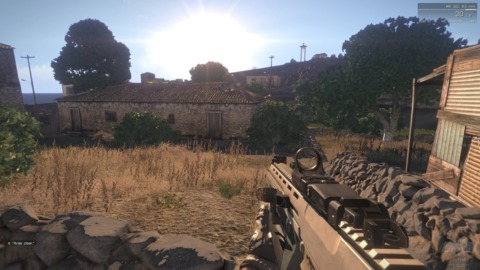
It's the lighting, however, that stands out most. Says Crowe, "The HDR [that is, high dynamic range lighting --Ed.] is a big step up from our previous games. There are many things that make the visuals in Real Virtuality 4 unique and impressive--no more so than the scale of the terrain or the range of detailed models--but we know that some compromises must be made. Other game engines do things that we can't, and they do them fantastically well, such as lighting in interiors or amazing wet-weather conditions. In ARMA III, I really like the detail on the soldier's character models. The artists have done a great job of making them military, and regimented, but different in subtle little ways, so your group doesn't look like carbon copies of each other. I like that our worlds can be huge, but there's still room for care and attention of the little details that make it feel rich."
I can confirm how much more refined the character models look and move, though there are moments in the ARMA III alpha when soldiers move in an odd, robotic, or otherwise unusual manner. (And for a game with so many explosions, the explosions look sadly canned.) I also noticed how much more natural radio chatter sounds than in ARMA II. In the past, the splicing of small audio clips made for weird, unnatural radio communication. In the ARMA III alpha, I was surprised by the high quality of voices all around; rather than being a distraction, voice-overs gave the soldiers bits of flavor and character.
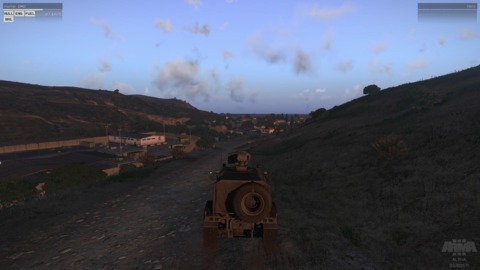
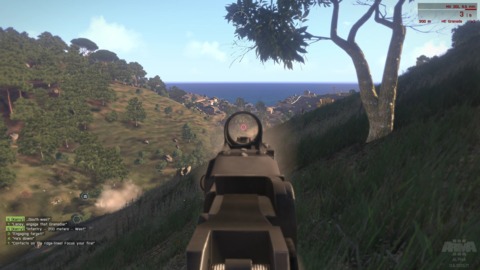
But the ARMA III alpha is about more than just technology: it's about war. And the war is not easily won, as each scenario makes clear. The infantry level gives you a feel for the care you must take rather quickly, as you make your way through a valley, avoiding the shots of gunners within the valley as well as from the hills above. If you're a newcomer, it should be immediately clear just how different ARMA III is from most modern-day depictions of battle. Expect to whip out your binoculars to get a good view of your surroundings, and to go prone and carefully inch forward to avoid the watchful eye of nearby soldiers. You must also exhibit eagle-like awareness of your surroundings in the vehicular scenario, in which you nab an attack vehicle and use it to lob grenades into a nearby base. Pay too little attention to nearby soldiers, and your car may take too much damage to its motor and leave you stranded. Waste too much ammo on enemy infantry, and you fail the mission.
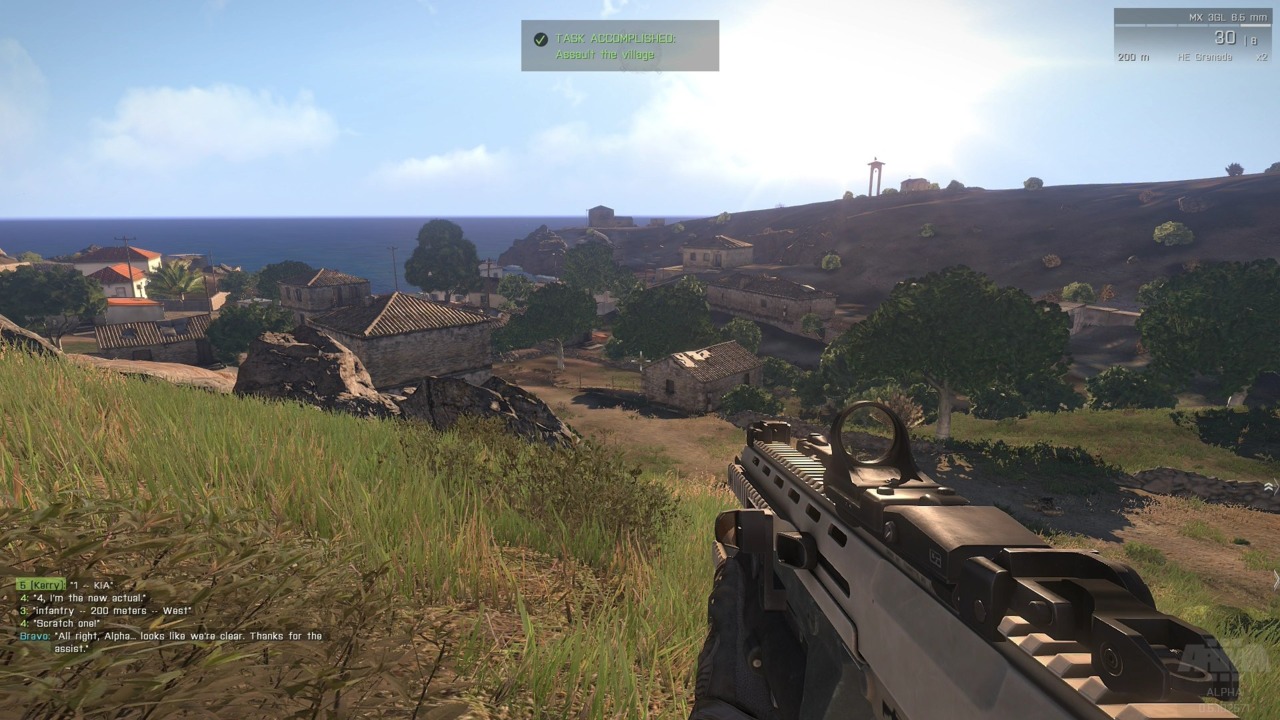
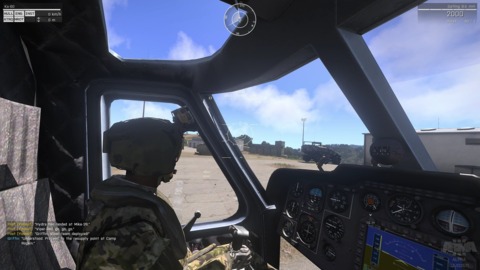
The helicopter scenario requires the most patience, forcing you to come to grips with authentic helicopter physics while simultaneously shooting down artillery installations and delivering troops to their destination. The ARMA III alpha is not a flight simulator, but its flight model is hardly arcade-friendly, either. The controls necessitate nuance--nuance most ARMA players already exhibit. But if you're a novice, the challenge isn't insurmountable: you might crash and burn more than a few times, but comfort does come.
Suffice it to say, the ARMA III alpha does not feel dumbed down, though it does streamline certain elements to make interacting with the game less cumbersome. I asked Crowe whether he thinks the full game will improve accessibility in the right ways without sacrificing the authenticity that makes ARMA such a hit. His reply:
"We're on the right track, I hope. I remember speaking to you last year at E3 about what 'accessibility' means and arguing that, for ARMA, it shouldn't be about 'dumbing down.' Rather, it's grinding down the rough edges: things that aren't authentic or fun to master; features or behaviours that are just somehow awkward."
"One good example is the way we handle throwing grenades in the ARMA III alpha," Crowe continues. "The feature isn't complete, and in its current state, I think it's a bit too simplistic. You press a key, the grenade is tossed, whatever animation state you're in. I think that's a legitimate example of where we haven't quite yet hit the right balance. Of course, it's a big improvement over ARMA II's turgid system. I basically didn't use grenades before, and now I do, so that's progress! It's more instinctive and usable, which is why we've left this WIP feature in the public build. However, for me, it's probably now too easy. There's not enough depth of control: you can't cook the grenade or manipulate the flight in any truly meaningful way."
Crowe's ultimate hope for grenade handling is to make it fluid and natural--but also to make sure it's simulated in an appropriate way. He's also conscious of how the modding community might further adjust that mechanic, and other ones as well. "This same through-process can be applied to a whole range of new or refined features," he says. "Is it useful? Is it appropriate? Are the community going to try to hijack it?"
Controls in general can be a sticking point for ARMA fans and detractors alike. I noted how much more fluid the game felt straight off--and it seems I am not the only one. Says Crowe, "The change hit me when I recently reinstalled Operation Arrowhead on a new PC. At least compared to ARMA III, the first run of OA was not a great experience--the first 15 seconds, the first 15 minutes. For example, I stuck a rifleman in the editor, moved around, and immediately felt somehow…stuck. I hope our players appreciate the difference in ARMA III."
The adjustments to how the game handles go much deeper, however. ARMA III can handle control presets, so if you're enamored with ARMA II's control scheme and have no intention of messing with what works for you, that's fine. But Bohemia Interactive is also pushing forward with a control preset that falls a bit more in line with standard controls in other games--though just what that preset will entail is still up in the air. "Sitting at Alpha, we've still got some way to go, and rancorous disputes within the team yet to be had," says Crowe, "but we're working towards our 'default' controls setup."
This rabbit hole of player control goes deeper still, however. More from Crowe: "The biggest changes are probably combat pace and adjusted stances, and the way that these are controlled. The stances enable an increased range of movement and are controlled using Ctrl as a modifier, together with WASD. Combat pace is where you can maneuver quickly with your weapon raised, making it more useful in closer quarters. Currently it's a toggle, but we're still working on how best to integrate this into the existing controls to make the best use of it."
My favorite of the four scenarios might be the scuba mission. It starts slow, having you swim from one mine to the next to disable them before emerging from the water and stealing a missile launcher from a nearby base. Even if you shy away from third-person views in the ARMA series, it's worth hitting the enter key on your number pad and moving out of first person, if only to admire the way your avatar glides forward. It's a nice, dreamlike introduction to the nail-biting bit of subterfuge that follows. The scuba options are new to the series, and I asked Crowe how they will fit into the overall package.
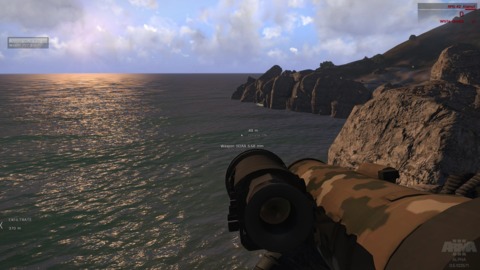
"First, it's a logical extension of what ARMA always offered, the idea of freedom or opportunity," he says. "It's another option, another tactical choice, that can be made to execute your mission. It, like other choices, comes with its own unique constraints and its own advantages. Giving players more opportunities always leads to good things. Plus, the sea turtle models are exquisite."
"Secondly, I like to think of it as removing an arbitrary barrier," Crowe continues. "It's like when I loaded up Grand Theft Auto III a while ago. I was in a pinch so jumped into the water, and died. I forgot that they only added the ability to dive in later versions. Now, we want to be careful not to make our game too 'arcade'--it comes back to the balance we were talking about before--so, there are constraints about using weapons underwater or how much air you have in your lungs. But we also don't want to unnecessarily frustrate the player when he wants to do something. It's not necessarily what gameplay it brings to the players, as what it's no longer preventing."
Based on what I played, I am not worried that ARMA III in any way represents a dumbing down of ARMA conventions, but I asked Crowe what he would tell anyone who voices those concerns. His response was candid. "Oh, veterans will always have troubled minds whatever I say! That's part of the beauty of being a diehard fan: complain loudly, frequently, but love unreservedly! More seriously, though, our teams are densely populated with ex-community members, and we're certainly keeping the core of ARMA III the same as ever. Once again it comes back to that difference between dumbing down features and trying to design them more effectively."
One thing Crowe isn't worried about is attracting the Modern Warfare-playing masses. Instead, his goal is to support new players and help them realize ARMA III's unique potential. He says, "ARMA will never be an 'easy' game, as it were. Its rewards are found in the mastery of the challenges it presents you--sometimes by design, and sometimes by our own limitations--and the openness of the platform."
So no, ARMA will never be the next Call of Duty or Battlefield. It will never be bombastic, or linear, and Bohemia Interactive has no current plans to bring the series to consoles. The team knows that its games have a unique identity on the PC gaming landscape and is unwilling to compromise its vision for the sake of being more cinematic. In fact, Crowe wants ARMA III to be there for the players exhausted with cinematic shooters. And he hopes that once they experience the kind of war only ARMA can provide, they won't have any need to return. "When I played the original Operation Flashpoint," Crowe says, "it just blew me away, and it totally ruined other critically acclaimed, but more linear, experiences. I've really never recovered. When you have a game set in an enormous world with a huge number of different weapons and vehicles, you'll find--even in some of the very biggest budget games--the odd glitch or imbalance. That's true of ARMA, but the rewards, for me, outweigh that."
Later this year, we will discover whether ARMA III finds that perfect balance of fluidity and authentic challenge. For now, anyone who has preordered the game has access to the alpha, which includes four single-player scenarios, online multiplayer (which we were not able to test, since the alpha wasn't live to the public), and a map editor. It's clear that Bohemia Interactive takes this series seriously. And that's to be expected, given how seriously the ARMA community takes the series, too. And that's as it should be; after all, few games take the subject of war as seriously as ARMA.
'Got a news tip or want to contact us directly? Email news@gamespot.com
Join the conversation