If you've been playing video games for a few years, you may remember a racing game for the PlayStation 2 called Paris-Dakar Rally. It didn't sell very well, and it didn't play very well, either. In fact, the game played like an old NES racer, had graphics that could have been done on the original PlayStation, and had about as many options as you could count on one hand--even if that hand had only two fingers. Perhaps as an apology for that terrible first attempt, Acclaim has released a follow-up called Dakar 2. Although Dakar 2 isn't as polished or realistic as games like Colin McRae Rally or World Rally Championship, it is nonetheless an approachable arcade-style take on one of the world's most grueling rally races--and a significant improvement on its predecessor.
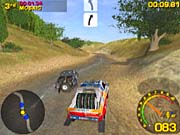
Dakar 2 isn't a complex game, either visually or in terms of overall gameplay. The scenery moves by at a smooth clip, and there are plenty of nice environmental touches, such as wooden bridges, flowing streams, and torch-lit tribal dwellings, but the texture quality and graphical sharpness aren't quite on the same level as in other games available for the current generation of consoles. Even so, the visuals in Dakar 2 aren't at all disappointing, because you still get to observe all the necessary details present in a rally race--in particular, dynamic lighting and shadows, splattering mud, and gradual body damage and discoloration. The game plays like many of the racing games you'll find at your local arcade, in that the controls are easy to pick up and the physics are a little on the bouncy end of the spectrum.
The selection of vehicles covers quite a range. There are three main vehicle classes: cars, trucks, and bikes. The car class is actually composed of lightweight pickup trucks modified with dune-buggy-style tires and suspensions, while the truck class contains diesel-powered big rigs. The class you choose has a clear effect on how difficult the game is. Dirt bikes are fast and light, which means they have a tendency to oversteer in sharp turns and bounce around on hilly courses. It's also much more common to take a spill on a bike than it is to roll over in a car or truck. The other side of the coin is the truck class. Dakar 2 is one of the few games to incorporate big-rig racing, and it's a welcome twist. Each truck is a modified dump truck or semi cab, which means that bouncing into the air or sliding around in the mud really aren't problems, thanks to the massive weight of these vehicles. Overall, the tire physics feel accurate. You can easily perform powerslides with a quad bike or car, and trucks pretty much have to lumber their way around each turn. In keeping with the game's overall arcade-style nature, the body physics are on the forgiving side. Pickup trucks and big rigs will bounce around a bit on the fringes of a road, but it's difficult to get them to turn over. Bikes tend to spin out when you oversteer or collide with other bikes, but not when you slam into barriers or outcroppings.
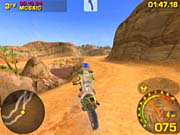
As in other rally racing games, the punishment for accidents in Dakar 2 is damage--although the repercussions aren't so severe as to take you completely out of a stage. Your vehicle can incur several levels of damage to any of four different areas: engine, tires, suspension, or steering. As each area develops more and more damage, you'll lose the ability to control the vehicle or accelerate to top speed. You have the option to initiate repairs, but you have to be at a complete rest to do so, and stopping for repairs can eat away precious seconds. Smart driving and knowing when to drive at a reduced speed are the best ways to avoid accidents, but you do have the ability to adjust various handling settings on your vehicle before entering a race, which can significantly reduce the amount of damage you sustain in certain situations. The list of aspects you can adjust includes tire air pressure, tire composition, gear ratio, suspension type, and transmission type.
Acclaim did a good job of listening to complaints aired about the first Paris-Dakar Rally and made sure not to make similar mistakes in the follow-up. There still aren't that many opponents visible on the course--you can pass four other vehicles in the campaign mode and three others in the arcade mode--but the CPU-controlled drivers do a much better job of driving the course and competing, especially on the hard difficulty setting. In the campaign mode, there's also a time-based cutoff that you need to meet in order to advance to the next stage, which gives you something to shoot for even if you're well ahead of the other competitors in your group. Each of the game's 12 different courses has a variety of shortcuts and natural obstacles to watch out for, but unlike in the previous game, you're pretty much free to drive wherever you like within the nearby surroundings of each route. For the most part, the roads that are cut into each stage and the turn warnings announced by the radio crew keep you pointed in the right direction. Three of the game's courses are set in unmarked desert areas, where there aren't any cut roads or optimal racing lines. In these stages, you have complete control over the route you take to get to each checkpoint.
One of the most glaring problems with the first game was that the ASO-sponsored Paris-Dakar logo was visible in the lower left-hand side of the screen during the entire run of each race. In Dakar 2, there's a local area route map and a GPS pointer in this portion of the screen, which makes more sense. Although the series' graphics have been improved in every respect, it's the audio that has undergone the more Cinderella-like transformation. The radio crew calls out each upcoming turn and caution accurately and clearly, even when you aren't taking the route identified on the map. As in the previous game, the music is primarily stereotypical European techno with a smattering of African drums and vocals, but this time it's done in a style that sounds remarkably like that of the popular German duet Enigma. Dakar 2 has one of the most unique and listenable soundtracks to come along in quite some time.
If you're looking for a rally game teeming with features and options, Dakar 2 probably won't meet your needs. It's not a simulation, and you can't unlock hundreds of different vehicles. Compared with other arcade-style racers, however, Dakar 2 offers a decent amount of variety. There are 18 vehicles in total to unlock: eight cars, four trucks, and six bikes. The game's four play modes include a 12-stage campaign mode, a quick race mode, an arcade mode, and a multiplayer rendition of the arcade mode. The arcade mode includes time trial and reverse route options.
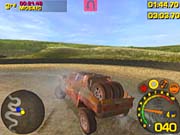
Like many games nowadays, Dakar 2 is available for both the Nintendo GameCube and the Microsoft Xbox. In terms of gameplay and appearance, the two versions are basically identical. The Xbox version has support for up to four players in its multiplayer mode and five short bonus courses in its arcade mode. The GameCube version supports two human players in its multiplayer mode, and instead of additional bonus circuits, it contains a set of a dozen course challenges that you can download onto a Game Boy Advance handheld. Even though the downloadable tracks are on par graphically with the other top-down-perspective racing games that are available for the GBA, this mode lacks punch because it never pits you against other opponents. Challenges involve beating a set time, gathering tokens, or avoiding obstacles.
Acclaim hasn't really done anything groundbreaking with Dakar 2. It's just a solid arcade-style rally racing game that happens to carry the license of a grueling 20-day, 6,500-mile road race that typically involves more than 400 competitors. Some people may take that to mean that the game should have more courses, longer stages, and dozens more vehicles visible during each race. There are other games out there if that's what you're looking for. For those of you who aren't as picky about the details, there's a passable amount of fun to be had right here.
