Grand Theft Auto with robots? That would seem to be the most apt description upon one's first impression of Scrapland, the latest action game from designer American McGee and publisher Enlight Software. Featuring a seemingly open-ended gameplay structure, a noirish murder mystery, a goofy sense of humor, and a huge city to explore, Scrapland would seem to have all the makings of a futuristic adventure of epic proportions. Unfortunately, the initial vibe the game puts forth doesn't quite pan out throughout its entire experience. Overly repetitive gameplay and mission designs knock a lot of the wind from Scrapland's sails as the game progresses, and the story could have been fleshed out in a more enjoyable fashion. Scrapland is still pretty good overall, but there's definitely a level of potential here that just doesn't ever quite get realized.
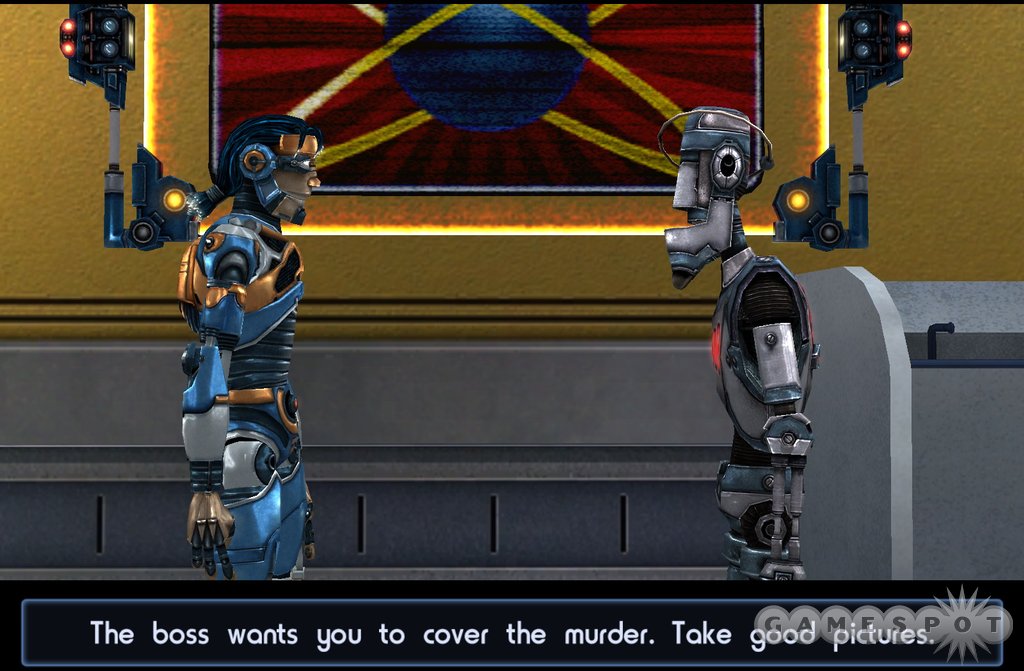
In Scrapland, you play as D-Tritus, a junkyard-born robot who, amid his many space travels, finds himself on the world of Chimera. Chimera has been nicknamed "Scrapland" by its locals. This is partially because it's made up of a lot of junk and partially because it happens to be inhabited entirely by robots. Upon his arrival, our hero is immediately decontaminated for fear of being infected by the germs of dreaded humans (more on that later). He's then assigned a job, because all residents of Scrapland must have one. With no other jobs available, D-Tritus is assigned to be what is considered the lowliest of professions on Scrapland: a journalist. D-Tritus heads off to work only to find himself wrapped up in an insidious murder plot almost immediately.
Murder is sort of a funny thing in the world of Scrapland thanks to something called the Great Database. The Great Database is basically a big storage unit for the matrices of all the residents of Scrapland. Anytime anyone dies, a simple payment to the order of bishops, which runs the database, affords you an extra life. Essentially, true death is a foreign concept to those who reside in Scrapland. Of course, that's until someone starts killing off key political figures in the Scrapland hierarchy...and subsequently starts stealing their matrices from the Great Database, which effectively stops any chance of bringing them back to life. Though a flesh-and-blood being is initially suspected of the murders (a big deal in a world that fears and loathes all organic life), the plot thickens significantly as time goes on. And, of course, you, as D-Tritus, are right there in the middle of it.
Much of your time in Scrapland is spent trying to solve these murders through a lengthy series of fetch-quest and vaguely GTA-inspired missions. You can travel on foot or via ship around Scrapland, though neither brings much in the way of variety. There are really only a few types of missions, and many of them reuse the same themes over and over again. You'll need to destroy a series of ships (or perhaps even just one very tough ship); go to someone's hideout and steal or photograph plans for a ship, its weapons, engines, or what have you; or pretend to be another robot to trick someone into giving you information or a needed item. There are a few other variances, including a series of side missions charged to you by the owner of a local gambling club, but most of them stick to similar gameplay conventions and don't deviate from the straight-and-narrow gameplay style Scrapland employs.
It isn't even just that the game uses the same types of missions frequently, either; it's that the game will actually charge you with performing nearly the exact same missions multiple times in a row. There are more than a few instances where you'll have to perform the exact same mission task in at least two to three missions sequentially, with only the slightest of variances. A couple of missions involve photographing plans that belong to a sect of mercenaries. In one instance, you're photographing a weapon, and in another, you're photographing a gunship. The setup for these missions is exactly the same, save for the replacement of the word "weapon" with the word "gunship" during the dialogue tree. The second time around, you do have to fight off a few more ships than the first time, but otherwise, it's the same thing over again. This happens much too frequently in the game.
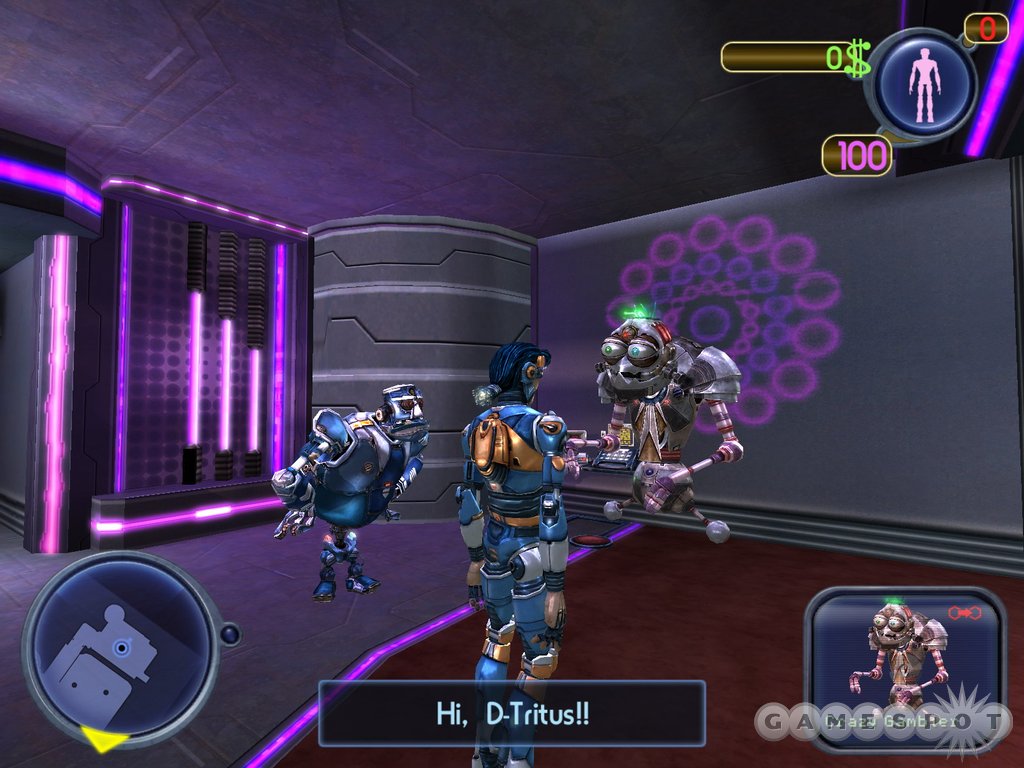
Fortunately, there are more-appreciable aspects of Scrapland's gameplay. When you're on foot, most of your work involves conversations with the many different robots that populate Scrapland. The robotic population is certainly made up of a colorful bunch of characters, and each and every level is populated with lots of them. However, there are only a limited number of robot types, and every character from that type features the exact same voice acting and the exact same dialogue when talking outside of a mission. But this is forgivable simply because the characterizations are almost always entertaining. Banker robots, for instance, are slithery, creepy creatures that are constantly robbing everyone they come into contact with, while the cops are similarly money hungry, though they're far more rough-and-tumble (despite their short statures), and they frequently walk up to you to demand cash for "protection." What's even better than interacting with these characters, though, is becoming one of them.
Thanks to a gizmo D-Tritus picks up early on in the game, you can actually become pretty much any of the robots you encounter during it. All you have to do is access one of the many Great Database hubs that are littered all over the gameworld, pick a form, and from there you will steal that robot's matrix for as long as you need it. This comes into play mostly during missions, where you have to trick some robot into thinking you're someone else. However, you can also simply take advantage of each robot type's special abilities when walking around. When you're a banker, you can steal money from other robots, and when you're a bishop, you can emit a destructive energy beam. The catch, of course, is that this is technically illegal, so some of the police robots may catch onto what you're doing while you do this. As a result, it's best to not do anything illegal for too long, time-wise.
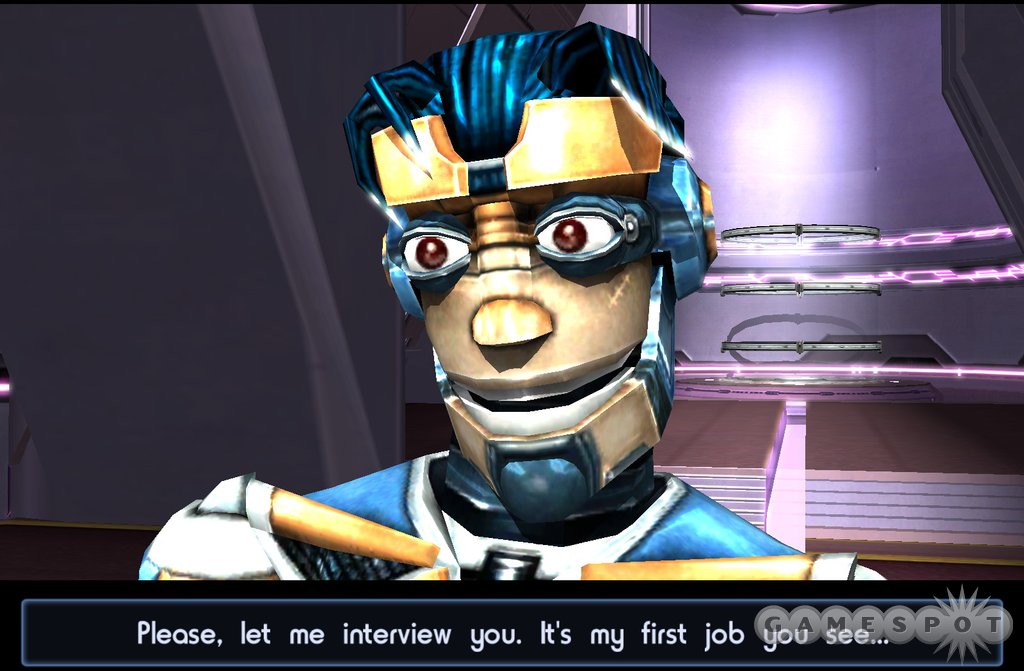
However, this is really the only particularly enjoyable aspect of the game's on-foot missions. Most of the rest of the time, you'll simply be running from point A to point B to point C, and so on. You'll basically run to communicators or assorted robots to receive your missions. This wouldn't be so much of a chore, except the indoor environments are almost always very, very large. While this would be great and all if there were more to explore or see in these levels, unfortunately, there really isn't. They're all pretty to look at and feature some nice set designs, but aside from that, the only purpose they serve is to house the characters that provide your missions, and there's just entirely too much aimless wandering involved to get to them.
The good news is that you won't have to spend all your time on foot, since quite a bit of your time will also be spent flying assorted ships. When you first begin the game, you're handed a clunker of a ship that gets you from place to place, but not to too much else. However, as you progress--and by getting the plans for new ships--you'll actually be able to buy those ships from a number of mechanic shops across the city. You can even trick them out with new engines, increased hull plating, and new weapons, should you choose to do so. Of course, this all costs money--quite a bit of it, in fact--and if your ship gets destroyed, it's gone until you can either buy a new one or steal one (albeit not your tricked-out version) from one of the game's parking stations. Or, well, at least that would be the case, except that thanks to the save-anywhere save system the game employs, you can always just save your progress right before you're about to be destroyed. Then you can reload from that save point, which prevents the hassle of having to buy a new ship.
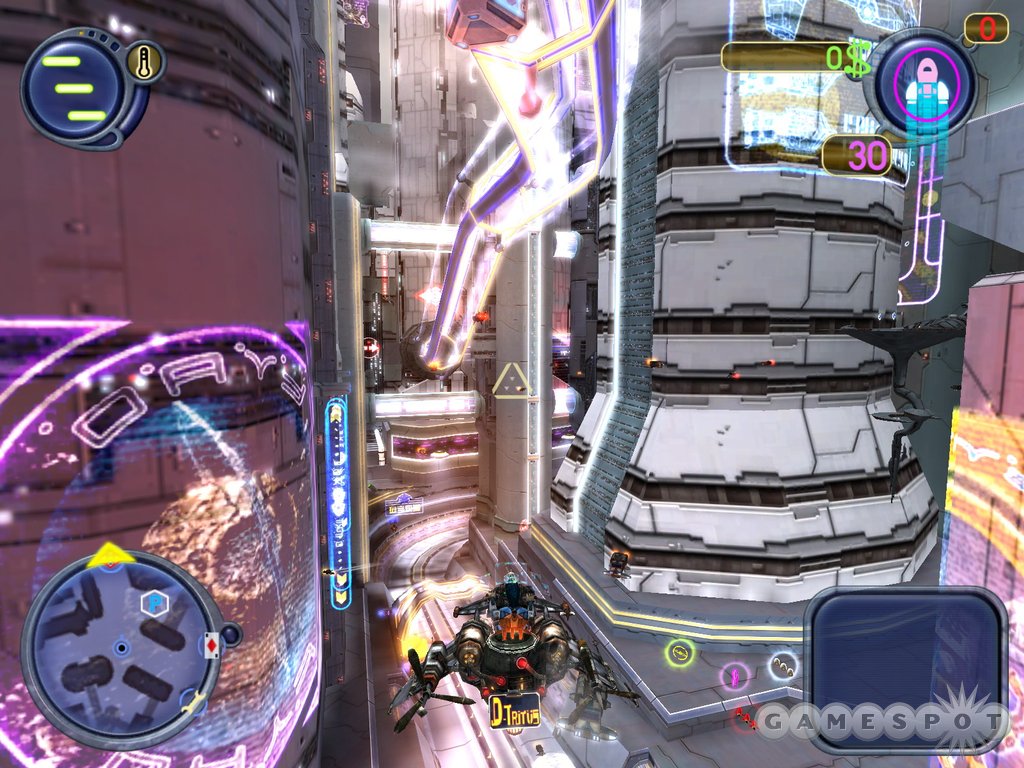
Flying around Scrapland is a pretty cool experience. The city is deceptively big, and it features tons of cool, futuristic scenery to check out as you fly. Regrettably, like the on-foot missions, there really isn't a whole lot to explore in the city beyond its window dressing, and the novelty of that does wear off after a while. Of course, it isn't totally boring flying around the city, because missions will frequently require you to engage in combat with other ships. Be they manned by cops, mercenaries, or crazed bankers, you'll have to shoot down a lot of ships throughout the course of the game. The keyboard-and-mouse control for piloting ships is extremely responsive and intuitive, and there are a nice variety of weapons at your disposal, giving you plenty of ways to blow up those robots. However, it isn't all fun-and-gun, because you will have to worry about the cops catching onto you, in addition to having to avoid getting shot down yourself, which does happen...and often.
Some of the ship-combat missions are almost ridiculously tough, mainly because the game has a nasty habit of making these missions drag on a lot longer than you'd probably prefer. The main reason for this is because of the game's power-up system. Essentially, there are a number of power-ups you can acquire for your ship that are scattered about each area of the city, including a hull boost and multiple types of ammo replenishments. The catch here is that other ships can also pick up these bonuses. So if you're fighting off a pair of mercenary ships and you've almost gotten them both down to the point of destruction, they'll suddenly veer off from the battle to find a hull boost that will put them right back in the fight. While it's totally possible to chase them down before they get to a power-up, this isn't always an easy option, especially if you've got other ships attacking you at the same time. This can cause some battles to drag on seemingly forever.
The main story mode is not the only place you can take part in some ship-on-ship combat, because the game also features a multiplayer mode. You can take part in a number of different modes, including deathmatch, team deathmatch, and capture the flag...that is, assuming you can ever find anyone online to play against. We spent the better part of a week trying to track down an online opponent, yet never came across one. Still, some time spent flying around the empty multiplayer maps at least did verify that the mode works. So, it's there, if nothing else.
It's safe at this point to say that Scrapland's actual gameplay is definitely not its most endearing quality (though, again, by no means is it bad at all). But what is, then? Is it the story? Well, yes and no. The plot itself starts out promisingly enough, and the characters in the game are all an entertaining lot. However, at the same time, the story doesn't quite pull itself completely together to provide a satisfying conclusion. D-Tritus is never really focused on, and you never actually get to know him very well at all. The whole murder mystery also seems to artificially drag out a lot longer than it should because of all the fetch quests and double crosses that keep occurring, many of which just seem tacked on for the sake of increased game length. There are definitely some interesting twists and turns, mind you, but ultimately, it feels like there's a better story that could have been told in place of the one you're presented.
What ultimately saves Scrapland from merely being another average action game is simply a level of charm you don't typically find in games of this type. It's tough to nail down exactly what makes it enjoyable, but there are a lot of little things that just make the game, for lack of a better term, cool. For one, the game has a very specific sense of humor. It's never laugh-out-loud stuff, but there are a lot of sly gags hidden within the various characters and situations you'll find yourself in, and occasionally there are some more-obvious site gags as well. The world of Scrapland is also just so big that you can't help but marvel at it. While we already mentioned that the sheer size of the scenery probably isn't enough to keep you entertained for too long, it's also never boring. There's just so much traffic--of the robot and ship varieties--in the background, while you're flying about or on foot, that it really gives you a great sense that this is a living, breathing city (or whatever the robotic equivalent would be).
There are also a lot of little details in the graphics that just make this a wholly pleasurable game to look at. The robot designs are extremely cool, right down to the smallest aspects. D-Tritus, for example, is decidedly more humanlike than the rest of the robot population, with bulging eyes and a ponytail haircut made from carefully placed cables. All the other robots are extremely easy on the eyes, too, and they feature excellent reflective shine off their metallic bodies, in addition to loads of detail and great animation. The same could be said for most everything else in the game, too. The many different environments are all similarly high in detail and are also similarly pleasing in an aesthetic sense. Spend some time walking around the Great Database, or just fly through the bustling industrial district of the city, and you'll see what we mean. With all that said, the game isn't visually perfect, by any means. Frame-rate drop is a frequent issue when a lot of characters are onscreen at once, and you'll notice some occasionally glitchy animations. Despite this, the game has an overall great look to it, which really provides a boon to its charm factor.
Of course, the characters would be nothing if the voice acting weren't solid, and, thankfully, it definitely is. Each character type has a distinctive voice and personality, from the snippy functionary robots that speak with nasally British accents to the vaguely effeminate bishop robots that speak with such superiority that you can't help but hate them. Save for a few weird reads and some occasionally spotty writing, the voice work is almost always great, though the one character who comes off a little oddly is actually D-Tritus himself. He speaks with such a friendly earnestness that it's actually a little off-putting when he accepts all these missions that involve killing lots of robots with total enthusiasm. Then again, since death is such a trivial thing in this world, that does make a bit of sense. Scrapland's soundtrack is another bonus to the game's sound design, as it features just the right mix of high-energy techno and mellow, mechanized ambient music to suit each situation well. Some of the tracks are a little cheesy, but mostly it's quality stuff that will have you tapping your fingers as you play.
Scrapland is a game that's exceptionally tough to dislike, despite the fact that many of the things it tries to do just don't quite work. The underlying game design is flawed in several key areas, and the story isn't quite as satisfying as you'd hope. However, Scrapland has just enough going for it to make it enjoyable to play through while you experience the whimsy and inherent goofiness of its quirky and unique world. It's the intangibles that ultimately save Scrapland from the junk heap, and, thankfully, there are enough of them to make it a recommendable play.
