Full Spectrum Warrior started out as a military training simulation commissioned by the US Army, and only later did publisher THQ and developer Pandemic Studios decide to turn it into a video game about modern squad tactics--but you'd never know that from playing the game. Full Spectrum Warrior features an innovative design and an effective control scheme, and it convincingly delivers the sights and sounds of modern squad combat in the war-torn Middle East. It may look like a shooter, but it isn't one, since you never actively aim or fire weapons in the game (except for grenades). The thing is, Full Spectrum Warrior isn't a fully featured strategy game, either, and it relies on a fairly simple, surprisingly abstract gameplay model that has trouble sustaining a rather short campaign (which can be played alone or cooperatively on Xbox Live). Indeed, the game often ends up feeling like a string of puzzles whose solutions are pretty obvious. Nevertheless, Full Spectrum Warrior is very good overall, and deserves credit for being something other than just another military-themed shooter or strategy game. It's just too bad that it isn't more involving.
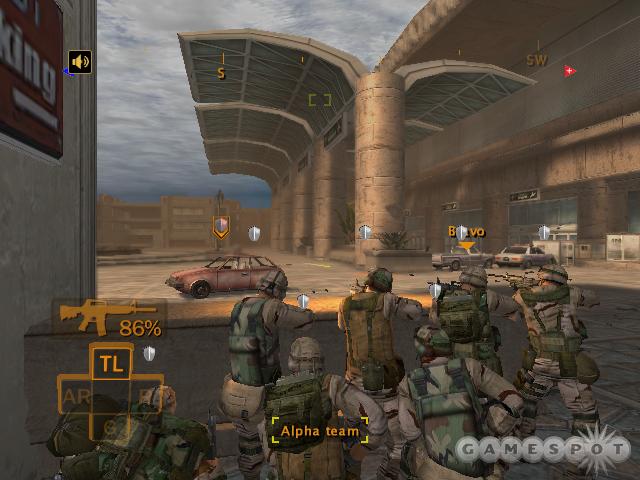
The game begins with a MOUT (military operations on urban terrain) training course that effectively familiarizes you with Full Spectrum Warrior's unique fireteam command system, how to use cover, how to lob grenades, how to lay down suppressive fire, how to flush out foes firing from behind cover, and more. These step-by-step training scenarios, like the rest of Full Spectrum Warrior's presentation, are thick with authentic military atmosphere and they establish that each of the men in your eight-man squad is a unique individual with his own personality. You, the player, do not represent a specific character in the game, but your disembodied perspective is always near to whichever of your squad's two fireteams is currently selected, as if you're in the thick of the action right with them. Your line of sight is limited to theirs, and when they run from cover to cover you'll seem to be running right with them, as if you're an embedded video journalist capturing the action on camera. Full Spectrum Warrior gives an outstanding first impression.
Perhaps it's a testament to the Army's MOUT training, but ironically, the training scenarios in Full Spectrum Warrior are so comprehensive that they teach you practically everything there is to know about the gameplay, leaving little else for you to learn during the actual campaign. The campaign takes place in the near future in a fictitious setting that's a dead ringer for Iraq. Here's how the gameplay unfolds in a nutshell: Every campaign mission is basically a completely flat, linear obstacle course of sorts in which enemies will routinely pop up and start firing on you using small arms and, occasionally, frag grenades or rocket-propelled grenades. These enemies will typically fire from behind cover, and your men should also always be standing behind cover when not in transit or else they're much more likely to get shot. Taking out entrenched enemies is what Full Spectrum Warrior boils down to, but the process very quickly becomes routine and it ceases to feel risky or dangerous despite the authentic-looking presentation. Also, since the levels are scripted to play out basically the same way each time, with predetermined enemy placements and mostly clear-cut paths to objective points, thwarting enemy ambushes becomes more of a matter of trial and error than skill and planning.
The most significant contrivance in Full Spectrum Warrior is that men hiding behind cover are completely invulnerable. For instance, if your team is firing around a corner at a man 10 yards away, who himself is firing with an assault rifle from behind some sandbags, no one is going to get shot, no matter how long you allow the stalemate to drag on and no matter how many bullets seem to nearly hit their mark. The game professes that, when you're behind cover, you're in a safe zone (though, certain types of cover, such as sofas or wooden crates, can't absorb much fire and will realistically fall apart before long). This aspect of the game may initially come as a surprise, but it's a fair element for Full Spectrum Warrior to impose in the interest of making the player focus on tactics rather than on twitch gameplay. However, the tactical options themselves are fairly limited.
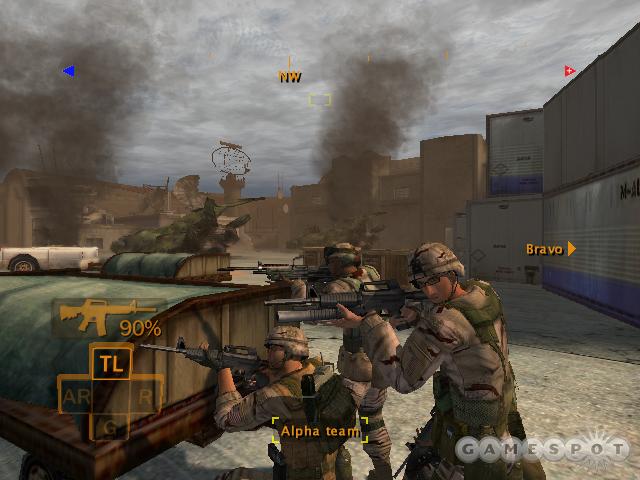
So what do you do in a stalemate situation? You may: Toss a frag grenade if you're close enough to the enemy (your men have weak throwing arms, apparently, as you can't send grenades very far); fire an M203 grenade (which, for gameplay reasons, flies straight ahead like a rocket whereas the real-world weapon is more like a mortar); toss a smoke grenade in front of your foe so that your fireteam may safely advance to a different location; or lay down suppressive fire on your foe, causing him to duck and cover, creating an opportunity for your other fireteam. You have limited use of all these options, though you'll find places to replenish your bullet ammo (but not your grenades) during the course of a mission. You always have two fireteams at your disposal, so in practice, you'll frequently have one engage the enemy in a stalemate while the other creeps up from the side and whacks the enemy where he's exposed. Little shield icons floating over the heads of friends and foes make it perfectly clear whether or not someone is in danger of being shot.
Full Spectrum Warrior may sound like it has a good number of different types of tactical options, but you'll usually be limited to just one or two. For instance, say there's a heavy machine gunner that has one of your fireteams pinned down in a corner, and your GPS map reveals that there's a conveniently placed alleyway that will allow your other fireteam to flank the gunner. Or maybe the only cover between you and the foe is a wrecked car, which gets you just close enough to use a grenade. Simplistic situations like this mean that the tactics in Full Spectrum Warrior are practically taken out of your hands on many occasions. Once you get past the thrilling presentation, you'll likely realize that the gameplay and the level design both tend to be very straightforward, and the result is a forgettable campaign whose few set pieces--ordering artillery strikes against enemy armor or teaming up with a pair of snipers--don't overcompensate for the frequent monotony of the action.
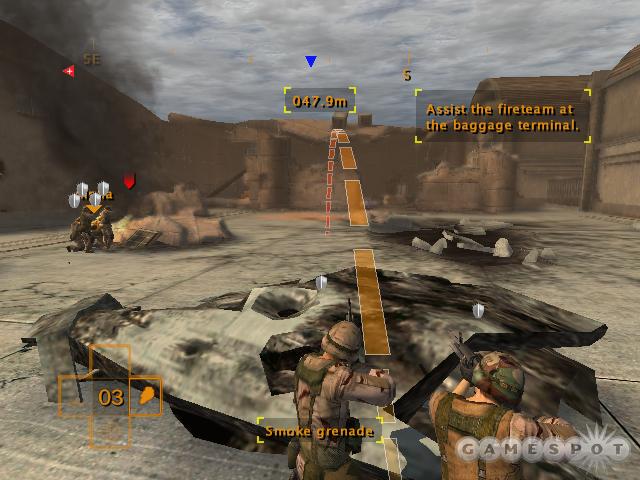
As you play, you'll notice that some options seem to be noticeably absent in the context of a game about urban warfare. For instance, you'll see your men riding in various vehicles during cutscenes, but you'll never get to use or control vehicles during actual gameplay. You also can't enter buildings in the game (except in a few specific cases where your mission path takes you through one), even though you'll always be surrounded by them and you will come across enemies firing at you from windows and balconies. It's not that there are clear-cut ways in which features like this could have been integrated into the game; it's just that the game shows you things that it seems like the game should let you do on your own. Since a lack of variety is one of the most notable shortcomings of Full Spectrum Warrior, these types of things stick out as omissions.
For what it's worth, the game controls very well, and it features an elegant and unique interface that's easy to get the hang of. Just as you don't actively fire most weapons in the game, you don't have direct control over your fireteams' movement--instead you order them to new locations kind of like you would order units in a real-time strategy game. An iconic cursor on the ground represents where your troops will fall in if you order them to move, and when you position the cursor near cover (at a corner, next to a car, and so on), the cursor will stick and will take the shape of the cover object, intuitively informing you that your men will take a fortified position there. One of the interesting things about Full Spectrum Warrior is that it simulates how battlefield commands aren't executed in real time. Once you order your troops to move or to fire, there's a noticeable lag between the time the team leader issues the order and when the order is actually carried out. This works fine with the tactical pacing of the game. However, it leads to some tense situations, like when you're blindsided and need to act quickly if your men are going to survive.
The artificial intelligence unfortunately doesn't present an interesting challenge, for the most part. To put a finer point on it, your enemies are too stupid, though that isn't true of your fireteams. The gameplay is designed in such a way so that your fireteams do most of the work without much input from you. Again, you'll manually lob grenades, but when it comes to shooting and keeping your troops' heads behind cover, they'll mostly take care of all that for you. They'll also automatically go prone if they come under fire when left out in the open. If given a regular move order, they won't defend themselves if suddenly confronted by the enemy--but there's an option to make your men advance cautiously, guns raised, and they'll attack foes on sight when doing this. On the other hand, your enemies often seem brain-dead, and whenever they do something that seems intelligent--ambush you as you approach or make a strategic retreat, for example--it's apparently because they're scripted to act that way, and they will probably act that way each time. On many other occasions, you'll see enemies do completely boneheaded things, like stand perfectly still as you send a dozen or more bullets at them from an unguarded flank, or cry out in a panic when you've tossed a grenade at their feet--but they won't actually run for cover. It's also worth mentioning that you'll never deal with overwhelming enemy odds in Full Spectrum Warrior. Don't expect Black Hawk Down here--the superior numbers will usually be on your side in any given skirmish, at least at the default difficulty setting.
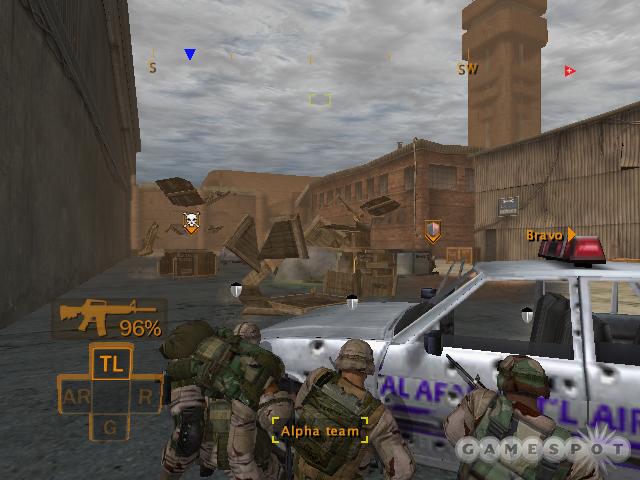
Full Spectrum Warrior offers two different difficulty settings, the tougher of which is much less forgiving of tactical errors and oversights, and it offers fiercer enemy resistance in greater numbers plus far fewer precious grenades for your squad to use per mission. At the default setting, your men can usually take several hits before going down, whereas they won't be so lucky on the hard mode. Even if a man gets gunned down, he doesn't instantly die; you can have his fireteam pick him up and carry him away to a casevac (casualty evacuation), where he'll get probed for a second by a medic and then get right back up, fit as a fiddle. If ever you have a second man taken down if one is already unconscious, then it's game over, and you get to resume your progress from the nearest save point (these are liberally dispersed throughout each mission).
The campaign at the default setting really isn't challenging since you'll realize that there's usually little harm in letting your men draw enemy fire for a little while. You'll learn to brazenly rush from cover to cover under the enemy's nose. You won't get away with this behavior on hard mode, but it's unlikely that you'll either play the game on the hard mode first or that you'll want to replay the campaign at the tougher setting once you've worked your way through it the first time, as the gameplay will have long since gotten repetitive by then. Still, the hard mode is much more challenging, but it approaches being very frustrating, even if you've finished the campaign on the default setting. Some rather lengthy loading times between failing a mission and retrying it doesn't help matters here.
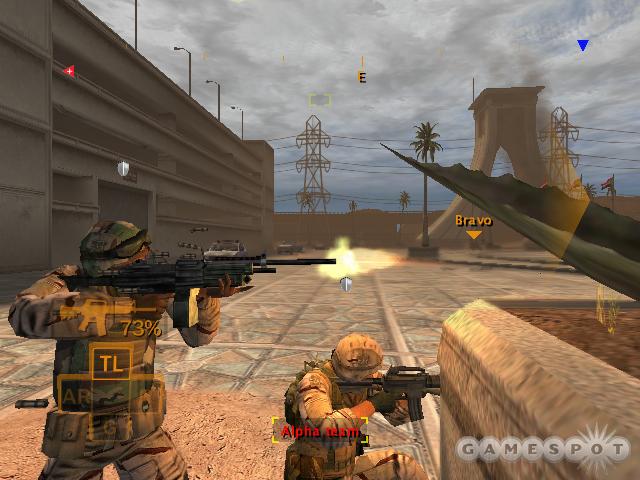
Meanwhile, the cooperative play mode, which is exclusively playable over the Xbox Live service, isn't a major attraction. All it does is limit you to doing half the amount of work you normally need to do. That is, instead of controlling two fireteams, you'll control just one and your partner will manage the other (the first player will also manage any tertiary assets, such as the sniper team that becomes available at one point). It's the same campaign whether you play it in co-op mode or not, and you can freely switch between progressing through the missions alone or with a partner. The co-op mode can actually be pretty entertaining, since you'll need to closely coordinate with your teammate using the headset. But since the underlying gameplay doesn't change, coordinating the fireteams turns out to be a pretty easy task and it really boils down to a basic question of timing (you'll ask for suppressive fire at specific moments, when you're ready, and things like that). One other option while online is to exchange replays of particular missions with other players. However, Full Spectrum Warrior replays aren't all that great, since this is a rather slow-paced game and you have no ability to manipulate the camera while watching a replay--just fast-forward. You can instantly jump into the replay and regain control of your squad at any point if you zigged when you should have zagged and want to try a different approach, though.
One of the things that makes Full Spectrum Warrior impressive despite the limitations of its gameplay, is that it truly looks superb. The animations of your men as they go about their business are lifelike and believable. The game's environments don't have a lot of variety to them, but they are certainly authentic and boast some impressive ambient effects, such as a few sequences that take place during a sandstorm (which will leave your men choking for air, which is a great touch). Explosions in the game also look terrific, and seem realistically subdued rather than unbelievably over the top like you're used to seeing in action movies. Grenades take out their victims with a sudden snap, and cars hit by explosions shudder violently as their doors get dislodged and their windows shatter (but the cars themselves don't go up in a fireball or anything like that). At any rate, while neither the game's character models nor the environments are terribly complex, most everything about Full Spectrum Warrior looks authentic and impressive, which is where a lot of the game's appeal naturally comes from.
Actually, the audio plays along with the graphics very well. Each of your troops has a unique voice, although the respective team leaders of fireteams alpha and bravo are the men you'll be hearing from most of the time as they constantly order their teams to move about using just a small handful of different, repetitious phrases. Other than that, though, you'll hear a lot of different speech, which is convincingly delivered by some good voice actors whose lines and deliveries sound like they could have come from a recent war movie. It's worth noting that Full Spectrum Warrior's dialogue is rife with swearing, which is mostly befitting a game in which people are constantly at risk of being shot and killed. However, in the game it seems a bit excessive at times, especially in how your men will routinely cuss out their enemies as they kill them. Still, the voice work in Full Spectrum Warrior is mostly great, and so are most of the sound effects, especially the explosions. The game's musical score is a fitting combination of American brass and Middle Eastern woodwinds, which is particularly reminiscent of the soundtrack to Black Hawk Down. It's very good stuff, but there's a distinctly limited number of tracks, so you'll hear repeats often. You'll also sometimes hear the action-oriented music playing at the wrong times--during relatively calm moments when all you're doing is moving your squad from one point to another.
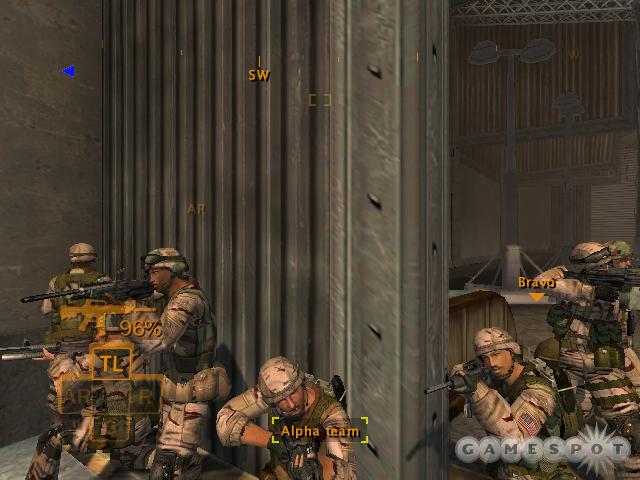
Nevertheless, there's no denying that Full Spectrum Warrior boasts a great presentation and a unique design. However, the gameplay itself just doesn't stack up quite as well. The campaign goes through the same paces until it ends abruptly after a little more than 10 hours, and it doesn't invite much replay value after that--not just because the missions play out the same way each time but also because you can't skip the cutscenes in between gameplay sequences (at least you don't have to go through the training again). Most military buffs probably won't get past Full Spectrum Warrior's lack of gameplay realism, and they won't find much in the way of real depth, variety, or lasting appeal in it, either. So it says a lot for the game that, in spite of these admittedly significant setbacks, it's still ultimately worth checking out if you're looking for something completely different.
