Like Infogrames' last driving game, V-Rally 3, NASCAR: Dirt to Daytona features great graphics, a wide selection of cars, and an incredibly deep career mode. Unlike V-Rally 3, however, Dirt to Daytona isn't marred by any control problems. In fact, fans of stock car racing will surely find this game to be one of the most complete and well-rounded NASCAR games currently available for the PlayStation 2. It still suffers from the two key problems that affected its predecessor, NASCAR Heat 2002: a relative lack of licensed drivers and a somewhat forgiving damage model. Those two issues aside, however, Dirt to Daytona is one thorough driving game.
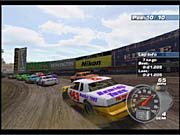
In fact, you typically expect to find such complex and brimming driving games on the PC, not on a console. But there's no denying Dirt to Daytona's depth. Its name, though somewhat confusing at first, is certainly telling. In the game's career mode, you'll be tasked with advancing from the NASCAR Weekly Racing series, where ordinary stock cars race each other on simple dirt tracks, to the NASCAR Featherlite Modified series, past the NASCAR Craftsman Truck league, and into the venerable NASCAR Winston Cup series. Basically, you'll start out in the dirt leagues, but with enough experience and checkered flags, you'll be able to reach "America's race," the Daytona 500. Dirt to Daytona's career mode spans nearly 30 seasons, pits you against 43 other drivers, and challenges you on 31 different dirt and asphalt racetracks. This structure similar to that of V-Rally 3, but there's much more to it.
The first thing you'll do upon starting a career is to create a driver. Immediately afterward, you'll be taken to your office, which serves as the main interface of the career mode in Dirt to Daytona. From here, you'll have access to your race calendar, which displays dates and information on upcoming races; press clippings summarizing the latest standings; a staff budget that will let you hire a pit crew, mechanic, and chassis builder; a garage that will let you work on upgrades and sponsor placement; and a massive parts catalog that contains nearly 100 different components that you can use to enhance the performance of any of your racecars. There was no financial element to V-Rally 3's career mode, but careful management of income plays a central role in Dirt to Daytona. Most of the features offered in its career mode, from buying a better engine for your Weekly Racing stock car to hiring the best pit crew for your Winston Cup races, require money, and the easiest way for racing teams to generate money is by slapping sponsor names all over their cars. When you start Dirt to Daytona's career mode, you'll be relegated to the Weekly Racing series, and you won't have any sponsors. If you perform well in the first race, you'll start to woo prospective sponsors, each of which will have different criteria that you have to meet from race to race. Naturally, sponsors that pay more will generally expect more of you than those that don't. As you acquire more sponsors, you'll start to earn more money, which you can use to buy new parts to improve your performance. This in turn will likely increase your chances of doing better in races and wooing sponsors with deeper pockets, allowing you to buy even better parts, and so on. In addition to purchasing upgrades, you can fiddle around with a number of different handling options like tire inflation, shock speed, wheel camber, gear ratio, and even the amount of tape that you apply to the front grille. Though, for the most part, you can choose to ignore most of these options and still be competitive.
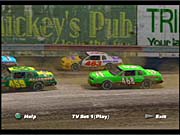
Interestingly enough, you can choose what part of your car you want any given sponsor's logo to appear on. Certain areas, like the doors and roof, are much more lucrative than, say, the bottom of the rear quarter panel. To that end, different areas of your car have different modifiers on your sponsors' contracts. A bad logo placement will reduce the amount that a sponsor has agreed to pay by up to 70 percent, whereas a visible area of your car can increase a sponsor's payout by as much as 130 percent of the contract rate. So not only does the game force you to race up to your sponsors' expectations, but you'll also have to find the most financially beneficial way to promote those sponsors.
If you place first in the Weekly Racing series at the end of a season, you'll be invited to join a Featherlite Modified team, where you'll have to go through the same rigmarole of wooing new sponsors, managing your income, buying upgrades, and hiring a new staff. When you finish a Featherlite season in first, you'll be able to move on to the Craftsman Truck series, where you'll start to race against some familiar faces. Not all the series' drivers are represented in Dirt to Daytona. In fact, only a small percentage of them are, but you'll still trade paint with the likes of Ken Schrader and Dennis Setzer. Manage your income wisely and place first in the Craftsman Truck series and you'll be invited to join a Winston Cup team. Again, like in the Craftsman Truck series, only about half of the Winston Cup drivers are actually in the game, though they're mostly the recognizable ones like Jeff Gordon and Rusty Wallace.
The different cars used in these four series all handle differently, and you'll have to adjust your driving style as you move up from the slow cars and loose tracks of the Weekly Racing series to the blinding speed and high-banked turns of Winston Cup tracks like the California Speedway. As far as handling goes, Dirt to Daytona is certainly more of a driving simulator than an arcade-style driving game. You'll have to be familiar with drafting, overtaking, and all the other pillars of NASCAR racing in order to be competitive. But despite its simulator-like feel, Dirt to Daytona features a liberal damage system, much like NASCAR Heat 2002. Though you'll clearly be able to make out bent fenders and loose wheels after slamming into a wall, it'll take an inordinate amount of punishment to render your car undrivable. In fact, you can stop in the middle of a race, turn around, plow into the oncoming field at full speed, and still be able to limp back to the pits.
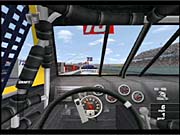
You'll officially finish Dirt to Daytona if you place first in this series, though this is no easy task, because of the time commitment involved. It's possible to place first in any of the four series in only a single season, but it'll likely take you numerous seasons to do so. Additionally, just because you move up to, say, the Craftsman Truck series, that doesn't mean that you can simply ignore your commitments to your Weekly Racing and Featherlite Modified sponsors. Your garage can hold four cars, one for each series, and you'll be expected to participate in all the racing events that pop up on your calendar, even when you've advanced all the way to the Winston Cup. The game can track your stats for up to 30 seasons of racing, though only the most dedicated racing fan will keep playing Dirt to Daytona's career mode after successfully finishing the Winston Cup series. For the rest of us, the game also has all the single-player modes from last year's NASCAR Heat 2002, including the memorable "beat the heat" races, which challenge you to outperform one of NASCAR's top drivers in about 30 different scenarios. As you'd probably expect, there's also a quick race mode and a championship mode that'll let you race through any one of the four series without having to worry about the other three or having to fool around with sponsors. The game also has support for up to four players simultaneously, though a Multitap is required to play three- or four-player games.
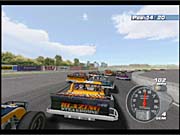
Like its career mode, the game's graphics are impressive. Dirt to Daytona clearly goes for a photo-realistic look instead of a stylized one, and it generally succeeds in doing so. The car models all look exactly like the ones you see on TV during the race weekends, and the game's tracks look just like their real-world counterparts. The game does have some instances of some minor slowdown, though it crops up very infrequently, and only when a full field of cars is clearly visible in front of you. Cars will leave skid marks after a particularly bad spill, and accidents always leave sheet metal and fiberglass bent and shattered. The sound is generally good, too, with each car's engine emitting a throaty growl throughout the entire range of the power band. There's no real variety in engine sound between cars in the same series, but then again, there isn't that much difference in real life, either. What's more, none of the secondary sound effects like tire squealing or collisions get repetitive.
Ultimately, Dirt to Daytona is a sound NASCAR simulation with one of the most robust career modes of any driving game to date. Its relative lack of licensed drivers and overly forgiving damage model might put off some of the more hard-core followers of this sport, but it shouldn't. Its career mode more than makes up for any perceived shortcomings by offering endless hours of play. Even if you bought last year's NASCAR Heat 2002, you owe it to yourself to check out Dirt to Daytona.
