Resident Evil Outbreak Online Hands-On Impressions
We take the Japanese release of the first online Resident Evil game for a spin.
When console franchises make their way online, they usually jump to a massively multiplayer format, like Final Fantasy XI, or they stay more or less the same as their offline installments with the addition of a multiplayer function, such as Bomberman Online. With Resident Evil Outbreak, it's the latter. The game keeps most of its fundamental aspects from previous releases in the series, such as the controls and basic gameplay conventions, and it adds in a number of new systems. Getting into Resident Evil Outbreak doesn't present much of a learning curve for experienced players, and Capcom has made numerous modifications to make the game suitable for online and team play.
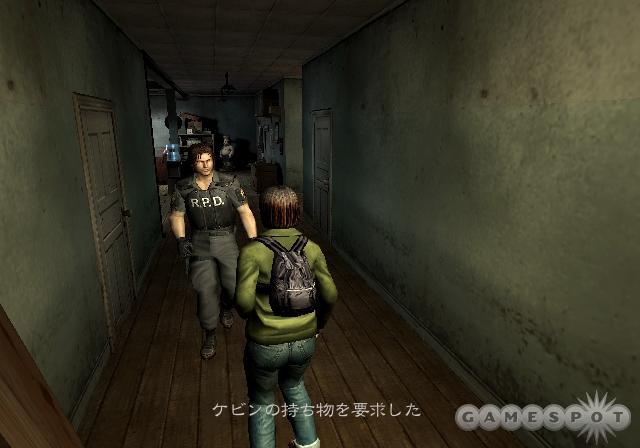
One of the fundamental changes in Resident Evil Outbreak is the structure of the game's scenario. Instead of having one main storyline, like in previous installments of the Resident Evil series, Outbreak is composed of five short stories. There doesn't seem to be any relationship between each of the scenarios, aside from the same theme--escaping from Raccoon City--which allows the stories to have a variety of unique settings. For example, one scenario is about escaping from a zombie-infested bar and riding out of the city with the cops. Another scenario is about getting out of a hospital, which just happens to be the hiding place of a leech man, who's more obnoxiously persistent than even Nemesis from Resident Evil 3. None of the stories are very long; they can be finished in about 10 to 30 minutes once you know how they work. Considering that the game is targeted at online play, it seems Capcom designed the stages to be played as single sessions, beatable in a short amount of time. In order to give the game replay value, Capcom has added a lot of unlockable bonus features, such as special costumes.
The characters in Resident Evil Outbreak are ordinary citizens, like a waitress or a plumber. This means that most of them don't have a gun at the beginning of the game, unlike the characters in previous installments in the series. Fortunately, it's not hard to find the weapons that are scattered throughout the maps, which can be traditional weapons, such as pistols and shotguns, or household items, such as broomsticks and bug spray.
The civilians' relative inexperience at fighting zombies justifies the game's focus on cooperation, but the characters in Resident Evil Outbreak aren't really inferior to the fighters from past games. They can tackle zombies when they don't have any weapons, eventually make the zombies fall to the ground, and then kill the zombies with enough stomps of their feet. Each of the characters also has a couple of specialties, one for use during combat and one for normal use. For example, the reporter, Alyssa, has a lock pick that can be used for opening locks without a key, and she also has a sharpshooting skill that causes extra damage when she's using a gun.
The inventory system has changed significantly. Aside from Yoko, who has a backpack to keep additional items, the characters can only hold up to four items, and the storage chests seen in previous games have been eliminated. These changes were made to encourage player cooperation; you must hold onto items for one another. A number of other changes have been made to the gameplay to allow players to help each other out, which seems to be the key to Resident Evil Outbreak. You can give or ask for an item by selecting the item from the inventory window. This window displays the inventories and health conditions of all the partners who are nearby, so it's easy to figure out who has something that you want or who is in need of an item. But the game moves in real time while the inventory screen is open, so you need to be careful that an enemy isn't nearby when you're giving or trading items. You can also lend a hand when a partner is hanging off a ledge or getting bit by a zombie, and you can also carry a partner around when he or she is limping from damage.
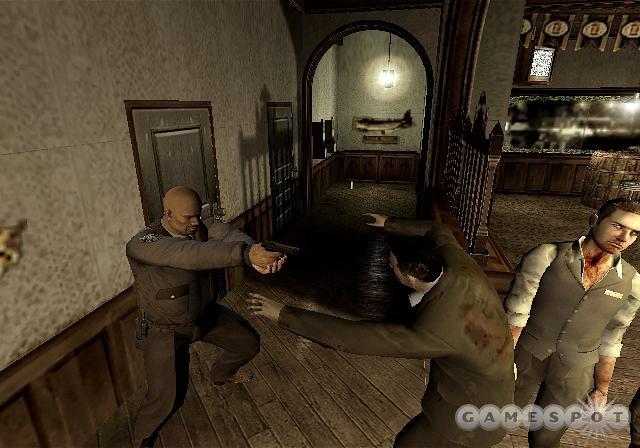
To further create circumstances for cooperation, Capcom has made the player characters in Resident Evil Outbreak more resistant to damage than in previous releases. While the characters go limp as easily as in previous Resident Evil games, they don't die right away after they take too many hits. They continue to stay alive, though in a crawling position from which they can't open doors, attack enemies, or pick up items. A partner can help a player to recover from this position simply by lending a hand and pulling the player back up, in which case the player will return to the limping position again.
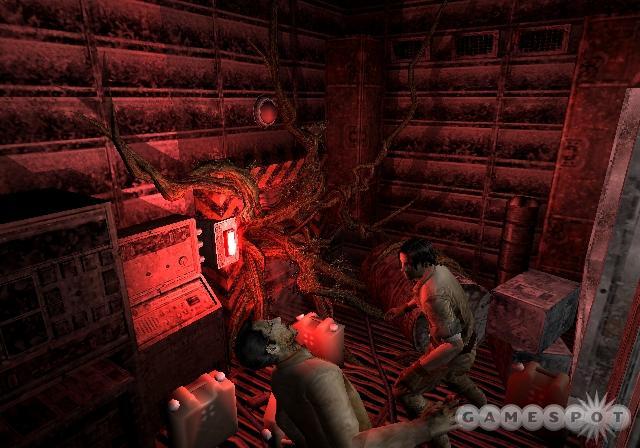
However, the citizens of Raccoon City don't seem to be as resistant to virus infection as the main characters in previous Resident Evil releases. In a new twist for the series, Resident Evil Outbreak implements a "virus indicator," which starts counting from the beginning of the stage and runs like a time limit. The virus indicator runs constantly, and the infection increases when you receive damage from the zombies. When the infection reaches 100 percent, your character dies and the game is over. There's a little bonus if this happens in online mode, since you get to control the character as a zombie and can attempt to attack your former allies. But the transformation to a zombie is relatively insignificant to the gameplay, since the time span during which you can control the character is short, the zombies are slow and weak, and players often turn into zombies together. The transformation to zombie usually happens near the end of a stage, around the boss battle, when your infection reaches its limit from the progress of time and accumulated damage.
Communication in Resident Evil Outbreak is accomplished by using a list of command presets that can be executed with the combination of the right analog stick and the L2 button. The commands are limited to very basic phrases like "Go!" or "Thanks!" and can be specified together with character names. When you're playing offline with computer-controlled partners, the orders are pretty important since they're the best way to make the computer characters do what you need them to (especially in terms of making them follow along behind you). While the computer-controlled partners have enough sense to help you out when you're attacked by a zombie or crawling on the ground, they're rather incompetent in general. They often wander around aimlessly, sometimes even into areas that haven't yet been unlocked.
In our experience with the online mode, most players are usually competent enough to know what to do in different situations, so the commands are used more often to call out a player's name when there's an item to give to him or her and to reply back with gratitude. Resident Evil Outbreak doesn't allow messages to be typed midgame, so it's important to make plans in the lobby if you are thinking of going through a stage in a certain fashion. It's also easy to get lost, since partners aren't visible on the map screen unless they're close by and talking, which adds some extra atmosphere as a survival game but also comes as an inconvenience. With good partners and communication prior to starting the level, each member can solve a different area, so you can clear a mission in less than half the average time. You can also challenge the game in unusual ways that just aren't possible with computer-controlled AI, such as going though the stages completely bare fisted, lynching zombies from all directions when they appear, and lunging at the doors together to break them open instead of using keys.
One of the interesting points about the communication system is that there's an "ad lib" option (which you activate by pressing the square button), which is supposed to let characters give hints for solving parts of the game. Instead, it mostly makes the characters swear excessively. As understandable as it is in a situation where there are lickers and hunters chasing you, it's amazing how many dirty phrases come out of this button, at least in the Japanese edition of the game. "Son of a bi***!", "S***!", "Kiss my a**!", and a number of other phrases are repeated by the characters in English voiceover by pressing the ad lib button, and they get translated textually into more subtle Japanese phrases such as "That's impossible!" or "I guess I've been unlucky!" It isn't hard to imagine that these parts of the game will be censored in the American edition.
In terms of unlockable secrets, Resident Evil Outbreak has the largest collection of extra costumes so far in the series: 31, to be exact. Some of them give the characters a new look, while others make the character models playable with non-player character skins, such as a laboratory worker who gets killed during the game's intro. There's also a ton of demo movies and CG portraits that can be uncovered. Infinite ammo, a traditional bonus in the Resident Evil series, is also available. Secrets unlocked during the game can be viewed from the "collections" menu in the title screen. But the unlocked secrets need to be purchased like an item before they can be used, which requires gameplay points that can be accumulated by playing through the stages.
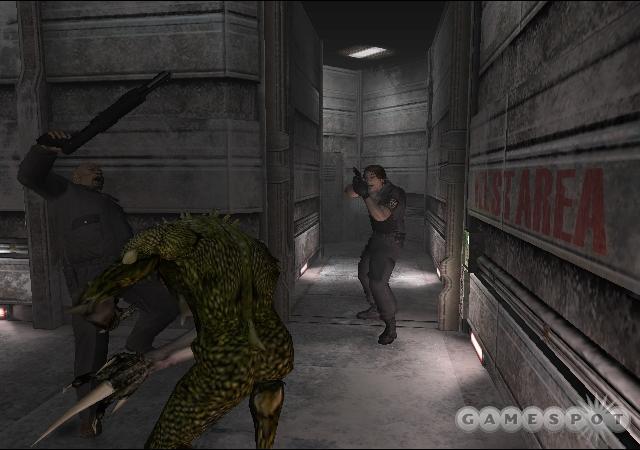
A key issue in playing Resident Evil Outbreak is that the game loads really slowly in DVD mode. This problem can be solved by installing and playing the game via the PlayStation 2 hard drive, but there's still some noticeable load time even when using this add-on. The real-time backgrounds may be the reason for this, although each room in Resident Evil Outbreak is relatively small in comparison to those in previous games in the series. Although the game is rendered in real time, the camera angles are still fixed, like in previous series installments.
While Resident Evil Outbreak is enjoyable in both its offline and online modes, the rather short length of the game may turn out to be its biggest drawback. Outbreak probably has as much volume as a full-scale Resident Evil release, but it feels like less because the game consists of five different and relatively short parts rather than one large scenario. Hardcore series fans who were waiting for a new adventure may find Resident Evil Outbreak a bit too short to satisfy their tastes, and online gamers will probably have played the game out in a month or so. It would help if new stages were released as update patches, but no major updates have been released during the past two months that the game has been operating in Japan. On the other hand, Resident Evil Outbreak is probably a good entry-level game for newcomers to the series, especially considering the ease of play on its lowest difficulty settings.
Got a news tip or want to contact us directly? Email news@gamespot.com
Join the conversation