As much play as "tycoon" has had in PC game titles over the last few years, it can be easy to forget that the term had another life before defining a game genre led by mass-market bestsellers like RollerCoaster Tycoon and Zoo Tycoon. Railroad Tycoon 3 can claim an older and more authentic tycoon heritage as much because of the series' more than decade-long history as the fact that it deals directly with the cutthroat business practices of 19th-century industrialists like Cornelius Vanderbilt and his ilk. While it builds on nostalgia for powerful steam locomotives and for earlier days when the business landscape was wide open and ripe with opportunities, it's even more than that, with missions that span two centuries of railroading. Even though the impressive new 3D engine makes the trains plenty interesting to watch as they roar by, this isn't a strict simulation for train lovers so much as a strategy game of business and building challenges. But as such, Railroad Tycoon 3 is a breeze to get into and will offer anyone hours of enjoyment.
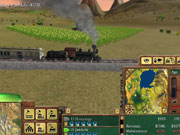
Railroad Tycoon 3 covers a lot of ground without miring you in details best left for unseen assistants. With a design that streamlines a big chunk of micromanagement, it's big-picture time and the task at hand is laying down the background for industrial progress. There's no need to have played PopTop's Railroad Tycoon 2 from 1998, but those who have will--after the shock of the major graphics overhaul wears off--quickly notice that managing cargo loads is much simpler. There are also many more industries to build in the extra time freed up by not micromanaging payloads, and structures can be placed anywhere on the map and not just in the station. These changes, plus enhancements to the economic model, work to create better pacing and a more interactive world.
The typical scenario has you founding a company with your limited start-up funds. Gradually, over the course of 20 or 30 years, you connect the towns and cities of major regions from around the world. You can play in specific time periods, like the pre-industrial Midwest, Texas at the tip of the oil boom, or modern Europe during the last decade's reunification. Of course, you're not alone in trying to reap the financial windfalls of having a transportation monopoly, and computer players will race to grab prime routes and cut into your profits. Fighting back--on the tracks and on the stock market--is a natural part of the tycoon legacy. A dynamic economy ups the ante, with boom and bust cycles and the appearance of new industries you can buy up to diversify and create more business for your trains.
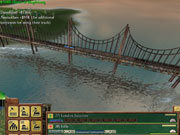
Laying track is the first and most important step of the game. It's intuitive enough that routes should connect cities that are full of goods and passengers in need of transport. Unfortunately, things like hills and rivers often get in the way. Taking geography and efficiency into account is what makes the seemingly simple task of connecting two points a satisfying challenge. In a process that a two-part tutorial effectively walks you through, the interface makes it easy enough to drag track from one point to the next. Before you release the mouse button to finalize track construction, the critical element to watch is the color-coded elevation guide that marks the grade from green to red for every track segment. Naturally, flat track is fast track. The great news is that there's an undo button. This all-too-rare feature can really save your bacon and keep you from wasting money you don't have when navigating difficult terrain. Also in your construction toolbox are options for double track, electric track, and buttons that regulate the frequency that tunnels and bridges appear on track as you drag it over obstacles. Building can be an intricate process of trial and error in hilly regions, but the reward of zooming in the camera and turning on the grid overlay is a faster route and bigger profits.
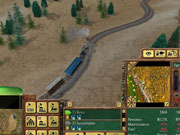
Track isn't much good without trains. Depending on the time period and country, scenarios can offer a dozen different steam, diesel, and electric locomotives, with some appearing or becoming obsolete as the years progress. You can have quite an assortment running on a large network, picked for different purposes. Fast trains are great for time-sensitive express cargos (passengers and mail), since speedy deliveries end up making you more money, and people pay more for elegant-looking trains. Yet, other engines will be cheaper to buy or maintain, are more reliable, and/or are better at climbing hills. Trains can also now have up to eight cars, and some engines are better at hitting close to their top speeds with heavier loads.
The bulk of the money to be made comes from setting up smart routes with the right match of locomotives and destinations. Payloads don't just magically appear. Passengers and mail now have specific destinations and will only be available if your rail network connects where they want to go. Since express cargos pay well, that's a reason to not only expand beyond a few industrial centers but also to connect to competitors' track. Another major change is that raw materials will now move (slowly) overland and along rivers, even without train connections, so you don't necessarily have to worry as much about getting the basics to towns where they can be processed into more lucrative goods. While building stations in the middle of nowhere just to pick up cattle or grain might have been an ordinary practice in the previous game, that's mostly a thing of the past. What underscores your role in a region's growth is that cities grow dynamically in response to the actions of you and your competitors, adding both population and new businesses. Cities are also somewhat randomized every time a map is played, and many scenarios include historical events scripted to radically affect the economy, though they mostly reflect technological change.
To put your tycoon skills to work, there's a campaign with 16 missions and a number of stand-alone scenarios, plus a sandbox mode that drops the financial part of the game to focus purely on building. The "campaign" is essentially a launch pad for the missions. The notion is that of a train museum with a helpful elderly curator who colorfully narrates the transition between four mission sets and also narrates cinematic intros for each map's setting. There's nothing to stop you from playing the missions in any order, or skipping the tutorials, but following the prescribed order does make for a gentler introduction. Except for the last three futuristic scenarios that use radical geographic and climatic change to create some odd, artificial challenges, all the maps are solidly grounded in historical moments, putting you in charge of: the Central Pacific's push to connect the Transcontinental Railway, the Orient Express, and turn-of-the century efforts to build a route across Africa.
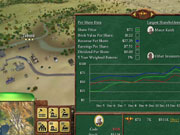
While you'll master the intricacies of building track, reading industrial supply and demand, and routing trains within a couple of missions, the variety of goals keeps things interesting as you progress through the campaign, and there's the chance to win silver and gold medals by meeting stiffer challenges. The goals for all three medal levels are established in the briefing and can be as simple as connecting two distant cities, at the bronze level, or as significant as acquiring all other companies and gaining huge personal wealth, at the gold level. There are even a couple of purely tactical missions, where no building is allowed and time is counted by minutes and days rather than months and years. An early example of this has you running deliveries for the military in the days following Pearl Harbor, and it takes careful planning and manual one-off routes to gather up the goods from cities across the eastern seaboard. You can easily monitor your progress toward medals in a ledger that is thick with statistics. This ledger is also handy for singling out underperforming trains.
Only some mission goals require you to play the stock market, but the huge funding requirements of building a major railroad will likely push you to the financial markets at some point or another. Running a two-town line won't hold your interest for long. For big cash infusions early on, there's the bond market to turn to, but not only will the spigot turn on and off depending on your credit rating, the interest payment can weigh down a young company. As in the previous game, there's a stock market that dynamically follows the fortunes of the railroad companies and the economy at large. It can be as rewarding as it is risky to buy on the margin or sell short, and hostile takeovers of a company with cheap stock are possible. General economic cycles and random events can have a major effect on how much cargo there is to move, thus influencing your bottom line. Since you don't have to deal with cargo on the level of buying low and selling high--the automated system does that now, with some settings to tweak--it's possible to run the game at higher speeds to see changes happen more quickly. There's also plenty more time to look for prime investment opportunities in businesses, which can be purchased much more cheaply in cities without a train station. These business can then be connected to your rail empire.
Railroad Tycoon 3's graphics reflect how far things have come in the last five years. The 3D engine is capable of smoothly zooming from a distant regional map right up to close-ups of the trains. Picturesque hillsides are covered with trees, plains are dotted with farms, and the water along sea- and lakeshores gets the modern dose of undulating and reflective effects. There's also a day and night cycle and some weather effects thrown in for good measure. Yet, what's most surprising are the relatively low system requirements, since the game ran nicely at 800x600 on a 1GHz Pentium III with a GeForce4 Ti card, which is still quite a bit above the 400MHz processor listed as the minimum requirement.
The sacrifice for supporting such a range of systems does seem to be that towns are represented as fairly sparse groupings of houses, commercial buildings, and businesses. The largest modern cities feature just a couple of dozen structures. However, considering the game's scope, this and other quibbles about visual realism don't ever get in the way of the feeling that you're running a powerful rail company. Though there's an overlay or two that's hard to read at first, the overall presentation is refined, and the flavorful voice-overs and cinematics definitely help establish the historical setting. At the same time, the nostalgic tone fits the early scenarios better than those set during recent or future years. On a related note, the musical score is narrowly focused on American folk traditions, with plenty of harmonica, fiddle, and banjo tunes to add old-time railroading atmosphere. The game includes 90 minutes of music in MP3 format, but you might not notice there's that much, since it's all of similar style.
Railroad Tycoon II benefited from a fan base that produced plenty of downloadable scenarios, and we can expect similar things from the new game, which has editing tools built in. Between this and the fact that there are four levels of difficulty that tweak the economy for or against you, the game should have plenty of longevity. That's not even considering the fact that the multiplayer component features a built-in game browser, which makes it easy enough to find players online. Take note that the multiplayer mode makes some conspicuous changes to the game, removing the very useful undo button and the bulldozer tool, presumably to avoid competitive exploits. Not only does this mean that games can be filled with odd track configurations from various players' track-laying attempts, but it can seriously aggravate any mistakes, lag, or odd track tool behaviors.
Never has there been a tycoon game this visually attractive or effectively designed to minimize micromanagement. Railroad Tycoon III is surprisingly easy to learn for a game of its scope, and it has something for anyone with a fondness for trains or for making loads of money--which means just about everyone.
