Act of War: Direct Action Q&A - Overview
Atari senior producer Henrik Strandberg tells us what to expect from this "technothriller" strategy game.
Real-time strategy games used to come in two flavors: the kind with elves, and the kind with tanks. Both kinds involved rushing to collect the most resources, construct the biggest base, and churn out the largest army. But recent real-time strategy games are attempting to break with tradition. For example, consider the upcoming Act of War: Direct Action from Atari and Eugen Systems, a game that will focus on a near-future "technothriller" conflict--the kind that involves international conspiracies, political intrigue, covert military operations, and motion-picture adaptations starring Sean Connery and/or Denzel Washington. In recent years, this kind of fiction has been popularized by authors like Tom Clancy and Dale Brown--and the latter is actually contributing to the game's development. We sat down with Atari senior producer Henrik Strandberg for more information. Be sure to watch the new trailer video as well.
GameSpot: What's technothriller-author Dale Brown's involvement with Act of War? How'd he get involved with the project, and does the game have any ties to his novels?
Henrik Strandberg: We recognized early on that in order to realize our vision for the game, we'd need to collaborate with an established military expert, as well as someone who knows how to tell an entertaining technothriller story, so Dale turned out to be the perfect choice. Together, we worked out what a plausible near-future universe could look like, how someone could manipulate this future universe for his own interests, and how "the good guys" could respond to such a threat.
Our screenwriter, Susan O'Connor, then translated this "story kernel" into a 50-page screenplay and about 2,000 lines of in-game dialogue, and Alexis [Le Dressay] at Eugen used it to create his mission designs, while Dale went his way and fleshed it out into a 400-page novel (which is also due out next spring). So while the two stories coexist in the same universe, covering the same chain of events, we recognize these as two completely different media that need to be treated differently. So the book isn't based on the game or the other way around--it's all one big live entity.
In addition, Dale has been helping us get all technical details right, the dialogue authentic, the near-future technology believable, and so on.
GS: Tell us a bit about the single-player campaign. We understand that there are three factions that you can play. What are they? And how many missions are we looking at?
HS: In the single-player campaign, you control the task force Talon, a "direct action" team (the opposite of covert ops) reporting directly to the US president. These are the guys who have access to all the really cool high-tech stuff. In most scenarios, they're supported by the regular US Army, which uses a mix of weapons and equipment that's been around for a while and stuff that's kind of experimental.
The "bad guys" are a mix of terrorists, mercenaries, and locally recruited military units, and they use a wide variety of existing, mostly non-US hardware and experimental high-tech stuff. Of course, both sides have their own strengths and weaknesses so they're balanced in multiplayer.
There are 14 chapters in the single-player campaign, each with between one and four missions.
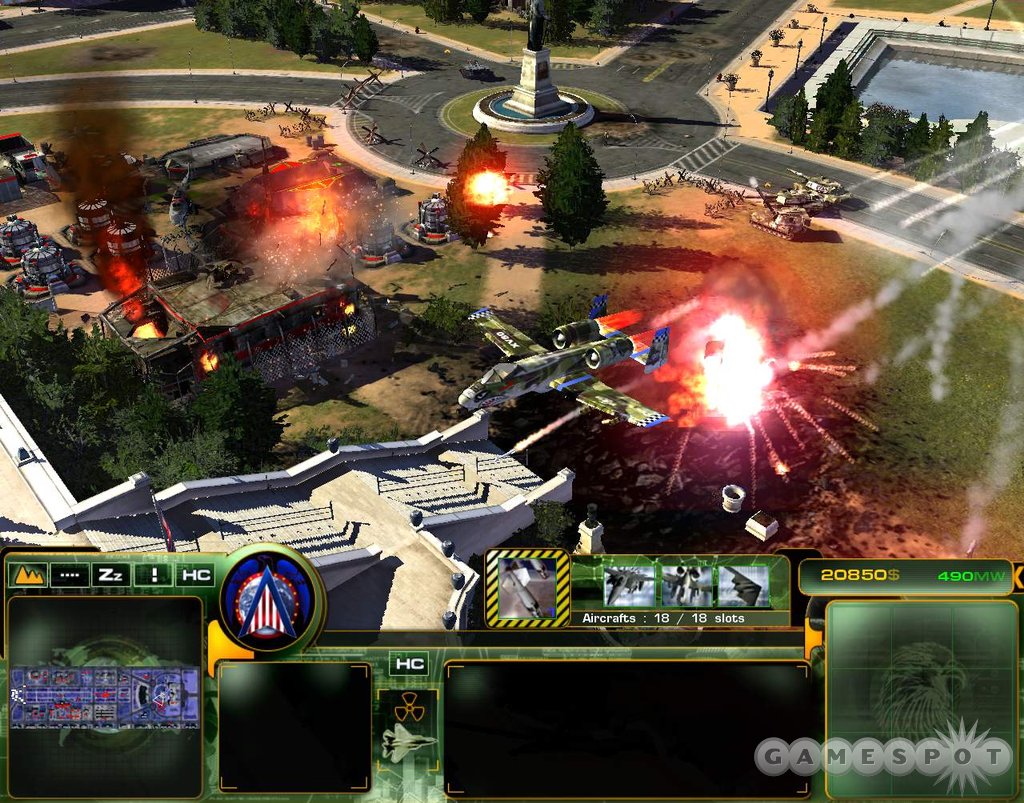
GS: We've seen the impressive Washington, DC, level, where your forces battle it out just blocks away from the Capitol building, but what other locales do you have in mind for the game?
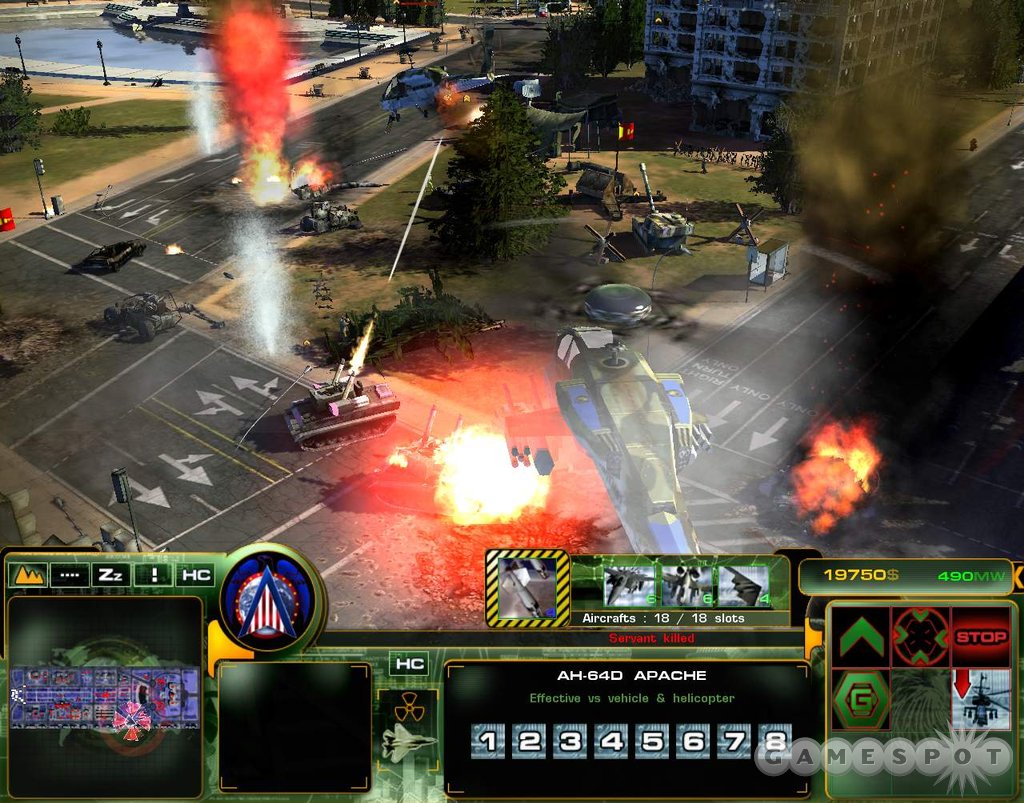
HS: Act of War: Direct Action is a global technothriller, so the story takes you around the world, from North Africa to the UK (London) to the US (San Francisco) and back to Africa (Egypt), and then on to Russia before you return to the Washington, DC, level you're referring to.
GS: We know that Act of War will involve constructing bases and building units, much like a traditional real-time strategy game. Oil is one of the resources in the game, but are there any others?
HS: Oil is basically just used to get you started quickly and to provide a familiar setting to real-time strategy fans. What really makes the difference are what we call "human resources," such as prisoners of war and other noncombatants (downed pilots, stranded tank drivers, unarmed noncombat personnel operating the enemy bases, and so on). Capturing these, and ensuring the opponent doesn't capture yours, makes all the difference. For example, capturing one POW awards almost as much money as a full tanker truck, and a prison camp with 10 prisoners generates more money than an oil well, and is an infinite resource.
Secondly, your troops earn experience, which makes them considerably better in battle, and ensuring that you don't lose experienced troops to the enemy also makes a big difference.
This Means War
GS: You can interrogate prisoners of war in the game, and the enemy can interrogate troops that it captures. How does this prisoner feature work, exactly?
HS: Interrogating a POW basically reveals an area of the map that's otherwise concealed under the fog of war, which is vital information before you launch an attack, of course.
GS: Act of War will feature modern-day real-world equipment and futuristic, hypothetical weapons. We're familiar with weapons like the M-1 tank and Apache helicopter, but what are some of the new weapons in the game?
HS: We have worked with Dale to come up with a nice variety of contemporary, experimental, and conceptual near-future technology in the game, to create a realistic projection of what a near-future battlefield could look like. A "first look at tomorrow's war," if you like, that is reflected in air and ground units, in vehicles and infantry, and in tactical weapons and strategic technology, but with some creative license thrown in.
Here are some examples of the equipment in the game that exists today only as ideas, concepts, and prototypes: the remotely controlled multipurpose "spinner" drones, which can be customized for use as reloadable bomb drones, or as antitank or antiaircraft drones; the "SHIELD" units, which are basically combined infantry-personal-protection suits and weapons platforms ("mech units," if you like); and stealth vehicles that use optical camouflage technology, as well as technical detection-prevention devices, sort of like James Bond's invisible car. However, this isn't science fiction. The technology exists--in theory, at least.
GS: What will multiplayer be like? How many players will it support, and what kind of game types?
HS: Up to eight player slots can be configured to basically any type of last-man-standing game. All slots can be either human or any of four AI difficulty levels, and you can configure team alliance in any way. As an example, our current favorite is playing with two player teams against one team with three hard AIs. The two human teams have to cooperate in the beginning to withstand the AI's attack, but once one AI opponent has been destroyed, it's just a matter of time until one player turns on the other, and if both human players try too hard to maneuver into position to deliver that killing blow, the AI will come back with a vengeance. These games last way longer than the oil on the map, and the AI, with its split vision, is much better at managing its human resources, so it's a formidable opponent even without cheating.
GS: The game looks very sharp. What kind of graphics engine is it using?
HS: We use a proprietary engine custom-developed by Eugen for Act of War: Direct Action, and it relies heavily on shaders and other technologies you normally mostly see in shooters. Various texture-compression techniques also allow us to have more, bigger, and more-defined textures than most other games, which makes a huge difference. But what makes the game so impressive is the sheer amount of polygons we can throw at it--up to 5 million per level, which lets us build massive yet highly detailed levels. This is why we can have two to four missions on the same huge map without any interruptions for loading.
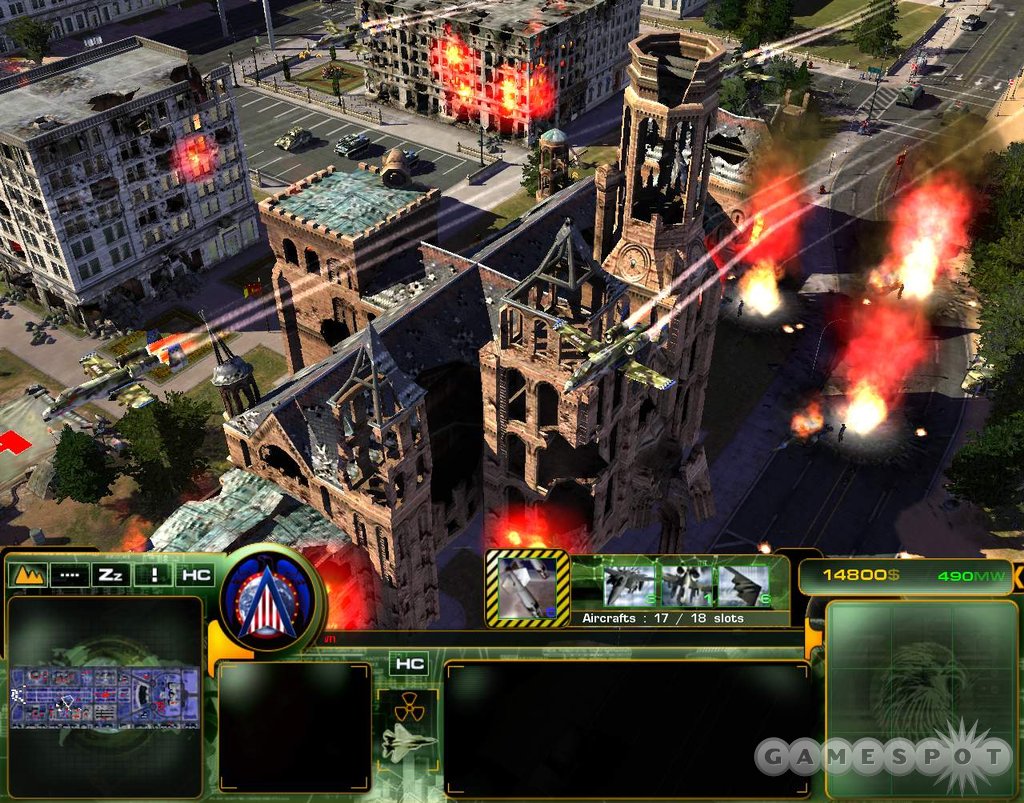
GS: There's a lot of urban warfare in the game. We understand that architects were even consulted to get the interiors of buildings correct. How will the game handle room-to-room combat?
HS: The developer, Eugen Systems, was founded by a systems engineer, Cedric Le Dressay, and his brother Alexis, who's an architect, and they've brought many practices from their previous careers into the development of this game. One that we've already covered is the sense of scale and attention to detail in lighting and architecture in these massive urban environments, but their development processes are also quite different from what I'm used to from my previous 15 years in the industry. And as you can see from the screenshots, the results speak for themselves.
GS: Do you have any memorable moments that you've encountered so far in the game?

HS: For me--for many reasons, but mostly personally--the most memorable moments in the game are definitely from the live-action cinematics, which were shot during a couple of very intense weeks this summer. It was just amazing. We were up to 100 people working on the sets or the locations, from the director and the actors and camera crews, all the way to extras, caterers, carpenters, makeup artists, costume crew, and so on. You'll see some of the fun we had in the "making of" videos, but it was just an unforgettable experience to be part of this film crew for a couple of wonderful weeks.
That's also what I believe most players will remember after having played Act of War: Direct Action--not the cinematics themselves, but the whole presentation and the way interactive and noninteractive content is interlaced to create this technothriller suspension of disbelief that lets players mentally travel into this near-future world, feel what the characters feel, and even feel like some of this could actually happen.
GS: Thanks, Henrik.
Got a news tip or want to contact us directly? Email news@gamespot.com
Join the conversation