These days, if you're a fan of the sport of hockey and video games, you're living the good life. Developers have been upping the ante on their hockey titles far more substantially in the last few years and are really working hard to make their NHL titles better so they can compete with the NFL, NBA, and MLB offerings. One of the main causes for this increase in quality hockey titles is competition--or a sudden appearance thereof. EA's long-running NHL franchise has always been successful, but last year, Sega finally brought out an NHL title worthy of competing with EA's in NHL 2K3. This year, both companies have clearly worked hard at improving their respective games, each trying to get an edge over the other. ESPN NHL Hockey is the latest in Sega's series, and, for all intents and purposes, it is simply one of the best hockey games ever designed. EA's answer to ESPN is NHL 2004, and, in a few fundamental ways, the game actually does manage to beat out the opposition, though ultimately it falls a bit short of being the best overall package. It's still a really great hockey game in its own right, though.
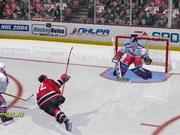
If you've ever played any of the EA NHL games, you'll feel pretty well at home with NHL 2004. Most of the basic controls are the same, but there are a couple of welcome additions. Last year's game introduced the concept of right-analog deking, which lets you dodge and weave between defenders by moving the stick however you may need to. Now, you can use the right stick to check players as well. When on defense, simply skate up to the player you wish to check, and then tap the stick in his direction. Depending on how much momentum you've built up, you can either shove the opposing player off the puck, or you can absolutely crush him into the boards. This checking system does take a bit of getting used to, as you have to be pretty precise in picking your directions for a hit. Overall it works very nicely. Of course, you still have the option of using button-based checking as well.
The other new addition to NHL 2004's control scheme is two-button passing. With two-button passing, you can either use a standard pass, or you can use a saucer pass to get the puck to one of your teammates. Saucer passing is useful for getting the puck past defenders, as you can lift the puck off the ice and over an opponent's stick. It's a little looser than a standard pass, but, ultimately, it should be. It's really a great addition, especially when you consider how hard standard passing can be. You have to be very precise in your choice of directions and in the level of power you put behind passes, as defenders are very quick to intercept even slightly mistimed or misdirected passes. Saucer passes still require pretty precise timing, but, directionally, you have a bit more freedom.
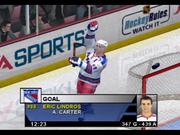
Another aspect that EA greatly endeavored to upgrade in this year's title was the overall grittiness of the sport. They have done just that! NHL 2004 is a brutal game of hockey, through and through, with bone crunching checks and a greatly improved fighting system. The right analog checking really helps in terms of making it a little more free-form and not restricting you to hitting whoever happens to be right next to you. There's more to it than this system, however, as the game features a gaggle of new hitting and checking animations that are superbly realistic. In fact, every time you send a player crashing to the ice or when you get sent there yourself, you definitely feel it.
As far as the new fighting system goes, it's easily the best around. Hockey fights are sort of a tough thing to re-create, as most of them usually just involve a couple of wildly thrown punches, teamed with a lot of jersey pulling and falling down. In terms of video game fights, most systems have been a total joke. They usually ape standard fighting games and end up looking like matches between a couple of Rock'em Sock'em Robots. The new fighting system, developed for NHL 2004, emulates realistic hockey fights but without all the falling down.
Essentially, fights occur based on how agitated a player is. If your team is losing, getting knocked around a lot, or is generally in a bad place, eventually one of your tougher players will become enraged to the point of wanting to fight. When that happens, you can either choose to ignore the fight, or you can engage in it by pressing the select button. Once that happens, the two players throw off their gloves and lock in a grappling stance. During the fight you're then able to punch high, punch low, block high, or block low. Keep in mind that a lot of the fighting is timing based. Block at an inopportune time or place, and you'll get walloped. Likewise, try to throw too many punches, and you'll get blocked and immediately nailed upside the head. All told, it's actually a pretty well done system, and the option of engaging in or ignoring fights is really useful if you don't feel like breaking up the flow of the game.
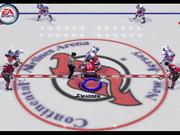
NHL 2004's player AI is also a big improvement over last year's problematic AI, which didn't really have much going on in terms of the defensive game. This is definitely not the case anymore. On either side of the puck, CPU players are a whole lot smarter this year and are especially more adept at breaking up your plays and keeping you from getting a straight line to the net. This does make the game quite a bit more difficult than you'd expect, and, even on the default difficulty, it'll likely take you a while to get accustomed to having to deke past some really tough defenders. On the flip side of the coin, it'll take a while to get accustomed to keeping opposing teams from just blazing right past you and setting up easy one-timers for the score.
You can't hang all of NHL 2004's relative difficulty on its AI though, because, really, a challenging game is always better than an unchallenging one. Ultimately, even if the game's AI were much easier to deal with, you'd still have trouble creating big plays--mainly because it can be very hard to handle the puck. Obviously, since you play hockey on ice, puck control is difficult to begin with. However, in NHL 2004, it's a little too easy to just have the puck slide all over the place. Players periodically skate right by the puck, missing it altogether. As mentioned before, passing is also quite difficult, so the combination of difficult puck control and precise passing makes it a tough task to create any kind of play. Ultimately, it's going to come down to whether or not you want to take the time to really master the system. It still provides great gameplay, but it's definitely not quite as user-friendly as ESPN's game.
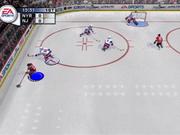
Where NHL 2004 truly succeeds is in terms of depth. Specifically, NHL 2004 includes a multitude of game modes. If you just want to play a quick game, you can simply choose the play now option. However, if you're up for a lengthier gameplay session, you can opt to play through a season, the playoffs, an elimination tournament, or the newly redesigned dynasty mode. This year's dynasty mode is easily the deepest ever designed for an NHL game, and it lets you take on the dual role of both coach and general manager for your chosen NHL franchise. At the beginning of the dynasty mode, you're told that your team's owner has fired most of the coaching staff and has sold off the bulk of the team's facilities. It's up to you as GM to rebuild the franchise--from scratch--and take your team to glory.
All of the usual conventions for a dynasty mode apply in NHL 2004, including player/CPU trading, free agent signing, roster management, and the like. However, duties are now split up between the GM and the coach. Coaching duties basically entail managing your team's lines, assigning jersey numbers, and monitoring the league schedules. The real bulk of the mode's duties lie on the general manager's side. Duties for the GM include signing, releasing and trading players, monitoring less tangible aspects (like team morale), and maintaining the day-to-day finances of the team. As you start your franchise from scratch, your players' morale generally tends to be on the lower side of the league, and, more often than not, they won't be playing to their full potential. To fix this problem, you have to upgrade your staff and facilities by gaining experience points.
Experience points are earned in the dynasty mode by initiating and performing transactions and making various business decisions. Simply winning games earns you a few experience points each time, but to get bigger additions to your GM's experience level, you need to make big trades, sign major free agents, do well in the NHL draft, and, most importantly, win Stanley Cups. Each time you hit a certain number of points, you earn a new upgrade for your team. Upgrades are split into two categories: staff and facilities. Staff upgrades include changes to your scouting, medical, coaching, marketing and legal personnel. On the facilities side, you're able to upgrade your equipment room, travel methods, team gym, practice rink, and locker room. Each category has its own specific advantage. For instance, upgrading your medical staff allows for a one week faster recovery period for injured players, whereas upsizing your practice rink increases your players' attributes for home games. As you go, you're also able to adorn your general manager's office with various rewards, like new furniture, carpets, and other items, to give your office a more personalized feel.
In the dynasty mode, you're also able to do things, like set dates and lengths for team practices, set ticket prices for regular season and playoff games, and sign TV contracts based upon how many superstar players you have on your roster. All in all, there's a whole lot to do in this mode, and it should keep players entertained for a long while as it does go for a full 20 seasons. However, if there's one complaint to mount against this mode, it's that you always start out in the dredges of the league. While it's a lot of fun to try and build a team from the ground floor, sometimes you might just want to leap right in with a team that's already good and just dominate for as long as the mode will allow. Perhaps an option to turn off the experience-building system might have been a nice touch, but, really, this is only a minor complaint in the grand scheme of things. It's still a really great and deep dynasty mode.
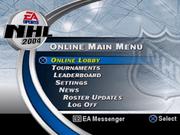
NHL 2004 supports exclusive online play for the PlayStation 2, and it offers all of the benefits featured in the rest of EA's current online lineup, including tournaments, voice chat, and downloadable content. After logging in to EA's servers, you're immediately able to jump into a game by accessing one of the available lobbies or by creating your own. With tournaments, you have the option of either joining an existing one or creating your own. When creating a tournament, you can determine whether you want it to be ranked on the leaderboards or not, how many teams you want (from four to 16), if you want unique teams to be allowed, the length of rounds (from one hour to three days), and whether the tournament is public or private. In terms of performance, nearly every game we played against an opponent with a decent connection speed was as smooth as smooth can be. There was no notable lag nor any drop-offs to speak of.
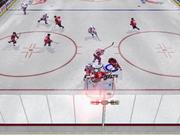
Graphically, NHL 2004 looks really spectacular--especially when it comes to animation. Hits are incredibly spectacular--particularly in those instances when someone gets knocked into the bench or gets absolutely leveled to the ice. The animation for skating is also extremely well done, and watching the players move up and down the ice looks amazingly realistic. The player models in NHL 2004 are also really great, with accurate body builds and very well-designed player faces. All of the game's arenas are designed with perfect detail and actually resemble their real-life counterparts. The crowd graphics are quite good--though the frame rate on the crowds is notably lower than the action on the ice, which looks a bit odd in certain camera shots. Additionally, the EA Sports style of presentation is readily apparent throughout the game, complete with all the slick menu designs and overlays that you've come to expect over the years. On the PlayStation 2, the game looks just as good as its GameCube and Xbox counterparts, with only a minimal amount of drop in frame rate and texturing, comparatively.
NHL 2004's audio presentation is also of excellent quality. Most of the in-game sound effects appear to be holdovers from last year, but, considering how great last year's game sounded, this is not at all a bad thing. Play-by-play commentary is still provided by Jim Hughson, but, this year, former color commentator Don Taylor has been replaced by Craig Simpson, a former NHL player and two-time Stanley Cup winner. While Simpson is definitely a better overall fit for the game, there really isn't enough of him to make an impact. He rarely says much outside of post-period summaries and makes occasional glib remarks about basic hockey strategies. Hughson is competent, though unspectacular. For the most part, he manages to be technically correct, but his constant over-emphasizing of player's names, along with the repetition of his lines, can wear thin pretty quickly. The game's soundtrack consists of a number of licensed artists, like the Deftones, The Ataris, Gob, Adema, and Alien Ant Farm. Though the songs themselves aren't necessarily a perfect fit for the sport of hockey, the soundtrack is consistent for its genre and, overall, works just as well as any of the other EA Sports games to feature licensed music.
To sum up NHL 2004, it's simply a great game of hockey. The new additions to the gameplay, all-new dynasty mode, and upgraded graphics all provide a really excellent experience. Additionally, the PS2 version's excellent online play bulks up its lasting value even more. Although the game does fall just shy of beating out ESPN NHL Hockey as the current champion of simulation hockey titles, any previous fan of EA's NHL series will find very little to complain about in this installment and should absolutely check it out.
