The once-peaceful land of Riviera has become the central battleground in the war between angels and demons, and, as tends to happen in video games, the only ones powerful enough to stop the fighting are a flirtatious fallen angel, four boy-crazy girls, and a talking cat. That's the premise underpinning Riviera: The Promised Land, a role-playing game for the Game Boy Advance that's as diverse as it is formulaic. However, the game ultimately exceeds expectations thanks to its engrossing story and superslick production values.
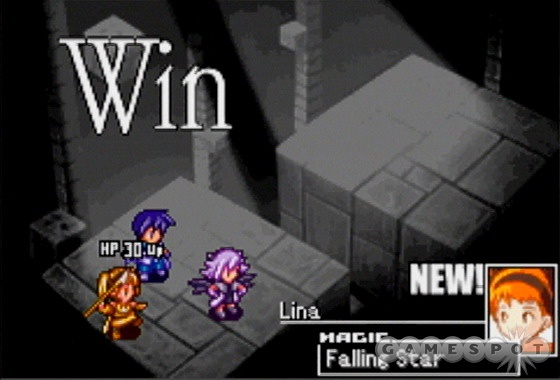
At its core, Riviera is a turn-based RPG cut from the same cloth as games like Final Fantasy and Golden Sun. Players set out with a party of five characters and wander the land defeating demons, all the while gaining new weapons, beefing up stats, and accumulating little bits of the story along the way. Fans of plot development will be in heaven with Riviera. There's text to read on literally every single screen. Also, many of the conversations and events in the game incorporate a Choose Your Own Adventure-style dynamic, where the choices you make influence the kinds of information you get and the places you can go. In fact, these choices even affect which of five possible ending sequences you see when you finish the game. Because of the game's T rating, Riviera is able to deal with concepts like death, betrayal, and right versus wrong. There are also a few mild sexual innuendos here and there.
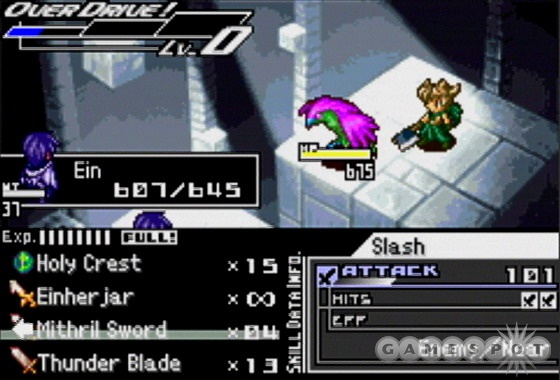
Riviera's gameplay is an interesting mix, because it borrows features from a variety of other RPGs, as well as from the strategy and dating sim genres. The movement interface has a point-and-click adventure vibe to it. Instead of walking everywhere, you advance to other areas and examine things by tapping the buttons that correspond to choices onscreen. The combat interface is the typical "pick an attack from a menu, and watch it happen" setup, but there are numerous strategy elements bookending the process. Before each skirmish, you have to pick three party members and four items to bring onto the battlefield, even though your overall inventory can hold five characters and as many as 15 items. You also have to set a battle formation, specifying which characters will form the front line and which will stand in the back. Each character has his or her own stats for traits such as strength, magic, defense, and vitality. Heroes and enemies alike also have weaknesses and resistances toward specific types of attacks. Weapons vary in terms of strength and range, and, in homage to games like Dark Cloud and Fire Emblem, each one breaks after a set number of uses.
The dating sim aspect isn't obnoxious, but it isn't subtle either. Frequently, you'll end up in situations where you have to favor one girl's opinion over another's. The sum total of these choices influences each girl's feelings about the male lead and mildly alters the dialogue scroll at the end of the game. If you play your cards right, you'll also get to see a few risqué hot springs scenes, which can later be reviewed at your leisure in the main menu's image gallery.
Level grinding is fairly important, just as it is in most role-playing games. However, Riviera puts a unique spin on the process. Instead of accumulating stats by gaining experience and leveling up, you build stats by mastering weapons. When a character uses the same weapon repeatedly (anywhere from two to 10 times), he or she will "master" that weapon. This has two effects. One, the character will learn an overdrive skill that can be used in battle. Secondly, the character's stats will increase. You'd think weapon mastery would be a difficult process, since weapons can break after so many uses. The game gets around this limitation by offering the player the opportunity to participate in so-called practice battles. You can select "practice battle" from the status menu to fight against previous enemies. In a nutshell, weapons don't lose endurance in practice battles, so you can build stats while saving your best weapons for the battles that count.
Even though Riviera's style of level grinding is very different from that of other RPGs, it's still just as time-consuming as the traditional process. In a game like Final Fantasy, you might have wandered around an area fighting random battles until your characters gained a few levels. In Riviera, every time you find a new weapon, you're selecting "practice battle" and gaining stats that way. Although the process is totally optional, you pretty much have to go through it if you want your characters to be able to handle the bosses waiting at the end of each chapter.
Longtime RPG players may find other things to complain about as well. There's the inventory system, which is limited to 15 total items, which sometimes forces you to throw away useful weapons and items. Then there are the Shenmue-style quick-timer events that decide what weapons you get and what paths are available to you. Key in the correct button combination before the timer runs out and you'll be able to access the library in chapter four. Fail and you'll have to proceed directly to the boss. Some people also may not like how streamlined the game is. Battles are prescripted, there aren't any side quests in the traditional sense, and you can't go back to an area once a chapter is completed. All in all, whether these things will bother you specifically is a matter of personal preference.
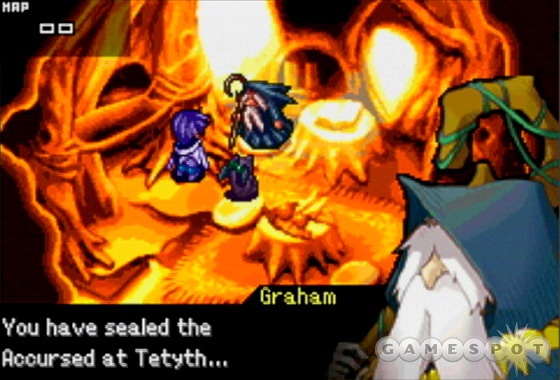
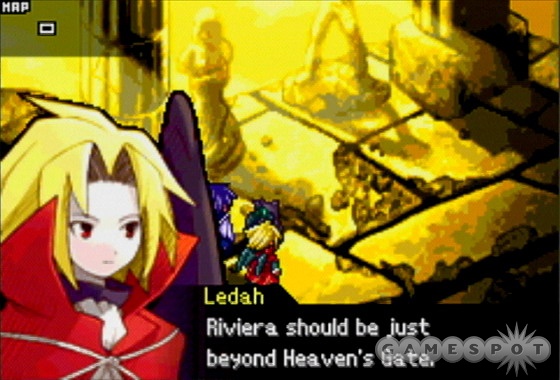
One fact is undeniable, however: Riviera's production values are through the roof. The visuals are gorgeous. Oh sure, the character sprites are the typical midget people you see in every game of this type, but they're colorful and stacked to the nines with animations for everything from attacks and victory dances to the hilarious reactions that happen as a result of various mishaps. Like Golden Sun, the heroes' overdrive attacks and the enemy's corresponding rage attacks often fill the screen with explosive sparks and other wow-eliciting visual effects. The hand-painted backgrounds are quite beautiful and detailed, even if they're also static and repetitive. Enthusiasts of the Japanese manga art form will be especially pleased with the game's cutaways, which are all drawn by hand and look like pages right out of a graphic novel you'd spend 20 dollars on at your local import-friendly bookstore.
As hot as the visuals are, the audio is absolutely on fire. There's a ton of speech in the game. The moment you power it on, a voice at the title screen greets you with "Riviera...the promised land." Throughout the game, there are all sorts of little voice clips that play during attacks, at the end of battles, and during certain dialogue scenes. And although the volume level is a little quiet, you can clearly understand what the characters are saying. The music is a high point as well. Beautifully composed, well-orchestrated, and catchy are just a few appropriate adjectives. Best of all, the instruments coming out of the GBA's speakers actually sound like real trumpets, violins, pianos, and so forth.
When all is said and done, it will take most people roughly 30 to 40 hours to finish Riviera. There are seven chapters in all, and, with practice battles factored in, a single chapter typically takes five hours to complete. Even once you've finished the game, there are numerous incentives to go back and replay it. The dialogue sequences you see, the weapons you get, and the paths open to you in certain areas are dependent upon the choices you make, as well as whether you successfully complete the quick-timer events that frequently occur. In that sense, the game won't play out the same for everyone, and it never plays out the same way twice. There are also five different endings to see and multiple extras to unlock, including a bonus chapter, a cutscene gallery, and music and voice test menus.
If you enjoy role-playing games, you really can't go wrong with Riviera. It doesn't necessarily bring anything new to the genre, but it presents a lot of the old concepts in unique ways, which is rather refreshing. It's also quite a spectacle to digest, thanks to the hefty narrative, gorgeous artwork, and masterful audio.
