History of Papyrus Racing Games
Papyrus Racing Games was recently shuttered, but its legacy as one of the genre's top developers will live on. Its games were so realistic that professional drivers often use their games to train for real life races. Get a peek into the history of the company in this special feature.
Design by James Cheung
See it in Action!
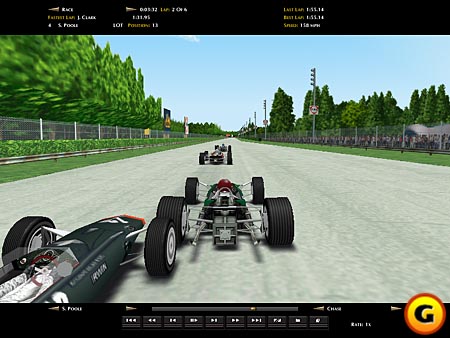
Papyrus' Grand Prix Legends is still considered to be one of the finest racing games of all time.
When Papyrus Racing Games released its final installment in the storied NASCAR Racing series in February of 2003 and was then officially shut down by publisher Vivendi Universal in May of this year, one of the most remarkable tales in all of computer gaming was seemingly brought to a disappointing and premature standstill. Rarely in this flighty, roller coaster industry has a single developer so mightily impacted its chosen genre. That Papyrus managed to survive for 17 years--an incredible stretch for a comparatively small design studio in a business increasingly dominated by heavily staffed juggernauts--was an amazing feat in itself. But mere survival wasn't the only plan in the Papyrus books. Changing the face of PC racing was its ongoing goal, and it was something the Boston-based company did very well throughout its entire run. Indeed, to say that the last decade and a half of computer driving would have suffered had Papyrus not been at the wheel is a serious understatement.
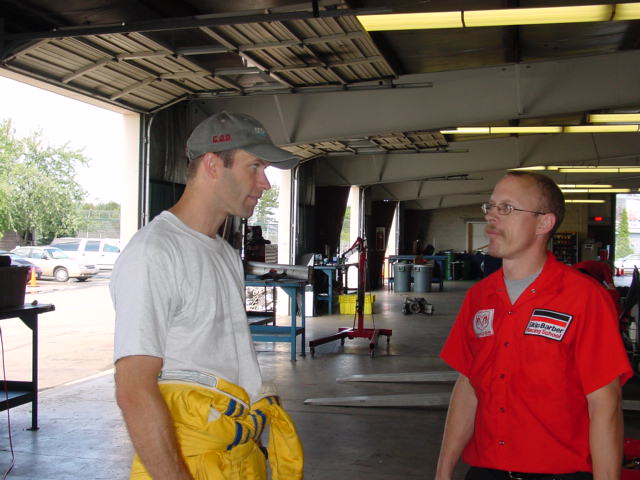
Fortunately, the standard-setting Papyrus racing concept is not as dead as some might think. In fact, as of this writing, founder and driving force David Kaemmer had just emerged from discussions with VU wherein he successfully recovered the rights to Papyrus' venerated racing simulation technology. If all goes as it should, that technology will resurface in the not- so-distant future within a different framework and under a different name. This is great news for fans of the ultra-authentic Papyrus style, and certainly worthy of the closer examination that we'll give it later in the article. In the interim, let's explore just what it was about this Massachusetts studio that propelled it from its relatively humble beginnings into arguably the most respected computer racing game designer in the world. Buckle up.
Born to Race
It was the mid-1980s and the home-based computer game business was still very much in its infancy. Hard drives had recently arrived on the scene, text-based adventures were commonplace, and PCs had only begun to hit the mainstream. Twenty-four-year-old David Kaemmer and his business partner Omar Khudari were fresh from a stint at an educational software company where together they wrote an instructional graphic adventure game for the Apple II system entitled "The McGraw-Hill Mathematics Solving Courseware," a product Kaemmer maintains was considerably livelier than its rather dry name might indicate. But recently, Kaemmer and Khudari found themselves deeply involved in something infinitely more interesting--something that held their mutual attention far more than a mere mathematics edutainment title.

Born and raised in Indiana, just an hour's drive from the storied Indianapolis racetrack, Kaemmer was drawn to the sport of auto racing at a very young age. His love of fast cars was almost obsessive, equaled in his teens only by an infatuation for the binary world of early arcade video games. Suffice it to say, Kaemmer lost more than his fair share of cash into one of the most notorious quarter-gobblers of the day, Atari's Pole Position. It was only natural then that as home computers began to filter into mainstream America, Kaemmer was an early convert. "I was probably one of the first people in west central Indiana to buy a Radio Shack TRS-80 Model I computer. My favorite program for the TRS-80 was 'Flight Simulator' from subLogic. I always wanted to figure out how to make a program that could draw a 3D image like that." When Kaemmer left McGraw-Hill in his early twenties, his two passions had already begun to overlap and integrate.
By 1987, with the McGraw-Hill game already behind them and firmly convinced the rudimentary action-oriented auto racing gaming scene of the time could use a heavy dose of authenticity, Kaemmer and Khudari formed Papyrus Design Group. On a conservative, realistic level, Papyrus operated primarily as a contract programming services company. Candidly, however, Kaemmer wasn't shy about his idealistic goal: to build the first truly authentic PC racing simulation. As Kaemmer now firmly maintains, only half-jokingly, "My partner Omar humored me by letting me write racing sims."

Yet there was little doubt in Kaemmer's mind where this whole thing was heading. He certainly had a plan. "It seemed to me at the time that the fan base for an arcade oval track game would be just about zero. How could Pole Position at the Indianapolis Motor Speedway be any fun? And with my interest in Flight Simulator, I thought it would be neat to make a flight simulator on a race track, with a 3D out-of-the-cockpit view and real physics. I started learning more about real racing and the physics of racecars, and I was hooked. Just as Flight Simulator let you climb into a Cessna and see what it was like to be a private pilot, I wanted to make a program that would show someone, as much as possible, what it was like to drive a racecar."
One of the very first publishers the Kaemmer/Khudari tandem approached was Electronic Arts, a young but promising San Francisco-based company that just happened to be looking for a talented young team to design an Indy 500-based PC game. As Kaemmer says, "The planets were aligned, and we found ourselves with a development contract." We should all be so lucky.
Two years later, the personal computer seminal auto racing simulation was complete. In Indianapolis 500: The Simulation, Papyrus had taken a real departure from the arcade-type action racers that dominated the young marketplace. In direct contrast to prevailing wisdom that a good auto racing game should be as wild and wacky as possible, Indy 500 was one of the very first games based on real-world telemetry. In fairness, Britain's own racing guru Geoff Crammond had developed and released a game for the Commodore 64 system way back in 1986. Revs, as it was named, delivered a semirealistic account of life behind the wheel of an F3 open-wheeled car, and it certainly found a fan base in Crammond's home country, but not so much here in North America. We'll discuss Crammond's other efforts later in this article.
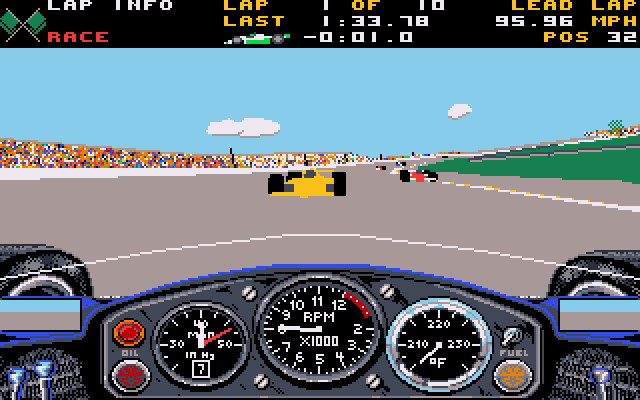
In any case, Indy 500 is generally and justifiably regarded as the PC's first true auto racing simulation. The game offered a single circuit (Indianapolis, of course) and slightly underwhelming graphics, even for the time. Nevertheless, Indy 500 did something that nothing else could: It made you believe you were really driving an open-wheeled racecar.
One of the true keys to a good simulation is its portrayal of the relationship between the four contact patches and the pavement, and Kaemmer's brainchild had it, in spades. When you took an Indy 500 turn at speed, you felt the car trying to break free from the road surface and struggle to maintain its grip. When you entered or exited a corner too quickly, you'd face the same sort of hardships of a real-life driver. In short, the game forced you to adopt a proper racing line and a believable throttle-to-brake interaction from the time you took the green flag until you hit the checkered several hours later.
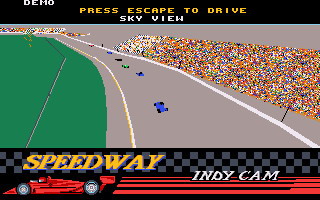
And if your car didn't feel right for one reason or another, you could head to the game's garage facility to enact modifications. Tires, shocks, wings--they were all adjustable. Indy 500 was an arduous and thoroughly convincing experience that demanded complete concentration and ultimately appealed to fans of hardcore authenticity. Total units sold to date: 200,000. Not bad for a game designed in such comparatively primitive circumstances.
Even more importantly, Indy 500 was to form the nucleus for every Papyrus game to follow. Kaemmer and company had come upon a clever formula in its watershed product that would be substantially revitalized and rebuilt over the next fifteen years to meet the demand of an increasingly sophisticated audience and to satiate Papyrus' desire for perfection. But in all truth, this initial effort was an excellent example of getting it right the first time.
Thanks to www.gamekult.com for Indy 500 screenshots
Pit Stop
But what about the money? Did Papyrus immediately strike it rich? Not exactly. According to Kaemmer, "The original Indy 500 was done on a budget of about $90,000--absurd by today's standards. EA gave us an advance against royalties, and we contributed some money of our own. I did Indy 500 by myself for about a year, then Rich Garcia, the first person we hired, worked with me for the last six months. The 2D game artwork was done at EA, by one guy, the sound effects and music were done by another guy at EA--and that was about it. EA wanted us to port the game to the Amiga (computer system), since sales were better in Europe on the Amiga, so I did that by myself in another eight months for another $30,000 or so. The Amiga sales helped get us to the break-even point."

Papyrus would not release another game until 1993, four years after Indy 500 first went to market. It was a generally prosperous but not an entirely thrilling period for the young company. They were busy performing contract programming and computer consulting work while piecing together the finances and personnel for its next big project, a game that would eventually be known as IndyCar Racing. It was also a time when Geoff Crammond made a notable reappearance, unveiling (in 1992) one of the great auto racing sims of the decade, the now-revered World Circuit: The Grand Prix Racing Simulation. The stunning World Circuit quickly proved Papyrus was not alone as a competent PC race sim builder. Keying on the rarified environment of Formula 1, the game authentically covered the world of open-wheeled racing as it was known throughout Europe and much of the world, and in virtually every aspect it surpassed the now-antiquated Indy 500.
Though the official governing body of Formula 1 racing frowned on the use of its name in something as trivial as a video game, World Circuit was clearly F1 all the way--from its 16 real-world tracks to its stunning vehicle power to weight ratios and its glorious scenery (particularly in locales such as the upscale seaside resort principality of Monaco). The game was much bigger, much more comprehensive, infinitely prettier and far more refined than Papyrus' only product to date.
Says Kaemmer, "I remember when we were working on IndyCar, and we were all proud of ourselves because we had real-time, perspective-correct texture mapping, and we saw a demo of World Circuit, Geoff Crammond's original F1 game, and got very worried. He was doing texturing on the road surface, which we were not--for frame rate purposes--and his game looked really good. So we went ahead and textured the road surface, too, and it turned out the frame rate hit wasn't as bad as we had thought."

The encore to Indy 500 arrived, finally, one year after the Crammond milestone. Still a DOS-based affair (Microsoft's Windows was now into version 3.0, but it remained unfriendly to high-end gaming), and once again rendered in what at the time was considered low resolution (blocky 320x200), IndyCar nevertheless showed that Papyrus was in this racing thing for keeps.
For starters, it was an officially licensed product. While Kaemmer is the first to admit that a license doesn't automatically make a good game great, he does acknowledge an IndyCar game without an IndyCar license would have been a far less effective and believable product. With the licensing in place, Papyrus was able to use real track names and designs. It strategically positioned authentic sponsor names and logos throughout the courses and on each authentically rendered automobile, thereby exponentially increasing the "wow" factor.
In IndyCar, published by Virgin rather than EA, Papyrus upped the stakes considerably from Indy 500, delivering such notable perks as multiple TV-type replays, a markedly enhanced garage and setup routine, and breakaway parts that flew hither and thither following serious instances of contact. Indeed, one of the "hidden" joys of any Papyrus game is reverse track driving, wherein the player attempts to create the most cataclysmic head-on multicar pileup. And certainly breakaway parts only added to the fun.
Nonetheless, Kaemmer remembers the potential victim count being quite a bit higher in Indy 500, where "The strategy was to lie in wait on the front straight, which was lined on both sides with a concrete barrier, and leave no place for the hapless opponents to go. We would quite often get everyone but four or five in one giant wreck. I may have gotten everyone once..."
The game shipped with eight tracks in total, and seven more in an add-on expansion pack. The final piece of the puzzle--Indianapolis itself--was added as a separate add-on pack after the proper licensing was secured. IndyCar Racing would ultimately sell in the neighborhood of 300,000 units worldwide, a definite step up from 1989's maiden effort and a real feather in the cap. Still, it wasn't the earth-shattering total for which Papyrus had wishfully longed. That pleasure would be reserved for the following year, 1994, when Papyrus trumped just about everyone.
Stretching the Lead
When Papyrus made the jump from open-wheeled cars to closed cockpit, closed-wheel "stock" cars, it did so with a bang that was felt throughout the industry. In 1994, NASCAR Racing simply blew away the competition, eventually selling in excess of 1,000,000 units and proving that perhaps this ultrarealistic racing concept wasn't a niche market after all.

What made NASCAR Racing such a megahit? The subject matter, certainly. With his latest entry in the simulation stakes, Papyrus tapped into an unexpectedly huge and ardent NASCAR fan base. Who knew NASCAR was so popular? Who knew that fans of the sport would also be so much more amenable to playing a computer game than supporters of other brands of auto racing? Who knew there was such interest in what some press pundits perceived to be "boring" oval racing? Maybe Papyrus knew.
Still not taking advantage of primitive graphics acceleration (3D cards were more a rumor than fact), NASCAR Racing nevertheless impressed with its beauty. Though a low-resolution version was certainly available, which, at 320x200, matched the now seemingly chunky and heavily pixeled images of IndyCar Racing, it was the high-resolution 640x480 version that really turned heads. Suddenly, automobiles looked like automobiles rather than rolling boxes. Players could actually discern sponsor logos and lettering from a distance. At the time, this was nothing short of incredible, particularly considering the game keyed on sophisticated physics modeling that so heavily commandeered the power of the CPU.
In practice, NASCAR racing vehicles veritably lumbered in comparison to the nimble, overpowered rockets of IndyCar. Clearly they were capable of some very high speeds, but their acceleration was comparatively sluglike and their cornering was, well...an adventure. But that was precisely the way it was in the real world. And much like real-life NASCAR racing, there was something oh so appealing about driving and watching cars that outwardly looked like the family wagon but battled door-to-door at insane velocities.

Much to its credit, NASCAR Racing also tapped deeply into the art of drafting. In real racing, drivers often attempt to position their cars directly behind the car in front of them, just inches off the rear bumper. Here in this small pocket of dead air, they can actually back off the accelerator a wee bit yet keep pace as the car in front essentially "drags" them along. Accordingly, they're able to conserve fuel and place less stress on mechanical parts. But there's one other great benefit to drafting. If you time it just right, you can accelerate full bore into that dead air pocket, then swing out at the last possible moment for a pass. If everything goes as it should, you'll carry a few extra miles per hour--enough to complete a successful pass. In NASCAR, where both the vehicles and the dead air pockets behind them are so large, drafting plays a very important role indeed. For that very reason, you'll usually see long "trains" of cars pulling each other around the track. If a driver makes the mistake of falling out of that train, there's a very good chance he won't be able to slot back in until he has dropped to the end of it. In NASCAR Racing, Papyrus expertly modeled the element of drafting, and in the process really added something to the sport's virtual representation.
And then there was the sound. Never had a racing game sounded quite like this. IndyCar had introduced the Doppler effect into PC racing, and that trend would continue throughout each successive game. But here in NASCAR, Doppler mixed with the expertly sampled and crafted low-pitched rumble of a NASCAR engine and the haunting reverberation of an arsenal of motors winding their way around the track. It was an awesome and somewhat eerie sonic landscape.
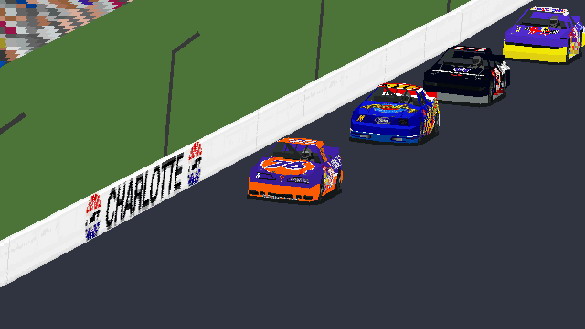
Expert drivers and those willing to take the tremendous time and effort--and it was taxing--to fully indoctrinate themselves into the Papyrus style, drank in the NASCAR Racing challenge. Furthermore, rookies were once again able to take advantage of a now-standard array of driver's aids such as auto-braking and auto-shifting. However, like most Papyrus products, the game did not feature a distinct "easy" mode. It was also rightfully hyped for its challenge and authenticity, and therefore ignored by many new drivers and those who preferred a less stressful "arcade"-type experience.
Still, sales figures for NASCAR Racing were impressive by any standard. With over 1,000,000 units shipped worldwide, the game proved that Kaemmer's philosophy had finally caught on in the mainstream. In fact, it may also have single-handedly spurred the manufacture and sales of driving wheel and pedal systems, which suddenly seemed to be popping out everywhere and often prominently sported the "NASCAR" name or logo in its advertising. Though many of the game's best drivers (and, if truth be told, most members of the Papyrus development team) actually preferred the venerable combination of joystick and keyboard, wheels and pedals looked cool and really added to the sensation of piloting a real car. Whether Papyrus' incredibly complex physics model actually responded better to a purpose-built driving system better than it did to a tight, high-end stick is still a point of contention.
Mechanical Dilemma
The only real downside to NASCAR Racing? Players absolutely needed the latest and greatest computers in order to experience a definitive visual and functional spectacle. Anything less than a top-of-the-line 486-66 processor and the texture-mapped 640x480 high-res version of NASCAR would crawl, particularly in instances of heavy traffic, or God forbid, a multiple car pileup. Furthermore, the high-res version of the game shipped only on compact disc, thus compelling race fans nationwide to purchase a newfangled CD-ROM gadget if they wanted to see the game at its best. Indeed, many critics and gamers took Papyrus to task for concocting a product that so precariously rode the top of the technology wave and undoubtedly compelled hundreds of PC owners countrywide to upgrade their machines.
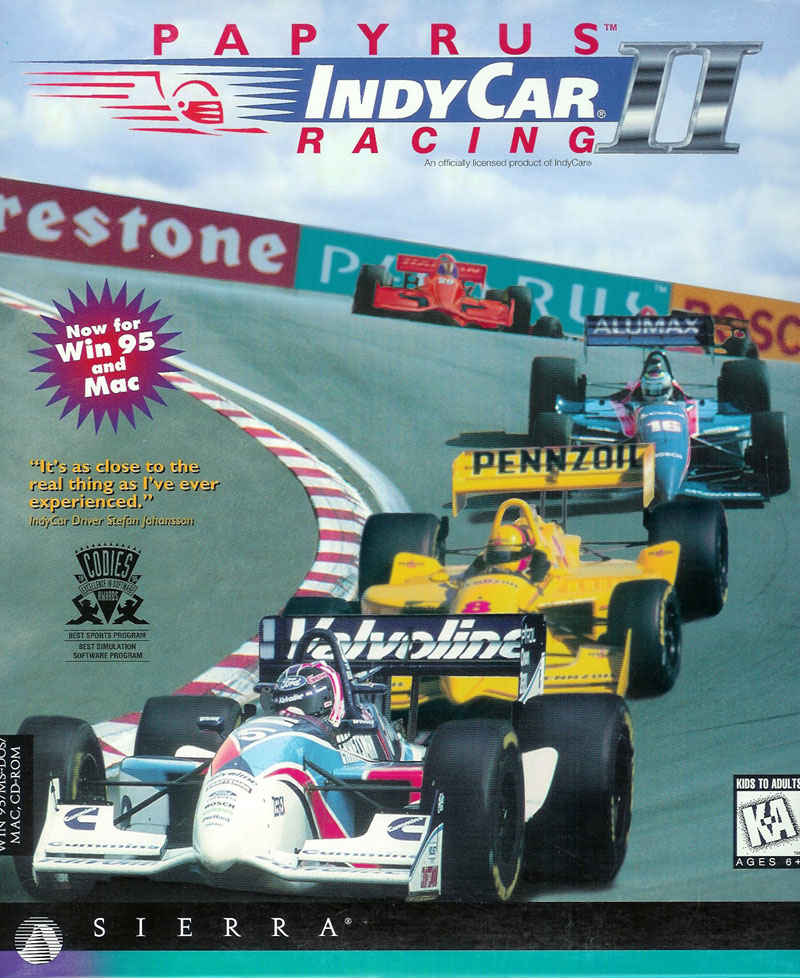
Nevertheless, riding the monstrous critical and financial success of the original NASCAR, Papyrus was now able to pump out its games at a faster clip and call even more of its own shots. IndyCar Racing II arrived one year later in 1995 and immediately proved that Papyrus wasn't going to rest comfortably on its throne. With the IndyCar sequel, Kaemmer and his growing team improved substantially on the first IndyCar and transferred much of what it had learned from its first NASCAR effort to an open-wheeled format. The game was definitely more difficult--and therefore rewarding--than the original, with far more complex car models and a much greater sense of danger.
In IndyCar II, Papyrus showed just how intricate and versatile its open-wheeled games could be. No longer could drivers use the same approach on Michigan as they did on Talladega, lest they experience one of a variety of serious repercussions. Now, the degree of banking, or lack thereof, at any given point on the track mightily impacted the handling. And if you swung down low to the relatively empty and certainly flatter apron to enact one of the carte blanche passing maneuvers that seemed so easy in the original IndyCar, your car would likely react violently to the change in orientation and careen back up to the wall or spin completely out. While much of this new physics sophistication was already on display in NASCAR Racing, IndyCar Racing II simply featured faster and more nimble cars and was therefore a pure joy to drive.

Yet the game was greeted with less than fantastic sales figures (180,000 units to date). There were a couple of key reasons behind the disappointing numbers. For starters, IndyCar II was once more plagued by the very same game quality versus computer capability issue that beset NASCAR Racing, and it is what would ultimately dog Papyrus through the next few years. Yet again, Papyrus was riding that knife-edge of technology.
IndyCar Racing II landed at a time when computer speeds were escalating at a sharp pace and just as the term "3D graphic acceleration" was beginning to infiltrate the market. The 3D add-on cards were in those final months and years of complete confusion before gaining acceptance and finding uniform standards. In the end, Papyrus elected to support its publisher's own Rendition 3D standard, knowing that few of its customers even owned the necessary equipment to take advantage of it, but fully unaware that the standard would be as short lived as it was. Moreover, the initial retail release of IndyCar II sported no graphic acceleration support at all; that support would come through a downloadable patch. Looking back, it's easy to see why many of the Papyrus faithful were befuddled at the situation, as they didn't really know whether or not they should spring for a 3D card.
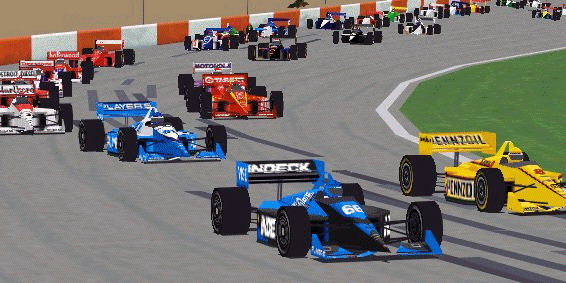
Kaemmer remembers the circumstances well. "I don't know if we were the first [racing game to adopt 3D], but we certainly were out on the bleeding edge. The Rendition card was our favorite in those days, since it had a 4-bit texture format that worked perfectly for our racetrack environments. We could have high-resolution textures with a fairly small amount of texture RAM. It looked great, and was less filling. Everyone had their own API (protocol for communicating with graphics hardware). The APIs were changing all the time, and DirectX was nothing more than a promise."
However, once IndyCar II's "Rendition" patch was downloaded and installed on a machine running a Rendition chipset-based graphics accelerator card, the results were quite simply stunning. This was the first taste of accelerated graphics many race fans had ever witnessed, and it was an impressive spectacle. Suddenly, the pixel-strewn world of prior Papyrus games--even the "high-resolution" 640x480 NASCAR Racing--seemed rudimentary in comparison. Cars looked rounded and smooth, the track surfaces gritty but not blocky, and the peripheral world (in particular the gorgeous sky and trackside scenery of courses such as Elkhart Lake) rich and lustrous. Yet even if you were lucky enough to have a Rendition card, an Internet connection to download the patch, and a machine capable of running the game smoothly, only a sprinkling of the courses were able to take advantage of the technology. That would later change when the game was rereleased with complete Rendition support more than a year later as "CART Racing." But more on that in a moment.
Yet timing is often the most important element of all, and in many ways, IndyCar II missed its mark. Kaemmer acknowledges that IndyCar II, unlike earlier Papyrus games, didn't exactly strike when the iron was hot. "[The original] IndyCar Racing was the natural follow-on to Indy 500, and as luck would have it, we shipped it at the perfect time--Nigel Mansell, just crowned World Driving Champion, had left Formula 1 to drive in Indy cars in 1993, so there was a lot of interest from around the world in Indy car racing--and it sold pretty well, even overseas. But we followed it up with NASCAR Racing, which sold several times as many units. Shortly thereafter, the CART/IRL split occurred, which pretty well defused any growing interest here or abroad (in what was formerly known as IndyCar)."
With comparatively sluggish IndyCar II sales figures and a slow disintegration of the real-life league, Papyrus' new parent company, Sierra, had little interest in revisiting this particular brand of auto racing in the future. Thusly, IndyCar Racing II--renamed CART Racing after the now-infamous CART/IRL disagreement--would be Papyrus' parting nod to modern-day, open-wheeled automotive competition.
NASCAR Racing 2 followed in 1996. Riding the coattails of the original, it sold quickly right out of the chute and continued racking up big numbers for several years. Today it remains as the second highest-selling Papyrus game of all time at 800,000 units worldwide.
NASCAR 2 was an upgraded sequel in every aspect but its physics engine. Yes, there were modeling tweaks and new perks to better exemplify the power under the hood and the subtle nuances of each track, but the nucleus of the physics engine that had been so true to Papyrus for so long, remained essentially unchanged. That didn't matter to the Papyrus masses, which embraced such innovative amenities as completely redesigned interfaces, upgraded garage facilities, and a talking crew chief/spotter. The latter in particular was a wonderful idea that aided immeasurably during instances of tight traffic. Papyrus even went so far as to add a substantially simplified "arcade" mode, thus going against its previous philosophy of designing games only for the hardcore simulation crowd.
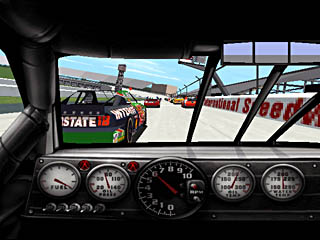
By now, Kaemmer's crew was a well-oiled machine. Rumors abounded that real-life drivers used Papyrus products to brush up on their techniques for tracks with which they were not overly familiar. To many virtual racers, Papyrus had become the final word in realism.
In 1997, it released the NASCAR Grand National Series Expansion Pack, an add-on for NASCAR Racing 2 that featured 10 new official tracks, two fantasy courses, and several new drivers and cars, but no serious, anticipated upgrades such as 3D acceleration support or pit crew animations. That was OK with most Papyrus fans, as they rightly felt NASCAR 2 was already pretty darn good. But some were now questioning just when the next big technological quantum leap would occur.
They wouldn't wait long.
Thanks to Velocity Motorsports for IndyCar II pictures
A Daring Move
Quietly, the rumor mill had been churning. Papyrus was allegedly hunkered down, hard at work on a game that would change the way we all race. It was purported to be a historical open-wheeled simulation, turning back the clock to a time before advanced ground effects, when cars were positively treacherous and drivers either heroic or flat-out crazy. If NASCAR Racing had been a breakthrough, the word was the next game would be a revolution.
And it would have to be. Geoff Crammond's team had already released the long-awaited sequel to 1992's superb World Circuit, Grand Prix II, which quickly soared to the top of the charts in 1996 as perhaps the finest open-wheeled sim ever devised. The game featured stupendous textured graphics, the genre's first fully rendered rear mirror views, astoundingly "human" artificial intelligence drivers, an excellent depiction of wheelspin, and cars that could rise up into the air and flip upside down. It looked and played wonderfully.
Even Microsoft jumped into the competition with 1997's overly ambitious CART Precision Racing, a flawed and buggy, but promising title that in some ways wasn't in the same league as the genre's heavy hitters; however, it sported some likable elements and it did go to show how quickly the field was opening up. As it turned out, CPR needed CPR and was ultimately a one-shot deal. Not to be outdone, Ubisoft let loose with a volley of its own in 1998's F1 Racing Simulation, a game that didn't get nearly the attention that it deserved on this side of the Atlantic. One of the very first racing sims to fully support 3D graphic accelerator cards, F1 Racing Simulation visually toyed with everything that had come before. The environmental effects were particularly impressive, especially the variable weather, animated clouds, and mesmerizing depiction of lens flare. The car models were both accurate and responsive, and the AI was plausibly reactive to given situations. Even by today's standards, the game looked great and drove magnificently.
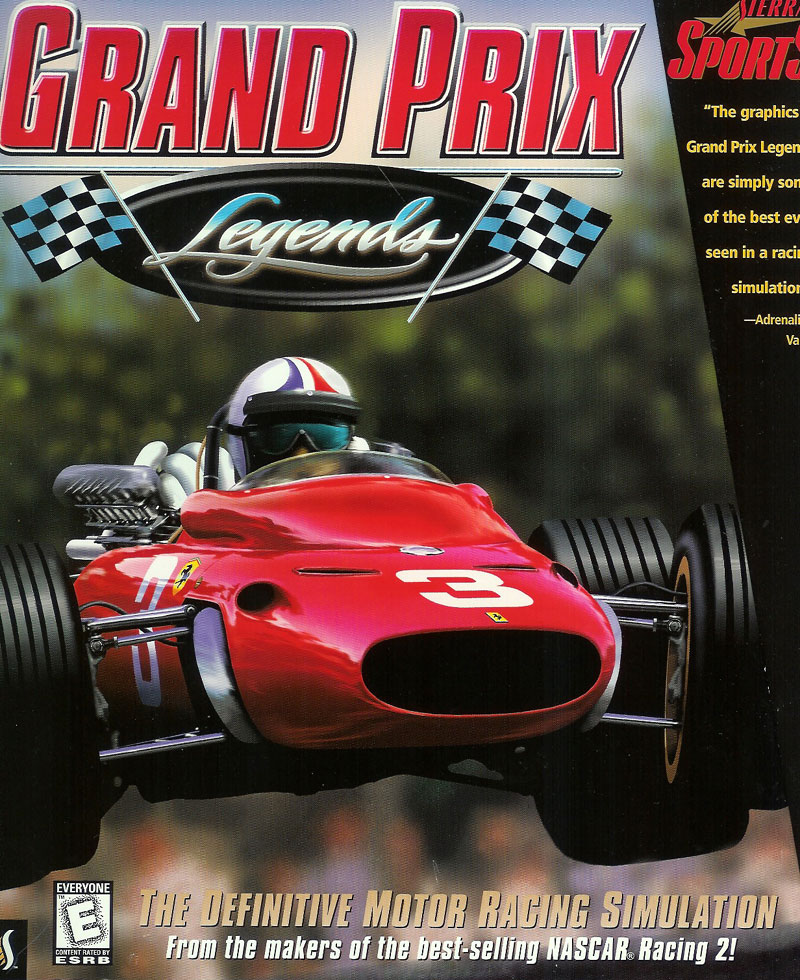
In the fall of 1998, Papyrus Design Group, through Sierra Sports, released Grand Prix Legends, and armchair racers the world over awaited the critical response. And soon it came. "Stunning," said one. "Amazing," said another. "World Class" raved one headline, while another claimed, "A new era of historical sports sims may be dawning."
And indeed, GPL may well have been Papyrus' finest hour. The experience of driving a Grand Prix Legends car was unlike anything that had preceded it, and for good reason. With its latest and arguably greatest game to date, Dave Kaemmer, Randy Cassidy, et al., had completely scrapped the respected but aging Papyrus physics engine and rebuilt it piece by piece, from the virtual ground up. They coupled it with heretofore-unseen levels of AI, intricate graphics, typically bloodcurdling Papyrus crash effects, and a compelling sense of history that focused on a highly interesting era.
But it was that physics model, constructed not only to truly replicate the four independent contact points of a real racecar, but also to demonstrate the squirrelly handling characteristics of a too-fast-for-its-own-good, mid-60s land rocket, which became the game's main claim to fame. Essentially, Papyrus had removed whatever safety net existed in its prior titles. Kaemmer himself said at the time that, "Driving a 1967 GP car is more difficult than driving just about anything else, and the simulation is more difficult than driving a real car...many people think that it feels like driving on ice."

One problem--the game was simply too difficult for the majority of players. As much as Papyrus prided itself on building games appealing almost exclusively to drivers willing to spend hours and days just learning how to come to grips with a dazzling, but incredibly challenging, physics model, in GPL it may have gone a bit too far.
One by one, each media review that bestowed GPL with its deserved accolades and high score also lamented that only the supremely skilled could ever hope to get a handle on the latest Papyrus beast. This alone was enough to convince many would-be candidates that the newest Papyrus effort was simply too tough. Worse still, the game once again floated just above the technology of the day. Reports of incapacitating frame rates abounded. In the end, the combination of treacherous gameplay, sometimes glacial frame rates, and esoteric subject matter severely impacted the sales figures of a product that was deserving of a better fate. Total sales to date are 200,000, though many of those came only after patches and user enhancements helped make it more of a reasonable proposition.
Kaemmer explains, "We focused on the Rendition and 3Dfx chips for Grand Prix Legends because they were the best at the time, along with a software renderer, and shipped GPL at the absolute worst time possible for 3D hardware support. All the drivers were buggy and our software renderer was fairly slow, since we had moved to 16-bit color to best exploit the graphics hardware. I'm pretty sure that no one who bought GPL was able to see the hardware-accelerated version without first having to find and download new video drivers. Maybe we were the first racing game producer to fall off the 3D bandwagon and break a leg."
"I think the main reasons that GPL didn't rack up big sales figures are that it didn't run well on most buyers' machines (due to the 3D hardware problem), it apparently wasn't a concept that got people excited, and it was incredibly difficult to play, in that order. One of the engineers at Papyrus, Grant Reeve, wrote a Direct3D renderer for GPL a couple of years ago in his spare time, and quite a few people since have dusted off GPL and discovered what a gem it still is with hardware-accelerated graphics. Word of mouth counts for a lot in this business, and no one will recommend a game to his friends if it doesn't run well on his machine. Unfortunately, the second problem--people weren't jazzed by the concept--needed word of mouth recommendations to overcome. Talk to anyone who has given GPL a fair chance and they will praise it glowingly as being an experience quite beyond mere gaming. It is auto racing, and auto racing is an incredibly exciting sport for the participants, especially back in 1967. The spectators are seeing just a small part of it."
"Unfortunately, we had to change the design of GPL in order to ship it on time, and instead of starting in the equivalent of a Formula Ford, graduating to Formula 2, and only then to a Formula 1 car, we allowed people to jump right in to the F1 car with no training time. It was like putting a novice skier at the top of an iced-over double black diamond and saying, "Have fun!" Needless to say, many people didn't. My regrets are that we didn't postpone shipping until the 3D hardware market settled down a bit and until we had finished the experience ladder design, but I'm pleased that we made it possible to drive on those classic racetracks in some beautiful and exciting racecars."

Nevertheless, Grand Prix Legends was--and quite likely still is--the ultimate in extreme realism. Its fan base remains one of the most devoted of any game from that era, and its long list of updates and patches have kept it current with today's hottest hardware. Still, its comparatively and unexpectedly poor showing did not sit well with Sierra, the company that owned Papyrus and published its products. Kaemmer, an admittedly fanatical realism devotee, remembers, "We had spent quite a bit of money on its development and, of course, you'd like to make that money back. The management hierarchy above us never really understood what we were trying to do, and we didn't see eye to eye on the reasons for GPL's failure. Actually, GPL went on to do fairly decently in Europe over the long run, so it really wasn't all that bad, but the long run is a difficult view to take for a public company and we had already been branded as 'a bunch of purists'--out of step with the marketplace. After GPL, it was a real uphill battle even to do a NASCAR game using the GPL simulation engine. Everyone was afraid that if a five-year-old couldn't drive it, nobody would buy it."
Hence, the next three Papyrus products were not cut from the GPL cloth. Seeing the light of day in 1998 was NASCAR Legends, a game most notable for its take on a NASCAR era sandwiched between the grassroots "stock car" stance of its formative years and the full-blown, purpose-built racecars of today. It was a sport fueled by the muscle cars of pre-gas crisis Detroit and filled with big names such as Richard Petty and Cale Yarborough. With a whole flock of "new" antiques roaming the typical allotment of NASCAR tracks, fans were somewhat satiated.
But when NASCAR Racing 1999 Edition materialized in 1999 and NASCAR Racing 3 appeared in 2000, the series clearly began to show its age. For those in the know, it looked like a classic tug of war between publisher and developer. On the Papyrus side was a team of designers certain they could successfully moderate the undeniably impressive GPL engine to a huge, but now somewhat disillusioned, NASCAR audience. They believed that a NASCAR game built on that physics engine, but with various drivers' aids and other "dumbing down" techniques, would appeal to a wide range of drivers. Meanwhile, Sierra worried that instilling the hardcore realism of GPL into NASCAR would be an undeniably erroneous move. The result was stagnation in the only operational Papyrus series.
Victory Lane
But with 2001's landmark NASCAR Racing 4, Papyrus was given the green light to bring in its GPL engine. The tide would then change, and not a moment too soon for those who had listened to rumors for three years about each new NASCAR being a truly new and revamped NASCAR.
Kaemmer admits, "It was definitely a balancing act. What finally turned the thinking around was that we got an internal demo going that showed what a Winston Cup car would be like in the sim, and it was pretty cool and easier to drive than GPL's F1 cars. The physics engine will do whatever the numbers say should happen. We've actually done cars similar to modern F1 cars, which are a handful but unbelievably quick, as well as 5000 hp Top Fuel dragsters, which are absolutely insane. It turns out that 1967 Grand Prix cars were very tricky to drive in real life--the drivers complained at the time that they were too skittish and had too much power for their meager grip. The designers were starting to look at four-wheel drive as a solution, and then some genius realized he could stick downforce generating wings on the cars, and things got much better. So we maybe blew it by choosing 1967 (for GPL). I've always felt that the driver aids are an impediment to learning, which is what a sim is all about. What we really should have been doing is putting people in lower-powered cars. But to sell to the mass market, we needed the brand recognition of the "Big Cars," so of course with no driver aids they are tricky."
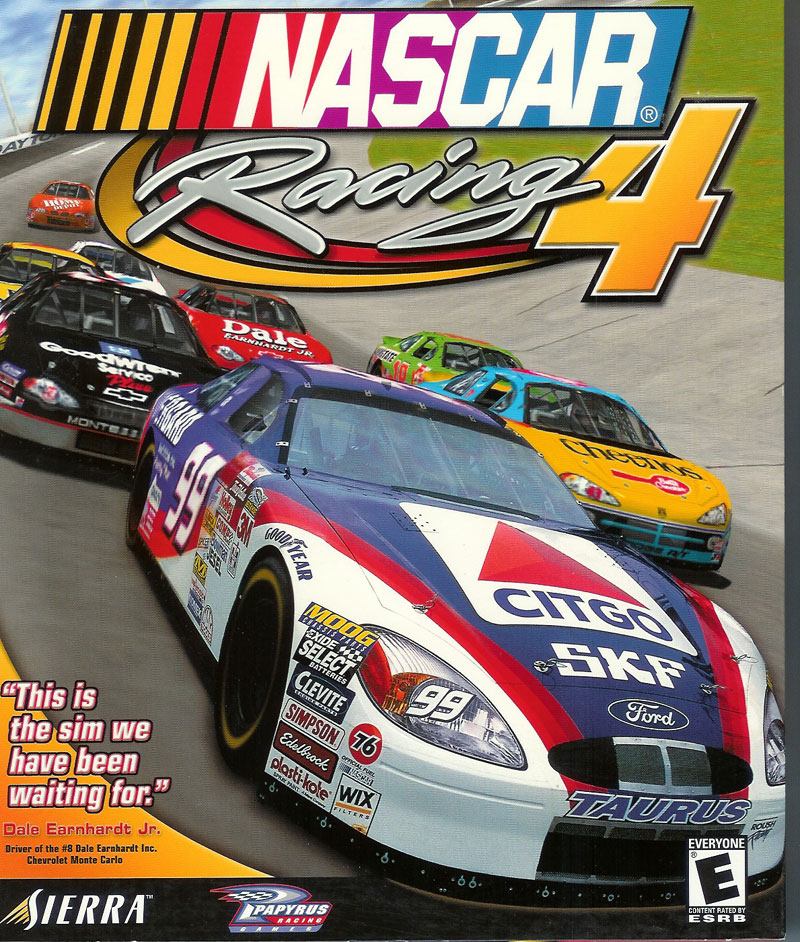
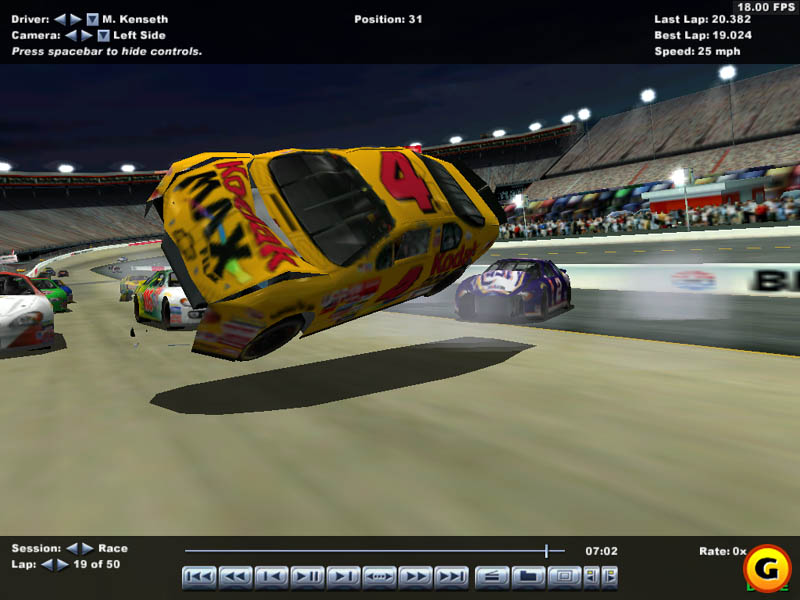
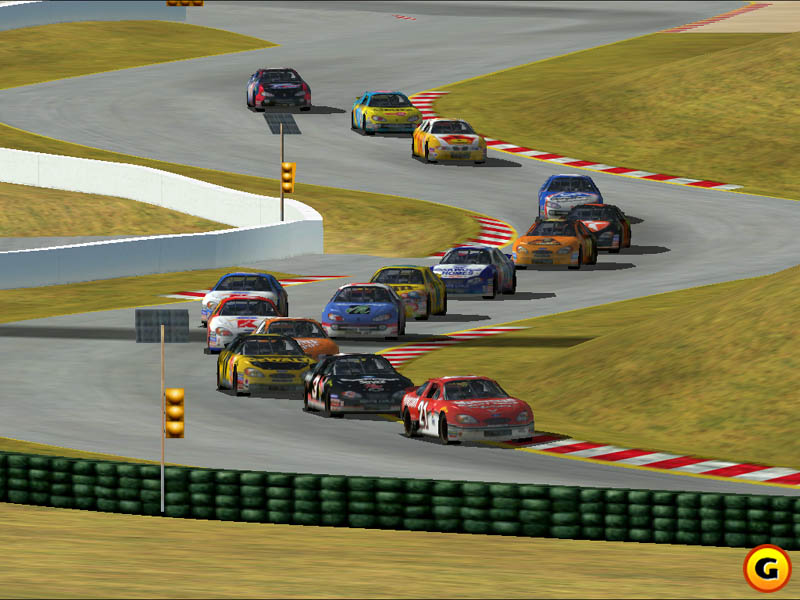
In NASCAR 4, Papyrus utilized everything it had learned previously and injected it into a game focusing on North America's most popular racing genre. To say it clicked is an understatement. NASCAR 4 cars sported active four-way suspension that reacted both visually and practically to weight transfers. The game featured source-sensitive lighting, real-time shadows, and stunning collision effects that sometimes tossed vehicles into the air, end over end. And because it took full advantage of 3D acceleration, the pixeled appearance of prior NASCARs was gone and frame rate hassles were no longer the issue they once were.
From a physics standpoint, NASCAR 4 confirmed that Papyrus could do precisely what it said it could do with the GPL engine. To quote Kaemmer, "It was definitely a vindication of the physics engine when Nascar 4 was so well received." In simple terms, NASCAR 4 could be anything you wanted it to be. Indeed, if all drivers' aids were used and alternate modes explored, it was the most approachable NASCAR to date. But if you wanted to hike up the difficulty and experience terrifying authenticity, you could do that too. You could even race with 40 of your best friends or enemies via the Internet, though the game's online frame rate proved to be erratic at best.
NASCAR 4 also further blurred the line between virtual and actual racing. "Real feedback started when we got Kevin Harvick and Dale Earnhardt, Jr. to beta-test NASCAR 4," says Kaemmer. "They loved it right off the bat, and were able to give us quite a bit of useful feedback about the feel of the cars and the realism of the tracks. Kevin Harvick told us a story about the first time he raced at Dover. He had never been to the track in real life, but had been beta-testing NASCAR 4 for a couple of months and had driven hundreds of laps around the virtual Dover. He said he hadn't driven more than two laps around the real track before he had a huge wide grin behind his helmet because he felt he just knew the track. It was as if he had been there before. He then proceeded to put his car on a pole."
NASCAR Racing 2002 Season followed in 2002 and then came NASCAR Racing 2003 Season. Both featured several minor enhancements, the latter being particularly noteworthy for its heightened difficulty and adaptive AI drivers. Papyrus (and its loyal followers) knew going in that NASCAR 2003 would be the series' swan song, and neither could have asked for a finer farewell. Certainly the game gave the good folks at Electronic Arts something to mull over for its own NASCAR series, now in its fourth year and striving to reach the same level of believability and authenticity.
Looking back, Kaemmer is justifiably proud of the Papyrus' heritage and in particular of sticking to his guns when things got tough. But how was it that this comparatively small studio was able to stay at the forefront of the realism curve for so many years, bowing only slightly when push came to shove? "I think the fact that we started with Indy 500, which really put us on the simulation path, had a lot to do with it. I ended up with a fanatical devotion to realism, which rubbed off on quite a few of our employees through the years. We never spent a lot of time thinking about what would make a fun game--only what would make the experience more like driving a real racecar. I think most of our competitors through the years were always worried about how difficult it was, and would sacrifice the realism, figuring that if it was difficult, it wasn't fun."
"To me, that's nonsense. How many people would play golf if it were a piece of cake to hit par? It would be mini-golf. OK, maybe a lot of people would play it, but they'd get bored pretty quickly, and they wouldn't spend much time on it. How many people play a lot of mini-golf? Anything that is truly fun in a lasting way in life takes time to learn--playing the piano, playing baseball, sailing, you name it. People don't devote themselves to simple things for long periods of time. Our software always seemed to be able to hold people's interest for a long time, since it takes skill, and the exercise of that skill is a tremendous rush, just like the real thing."
Post-Race Ruminations
And now, Papyrus is no more, along with Vivendi Universal components Sierra and Impressions Games. Why? Clearly Vivendi felt it needed to undertake a little general housecleaning. But in the specific case of Papyrus, there was quite likely more to the story. Kaemmer has some strong feelings in this regard. "I think there were a number of factors that led to Papyrus' closure. Chief among them is that interest in simulations, a category somewhat different than most games, hasn't grown at the same rate as interest in games in general. Simulations are more difficult to market, since the fundamental enjoyment you get out of them is learning a difficult skill. People buying a toy--which is how people think of computer "games"-- apparently don't expect or want to master a difficult skill."

"The computer game business is really becoming a toy business, especially with the popularity of console gaming. That's not the right market for a simulation. To revisit the golf analogy, it's like trying to sell real golf clubs at a mini-golf pavilion. Certainly you would sell some, but too many of the people coming through to play mini-golf aren't interested in real golf--it's too difficult and time consuming. That's what's happening to simulations, I think. The game industry is saying, 'Look, people aren't buying very many of these golf clubs--can we make a cheaper bag? Plastic instead of leather? Can you make it easier to play golf? It's too hard, plus people have to walk too far.'"
"The real problem is that we're reaching the wrong customers. If Papyrus were to have dumbed down the experience in order to make a console game, they would have had no competitive advantage. There are a zillion driving "games" out there and many of them look really nice since the console budgets allow for a lot of flash. But none of them are true driving simulators, despite what they say. They don't need to be. They are being sold by the licenses. What Papyrus did that really nobody else did was make true simulations--you can really find out what racing is like with a Papyrus simulation. If you can do well in GPL or NR2003, you know how to drive a car at the limit."

"For auto racing simulations there has always been a disconnection between the experience as a participant, which is what we were providing, and the experience as a spectator, which is what has always been used to sell the game. Auto racing is far more exciting for the participant than for the spectator, but people who haven't participated in it don't realize that. They are more interested in the soap opera that is professional racing, in the personalities of the drivers, and the paint schemes on the cars. That's why we've always had to rely on big licenses: NASCAR, IndyCar, F1, Porsche, Ferrari, and so on. Unfortunately, those licenses are getting more and more costly, and now it is absolutely necessary to be making console games to be able to afford the licenses. EA bought an exclusive license to NASCAR on all platforms, so they will be the sole NASCAR game producer for the next few years. And now that VUG can no longer sell Papyrus' NASCAR simulations, they decided to shutter Papyrus."
In fact, Kaemmer had already left the Papyrus stable before the doors had officially closed, after it "became apparent that there would be nothing in our future other than NASCAR sims." Although he maintains the NASCAR series was not in itself a problem, he also says it represented a very small slice of the overall racing experience--which was a much bigger pie that he wanted to more fully explore.
And that's just what the future holds. Along with right-hand man Steve Myers, Kaemmer has recently become associated with a very powerful ally: John Henry, principal owner of his hometown Boston Red Sox. Henry himself is a longtime ardent supporter and proponent of Papyrus, and together the two have founded FIRST-Racing.net, LLC and acquired the rights to Papyrus' simulation technology from Vivendi. The goal? To deliver an all-encompassing racing experience that incorporates everything from real-world track experience to online virtual competition.
"We actually see our new company as being in the racing and driving business, more than the game business. We are putting together a global Web site that will be a central place for anyone interested in racing and driving--from beginners, who need some initial instruction in a racing school, up to professional race drivers who would like the opportunity to get track time at a low cost. In addition to providing a simulator and training, we will be sanctioning online race series at all levels--from 140 hp Formula Fords up to 800 hp champ cars, with everything in between--and in many types of cars, including formula, sports car, stock car, even off-road cars. Racing is a very expensive sport, so not many people get a chance to participate. We would like to change that, to allow more people to really learn about racing and to experience some of the thrill. In addition, we want to open up the data formats so that our members can build virtual racecars of all types and tracks as well."
In the interim, the ex-boss of Papyrus has spent a good portion of the last two years revitalizing and recuperating from a 17-year overextended work schedule. He's also honed his real-life racing skills in the Skip Barber Formula Dodge Series, where he has managed more than his fair share of wins. It somehow doesn't seem surprising that Kaemmer has just recently built a kit car--a Caterham Super Seven.
In 1987, the Berlin Wall stood tall, Homer Simpson was an unknown, and home computers were quirky curiosities based on the even quirkier MS-DOS operating system. Yet 1987 was also the year in which David Kaemmer began a long multidecade journey that would shape and then reshape the virtual racing world.
That journey has not ended.
Got a news tip or want to contact us directly? Email news@gamespot.com
Join the conversation