ATI Radeon X800 Hands-On Preview
It's finally here! ATI has finally announced its newest next-generation graphics chip, the Radeon X800. Read on to learn about ATI's latest and greatest, and see how it performs against Nvidia's new GeForce 6800. We've also managed to get our hands on two previously unannounced GeForce 6800 boards for even more benchmarking fun.
Design by Collin Oguro
Ever since Nvidia announced its GeForce 6800 last month, the primary question surrounding ATI has been whether or not its next-generation chip could compete with the Nvidia powerhouse. Today, ATI Technologies has announced its next-generation graphics processor, the new Radeon X800. The ATI Radeon X800 matches the Nvidia GeForce 6 series with 16-pixel pipelines of its own, proving that the X800 will provide an increase in performance that's similar to that of Nvidia's newest technology.
Like Nvidia, ATI will offer different Radeon X800 variations that target various market segments. The high-end Radeon X800 XT Platinum Edition will ship on May 21 and will offer 256MB of 560MHz (1.12GHz effective) memory. Additionally, it will feature a full 16-pipe engine with a 520MHz clock speed, providing a peak fill rate of 8.32 Gpixels/s. The Radeon X800 Pro will have a slightly slower memory and a less-powerful graphics core. The Pro version will have 256MB of 450MHz (900MHz effective) memory and a 475MHz 12-pipe pixel engine for a peak fill rate of 5.7 Gpixels/s. The Pro version is supposed to ship today, but, according to industry insiders, cards won't reach end users for a couple of weeks.
| GeForce 6800 Ultra | Radeon X800 XT | Radeon X800 Pro | Radeon 9800XT | |
| Transistors | 222 million | 160 million | 160 million | 115 million |
| Core Clock | 400MHz | 520MHz | 475MHz | 412MHz |
| Pixel Pipelines | 16 | 16 | 12 | 8 |
| Vertex Units | 6 | 6 | 6 | 4 |
| Vertex Throughput | 600Mtriangles/s | 780Mtriangles/s | 712Mtriangles/s | 412Mtriangles/s |
| Memory Bus | 256-bit | 256-bit | 256-bit | 256-bit |
| Memory Clock | 1100MHz effective | 1120MHz effective | 900MHz effective | 730MHz effective |
| Memory Bandwidth | 35.2GB/s | 35.84GB/s | 28.8GB/s | 23.3GB/s |
Like the next-generation Nvidia cards, the Radeon X800 Pro and XT cards also use high-speed GDDR3 memory to fuel an equally significant jump in memory bandwidth. Both Radeon X800 versions will have six vertex pipes, which is the same number offered by the Nvidia GeForce 6800 series of cards. The Radeon X800 XT carries an MSRP of $499, and the Pro will set you back $399.
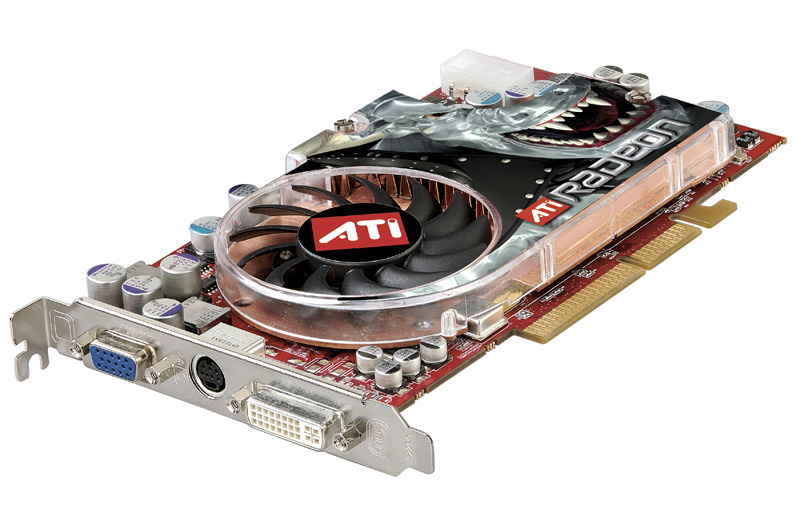
ATI separated the X800's 16-pixel pipeline design into four "quads," each consisting of four-pixel pipelines. ATI can disable quads as needed--in case of manufacturing defects--allowing it to "save" chips that would otherwise be discarded. A chip with three functional quads can still work perfectly in a 12-pipe Radeon X800 Pro card. The close-to-three-week gap between the launch dates of the Pro and XT represents the time ATI needed to filter out an adequate number of fully functional 16-pipeline chips for XT production.
The ATI Radeon X800 graphics processor features 160 million transistors, which is almost 50 percent more than the previous-generation Radeon 9800 XT. Surprisingly, the new X800 has a higher clock speed but actually consumes less power than the 9800 XT thanks to a 0.13 micron, low-k manufacturing process that employs copper interconnect technology. The addition of low-k helps to improve processor performance by reducing cross-talk interference between adjacent interconnects. ATI and its foundry, TSMC (Taiwan Semiconductor Manufacturing Company), first used the 0.13 micron, low-k process in the Radeon 9600 XT.
The reduced power consumption means all Radeon X800 cards will be single-slot solutions without any extravagant power supply requirements. Any system capable of running a Radeon 9800 XT will be able to support an X800-based card without a problem. In comparison, Nvidia recommends a 480W power supply for use with its next-generation, 222 million-transistor GeForce 6800 Ultra. As testament to the X800's low power demands, ATI actually uses small form factor (SFF) Shuttle boxes for its X800 demonstration systems. Granted, ATI's power efficiency will likely only be a major advantage in the high-end competition, since Nvidia's midrange and entry-level GeForce 6800 cards will be single-slot solutions with more-reasonable power supply demands. We must still, however, give ATI credit for offering gamers the only high-end next-generation card that doesn't require an expensive power supply upgrade.

Both new architectures from ATI and Nvidia offer incredible fill rate, vertex processing, and memory bandwidth gains, but ATI has chosen to target the Radeon X800 at the here and now by polishing its current design rather than by taking the risk of adopting new Shader Model 3.0 features. Nvidia has chosen to target the GeForce 6800 at the here, now, and more-distant future by allowing consumers to sacrifice convenience, a double-height card, and large power requirements for a more-robust feature set, including Shader Model 3.0. The new Radeon X800 does offer 2.x shader support, but it lacks the key SM 3.0 features of dynamic flow control, vertex texturing, and vertex streams.
Shader Model 3.0 is a collection of Microsoft DirectX 9.0c Pixel and Vertex Shader 3.0 features deemed necessary for next-generation 3D graphics. SM 3.0 hardware allows game developers to write longer shader programs with dynamic flow control, making the programmers' lives much easier and enabling more-efficient development time. Currently, developers are limited to short shader programs with limited branching capabilities. In SM 3.0, vertex shaders can access textures, allowing for true displacement mapping, which makes it possible for the graphics card to deform geometry in real time. Another SM 3.0 feature--geometry instancing--enables "batch" uploads of similar objects. Instead of spending valuable resources re-creating each object, geometry instancing allows the programmer to use a single base model and a large number of vertex streams that modify the model's appearance in each case.
The bad news is that the Radeon X800 isn't a Shader Model 3.0 chip. The good news is that we probably won't see a lot of SM 3.0-heavy games on the market until ATI finally does release an SM 3.0 part. Programmers can't risk spending a lot of development time on features that will only be enjoyed by a small percentage of the retail target market. Remember, we had to wait about a year and a half after the first DirectX 9.0 hardware hit the market before we saw high-profile 9.0 games, such as Far Cry.
The Radeon X800's Smartshader HD Pixel Shader 2.x engine offers more than enough graphical support for such high-profile game titles as Half-Life 2 and Doom 3. Actually, the previous-generation Radeon 9800 XT would be fine for both Valve and id's upcoming blockbusters. However, the new Radeon X800 doubles the pixel pipeline of the 9800 XT, adds 50 percent more triangle-processing power, and offers a few new features, including 3Dc compression, improved memory management, and a new temporal antialiasing technique.
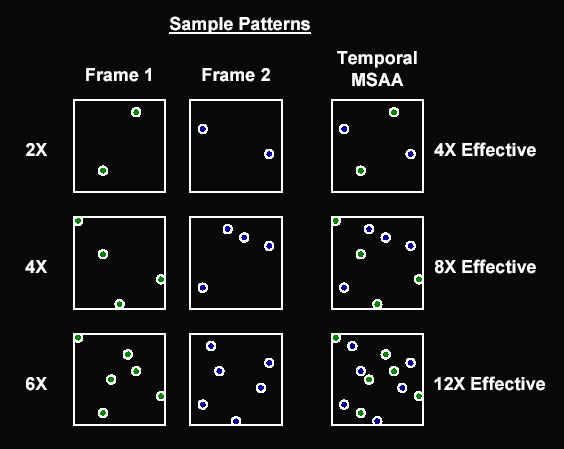
Temporal antialising is a new antialiasing technique that alternates between two different sample patterns for each frame and allows the screen display's natural persistence rate to blend the images together. Temporal antialiasing may only sample at 2X, 4X, or 6X, but the effective antialiasing quality level will appear to be 4X, 8X, or 12X respectively.
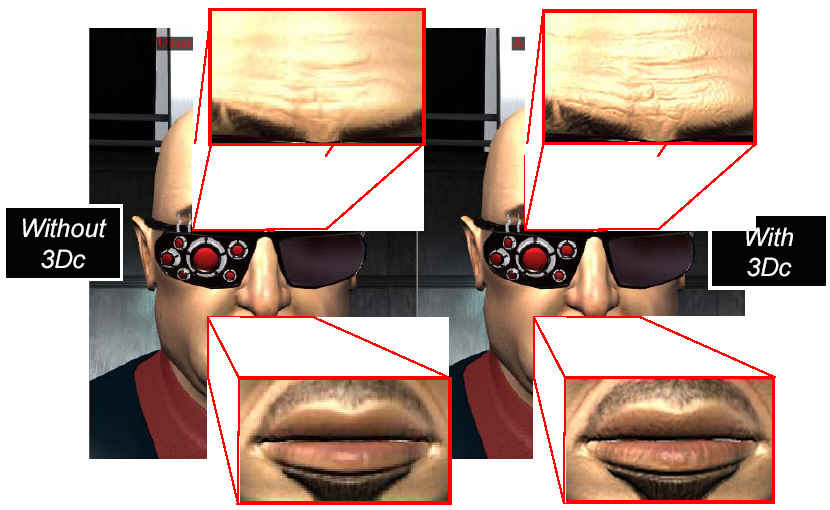
3Dc is ATI's new compression technology that's been designed specifically for normal maps. Games use normal maps to provide the illusion of 3D detail on a surface. The normal map adds information about the direction each pixel is facing to aid in creating realistic lighting effects, thus enabling the game to create even better 3D illusions on a flat surface. Unfortunately, normal maps also add pressure to the already taxed graphics memory subsystem. ATI's new 3Dc technology achieves up to 4-to-1 compression ratios, allowing developers to use more high-quality normal maps for better-looking 3D details.
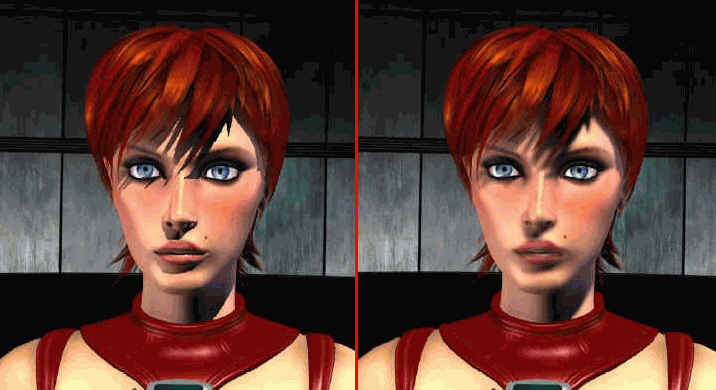
The Radeon X800's increased pixel and vertex processing power will go a long way, since we're only just seeing Pixel Shader 2.0 games right now. ATI worked with design studio RhinoFX to create its new "Ruby" technology demo, which demonstrates the high level of 3D gaming that's enabled by the Radeon X800. The Ruby demo uses shaders extensively to create depth of field, hair rendering, soft shadows, and simulated subsurface-scattering effects.

We tested our reference ATI X800 XT and Pro cards on a P4 Intel 3.4GHz Northwood processor with an ASUS P4C800-E Deluxe motherboard, 1GB (512MB x 2) of Samsung CL3 memory in a dual-channel configuration, and an Antec TruePower 480W power supply.
Nvidia managed to get us two new, previously unannounced GeForce 6800 boards--the GT and an unnamed "Extreme" edition--in time for inclusion in our testing. The 256MB GeForce 6800 GT will be a 16-pixel pipeline solution with a core clock of 350MHz and a 500MHz (1GHz effective) memory clock. The GeForce 6800 "Extreme" will have 16-pipes, a 450MHz core clock, and 256MB of 550MHz (1.1GHz effective) memory. Since this "Extreme" edition will be in limited release--based on however many "golden samples" (chips that are able to hit higher-than-average clock speeds) Nvidia is able to muster--we've tagged the 6800 "Extreme" with a "GS" moniker in the charts. We used a new 61.11 beta driver for use with the 6800 series cards, and we have disabled trilinear optimizations for all tests.
Our test resolutions are 1024x768 and 1600x1200, and we enable 4X antialiasing and 8X anisotropic filtering in our quality tests. When viewing the benchmark results, we suggest comparing cards in the same price range. The $499 Radeon X800 XT Platinum Edition should be compared to the GeForce 6800 Ultra, while the $399 Radeon X800 Pro should be compared to the GeForce 6800 GT.
3DMark 03
The Radeon X800 XT and the GeForce 6800 Ultra put up similar 3DMark scores in the 12,000 range, but it's interesting to see how the cards performed in the four separate game tests used in the final score calculation. The Nvidia cards hold the edge in the first three DirectX 7 and DirectX 8 game tests, but the Radeon X800 cards jump ahead in the final DirectX 9 "Mother Nature" test. It's worth noting that the third and fourth game tests best represent today's titles.
Unreal Tournament 2004
We've changed our custom Unreal Tournament 2004 benchmarking demo map to a DM-DesertIsle match to add more pressure to the test system. Scores have gone down slightly, but the CPU-limited results are the same. You might be wondering why we bother listing the obvious CPU-limited settings, but we want to show you that, even in new games like Unreal Tournament 2004, you have to dial up the settings to tax these new cards.
Call of Duty
Call of Duty, our sole OpenGL benchmark, is based on a highly modified Quake 3 engine. We used the built-in "timedemo1" demo file for all our tests. It's no surprise that the game is CPU-limited, but the difference between the frame-rate ceilings for the Nvidia and ATI cards indicates that there might be some room for driver work.
Far Cry
We weren't able to load our test map for three of the GeForce 6800 GT tests, but all the other cards ran without a problem. In Far Cry, we turned all the advanced settings up to "Very High" and "Ultra High" for the water. We enabled 8X anisotropic filtering through the console with the "r_Texture_Anisotropic_Level 8" command line, since the menu only offers options up to 4X.
The ATI Radeon X800 cards really shine in Far Cry, with both the Radeon X800 XT and the Radeon X800 Pro outperforming their GeForce 6800 counterparts in what is arguably today's most relevant game benchmark.
Halo: Combat Evolved
Halo is another DirectX 9.0, Pixel Shader 2.0/1.4-enabled game. We only have the basic 1024x768 and 1600x1200 tests, because the game doesn't support antialiasing. The GeForce 6800 Ultra score in the 1024x768 test raised a few eyebrows, since you wouldn't expect the Ultra to outperform the higher-clocked "golden sample" version. However, we were able to reproduce the same results a number of times.
Overall, we have to say that we're impressed with the ATI Radeon X800. The benchmark results read like two evenly matched heavyweight fighters trading blows in a title bout. The Nvidia cards may win in the older DirectX and OpenGL tests, most notably cleaning up in the first two 3DMark game tests and in Call of Duty, but ATI wins the Far Cry, Unreal Tournament 2004, and the DirectX 9.0 3DMark "Mother Nature" game tests. Nvidia does take Halo, but we really like ATI's performance in the DirectX 9.0 arena, since that's where game titles are going in the future. You can bet that Nvidia would love to trade 20 frames in Call of Duty for 10 more frames in Far Cry. Keep in mind that all of these benchmark scores can and will change as both companies grow into their new chips and begin releasing new drivers. Nvidia was able to increase its Far Cry performance by roughly twenty percent with its newest driver revision.
On the high end of things, it looks like the single-slot Radeon X800 Platinum Edition has the advantage over the power-hungry, dual-slot Nvidia GeForce 6800 Ultra, but the decision between the two also depends on how much you want Shader Model 3.0 support. If you choose the GeForce Ultra, you'll have to add an expensive power supply to your order, but you'll be able to sleep soundly at night knowing that you'll have Shader Model 3.0 hardware ready when you need it. If you choose the ATI card, you'll still have a next-generation part, and you can put the money saved from not upgrading your power supply toward that SM 3.0-capable card you'll be buying two years from now.
ATI, however, definitely faces a difficult challenge at the $399 enthusiast price point. The 16-pixel pipeline GeForce 6800 GT performs well against the 12-pipe Radeon X800 Pro. Unlike its bigger Ultra brother, the GT only needs a single-molex power connector and doesn't need a hefty power supply. In this matchup, it's almost as if you're getting SM 3.0 for free with the GeForce 6800 GT. ATI does offer 3Dc for normal map compression, but we'll have to wait and see how ATI does rounding up developer support. You could, of course, make the same point regarding the fact that Nvidia also has the uphill battle of drumming up developer support for forward-looking SM 3.0 technology that doesn't have a market yet.
Got a news tip or want to contact us directly? Email news@gamespot.com
Join the conversation