Catherine isn't like other video games. It isn't about saving the world, rescuing a princess, or slaughtering scores of nameless troops. It is, instead, about a regular guy in over his head. That guy is Vincent, a soft-spoken man so afraid of confrontation that he refuses to take control of events that change the course of his life. During the day, Vincent's attempts to make sense of his romantic entanglements lead to fear and desperation. At night, that desperation translates to cruel nightmares in which Vincent scrambles up an increasingly complex tower of emotions. Would you have guessed that Catherine is a puzzle game from such a premise? Yet, this is no ordinary puzzle game. Both Catherine's story and gameplay are so stimulating that they allow you to share in Vincent's increasing alarm as he struggles to find balance in his life--and to stay alive in his terrifying dreams. The game's difficulty can prove daunting, and scattered camera and control quirks sometimes hinder the fun. But if you've got the right amount of courage and stamina, Catherine rewards you with an unusual experience you aren't apt to forget.
Vincent isn't a typical hero. He isn't interested in greatness. If anything, he'd rather keep things just as they are: He thrives on status quo. His girlfriend Katherine (with a "K") wants to get married, which is a prospect that Vincent hardly embraces, either outwardly or inwardly. Faced with a decision he'd rather not make, Vincent relaxes at his favorite bar, The Stray Sheep, where he meets another girl, Catherine (with a "C"). Catherine is the polar opposite of Katherine. Catherine is perky and fun loving, while Katherine is focused and grounded. Catherine represents fun and freedom; Katherine represents comfort and commitment. After his meeting with this seductress, Vincent wakes the next morning--with her next to him in bed. Thus, Vincent's staid life is disrupted by this vivacious woman who soon proves to have a severe jealous streak. Vincent better not cheat on her, she proclaims; who knows what might happen? And Vincent, petrified by this sinister turn--while still intrigued by her ample physical assets--is scared into inaction.
The majority of the story is told through attractive anime cutscenes that do an excellent job of conveying Vincent's anxiety. Not only must he keep these two women from meeting each other, but he must also make sense of his own conflicting desires. In the most stressful moments, the camera zooms in close, showing his flustered expression and globules of sweat dripping down his face. Later in the game, Vincent's rising exhaustion comes through loud and clear when he rests his head on the table while his close buddies express their concern. A scene in which Katherine unexpectedly knocks at his apartment door erupts with more intensity than most games deliver with 10 minutes' worth of giant explosions and high-speed car chases. The talented voice cast makes these characters believable. The delivery is occasionally stilted when the voice actor has to sync his or her lines to lip movements created for the original Japanese voice-over. But actor Troy Baker effortlessly expresses Vincent's mood swings between fatigue and fright without making such extremes seem jarring. Catherine is a character study, but it is more absorbing than most game stories: Vincent is likeable and human, and you care about his path. You want him to find direction.
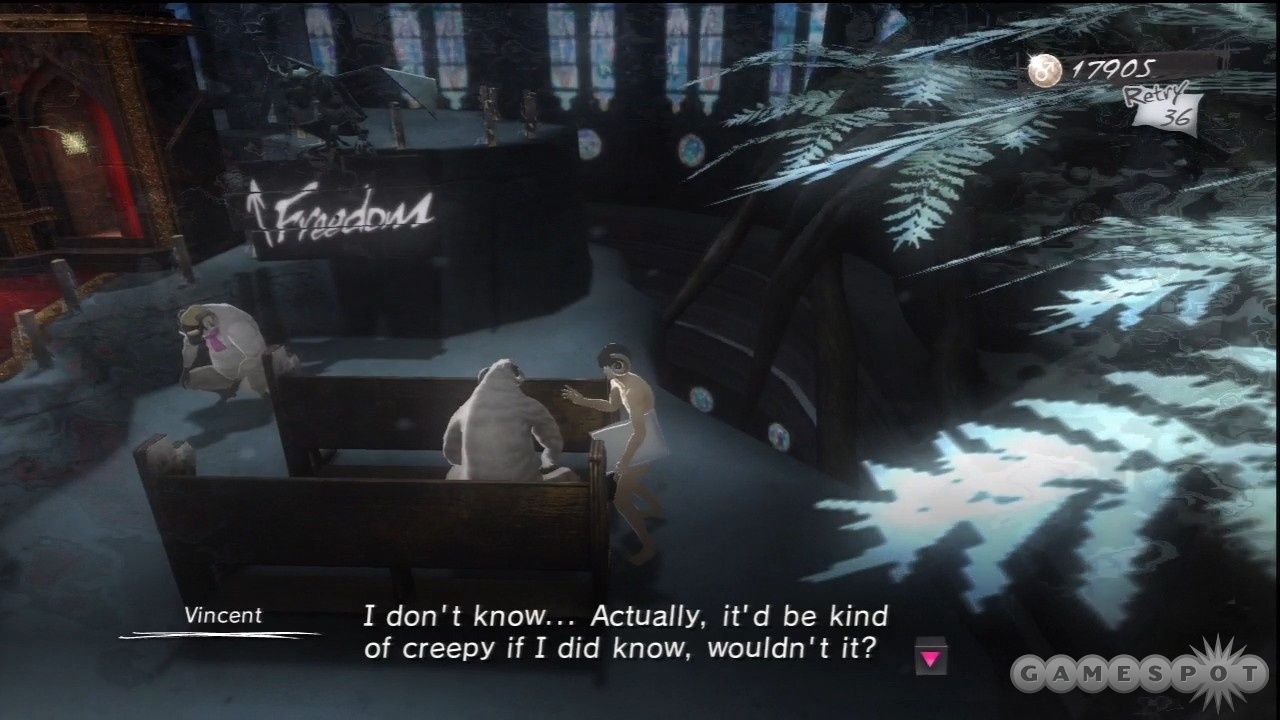
Catherine is the work of the same team that developed the Persona role-playing games. And though Catherine is not an RPG, if you've played the Persona games, some elements here will be familiar. Most notably, the day is separated into two vastly different portions. While Vincent is awake, you roam about The Stray Sheep. Here, you chat with your friends and strangers in the booths and at the bar. The elderly twins at The Stray Sheep have some cryptic comments for you ("Would you like to speak to Lindsay?" "Would you like to speak to Martha?"), and television newscasts and conversation threads discuss mysterious local deaths that seem connected to Vincent's haunted nightmares. You also receive text messages on your cell phone from both of your ladies-in-waiting. Opening a text from Katherine is accompanied by a whispered sigh; opening one from Catherine rings out a tinkling giggle. These effects encapsulate the women's traits effectively, cramming their entire personalities (and Vincent's perception of them) into a single audio cue. But you don't just mull over these texts when you receive them: You also reply by choosing from a series of canned sentences.
How you respond to these texts and the choices you make during other opportunities influence a morality meter of sorts. This isn't the typical good-versus-bad meter you find in other games, however; it's more of a freedom-versus-order meter. Responses that favor Catherine are on the chaotic side; those favoring Katherine are more disciplined. Where you stand on this meter determines how Vincent reacts to certain situations during cutscenes--and it also helps determine which one of the multiple endings you receive. The angel/devil graphic that pops up every time the meter is evoked is intrusive. Nevertheless, it's refreshing to see the ideas of good and bad cast aside in favor of less judgmental attitudes. Vincent might be cheating, but he's not a bad guy (nor an innocent one). Most games focusing on polar-opposite morals make it easy to follow a good or evil path; you just choose to be one or the other and select actions that obviously push the meter in that direction. Catherine isn't so cut and dry, and as a result, you are more likely to answer honestly, rather than "game" the system.
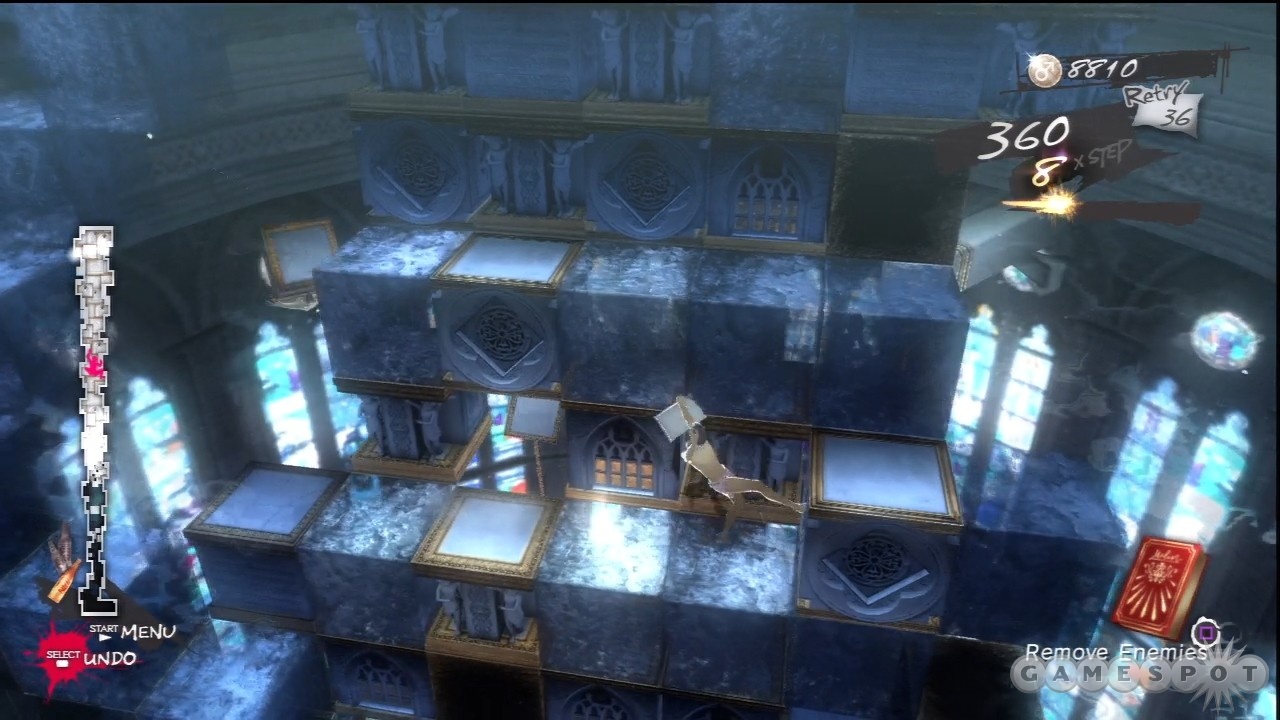
Vincent's fears come to a head once he staggers home from The Stray Sheep and falls asleep. Thus begins the second portion of your day: Vincent's nightmares. In his nightmares, Vincent carries a pillow, is clad only in his boxer shorts, and has sheep horns fastened to the side of his head. At the start of each dream, half-sheep Vincent appears at the bottom of a tall tower of blocks. Your goal is to climb to the exit at the top by pushing and pulling these blocks into arrangements that allow passage. Sound simple? After the introductory levels, it's terrifying. Levels are separated into such telling themes as "Inquisition" and "Prison of Despair." Torture devices and the symbols of Mars and Venus hang above ledges splattered with dark-red blood. Bleating sheep cling to icy blocks as they swirl about the gigantic chamber, lit by the sunlight seeping through stained-glass windows. All the while, remixes of dramatic and popular classical music sound forth, urging you upward. The works chosen--Dvorak's New World Symphony, Mussorgsky's Pictures at an Exhibition, and others--are common in symphonic halls the world over. Much of the music is discordant or rhythmically unusual, which elicits the right degree of tension. And each piece is absolutely apt; Borodin's Polovtsian Dances, for example, features a climbing-and-falling theme that perfectly mirrors the gameplay.
It isn't just the atmosphere that makes climbing these towers so intense. The puzzles are deviously constructed, each one making it more difficult to figure out how to arrange blocks in ways that allow you to reach the pinnacle. You have to think from the top down, often many steps ahead, which isn't a simple task. But you don't get all the time in the world to figure it out. The tower is slowly falling to pieces under you and forces you to stay on the move. Each level is a pressure cooker, threatening to boil over if you take too long or box yourself into a situation impossible to escape. You collect pillows that are used as continues, encounter one or two checkpoints on your way up, and can undo a certain number of moves. But even then, on medium and hard difficulties, Catherine is wickedly difficult. Later puzzles are hard enough to exhaust you, featuring ice blocks that cause you to slide off ledges, bombs that cause nearby blocks to crumble, and monster blocks that lick you to death if you hang from them. The emotion you can expect to experience while playing? Panic.
And that's just while playing standard levels. End-chapter bosses terrorize you further, threatening to stab you with forks or rain down hearts on you that reverse your controls. These boss levels also tend to move the camera around to give you a good look at the monstrosity chasing you up the tower. These shifts play with your perspective to the game's detriment; such indulgences shouldn't come at the price of a useful camera view. Even in standard stages, the camera can be a nuisance, given that Vincent can climb behind blocks and become difficult or even impossible to see, even when panning the camera around as far as it will go. The controls, too, might occasionally get in the way. They're generally fine, but if Vincent is in the middle of an animation, he may not immediately respond to your button press. In a hurry, you might move a different block than the one you intended. The resulting challenge is sometimes exhausting. If you find Catherine overly difficult, you can play on easy, though "easy" isn't the same as "cakewalk." And should you find yourself stuck on a level in the middle of the stage, you'll have to quit out and return to The Stray Sheep because only there can you change the difficulty level.
In Catherine, however, hard work reaps great rewards. When Vincent inches closer to his destination, a clanging bell signals his coming triumph. Once he reaches the top, Vincent cries out in elation--and so will you. The puzzles are fiendish but not impossible, and solving the tougher ones makes you feel incredibly smart. You get a tally of how well you did based on how quickly you climbed, how many piles of gold you collected on the way up, and the like. Then you receive a medal--bronze, silver, or gold--while listening to the joyous refrains of the "Hallelujah Chorus." Before you move to the next level, you enter a foyer populated by anthropomorphic sheep where you can save your game and catch your breath. Who are these sheep? Why do they insist that they are normal and you're the monster? You eventually make connections between the real world and that of your dreams.

Before you leave this safe area and move to the next tower, you enter a claustrophobic confessional, where a disembodied voice forces you to answer a question before continuing. These questions affect your freedom/order meter. And again, because there's no clear good or bad answer, you may be tempted to answer honestly. Some of these questions are straightforward. ("Is it easier to love or to be loved?") Others are ludicrous. ("Would you have sex with a ghost if it were attractive enough?") One nice touch: If you reload and play a stage again, the questions are different, giving the impression that there must be loads of them. Another nice touch: A pie graph shows you how other players answered.
There's more to Catherine than its single-player campaign. If you earn enough gold medals (not an easy task), you unlock randomly created trial levels for one or two players. And if you finish the campaign, you unlock a short-lived but hysterical competitive mode. It's a shame the barrier to unlock this mode is so high because it's a blast to find ways to hinder your opponent while racing to the top of your shared tower. And to make the proceedings even more absurd, the announcer offers bizarre suggestions. ("Players must now refrain from using the word 'the' while playing this round.") But such silliness is the exception in Catherine, rather than the rule. This story-heavy puzzler is mature and occasionally profound, exploring themes like sexual fidelity, personal responsibility, and trust. Catherine doesn't just challenge your hand/eye coordination: It challenges your intellect and your emotions.
